GALLUP NEWS SERVICE
Princeton, NJ -- The immigration debate currently taking place in the United States is driven largely by concerns about large influxes of unskilled workers. From the Latin American perspective, however, the problem is that migration is being considered as an option not just by poor or unskilled workers. Gallup World Poll data indicate that, of five Central American countries surveyed, all but Costa Rica seem to be draining skilled workers.
Among the studies of the five Central American populations -- including Costa Rica, Guatemala, Honduras, Nicaragua, and El Salvador -- the intention to emigrate is not necessarily explained by unemployment. In fact, respondents who have jobs are at least as likely as those who do not to say they have plans to move someplace outside their own country.
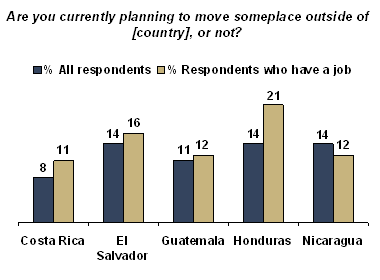
Many Central Americans seem to be looking for opportunities to fully realize their potential by taking on higher-quality, well-remunerated jobs that simply aren't available in their homelands. In El Salvador and Honduras, the numbers of professionals and entrepreneurs seeking to leave their country are particularly high.
Among Salvadorans, 25% of professionals, 19% of business owners, and 29% of skilled workers say they plan to emigrate. Perhaps most troubling, those Salvadorans who perceive that they have some sort of talent are almost twice as likely as those who claim no particular talent to say they plan to emigrate -- 22% vs. 12%, respectively.
Survey Methods
Results are based on face-to-face interviews conducted in 2006 with randomly selected national samples of approximately 1,000 adults, aged 15 and older who live permanently in the five Central American countries polled. For results based on these samples, one can say with 95% confidence that the maximum error attributable to sampling and other random effects is ±3 percentage points. In addition to sampling error, question wording and practical difficulties in conducting surveys can introduce error or bias into the findings of public opinion polls.