GALLUP NEWS SERVICE
PRINCETON, NJ -- In a nationwide address yesterday evening, President George W. Bush announced that he would authorize federal government funding for embryonic stem cell research using only those stem cells that have already been extracted from embryos. The government would not fund research, he said, on stem cells that have yet to be extracted from embryos, rejecting the argument made by some proponents of such research that many of those embryos will be destroyed anyway.
A CNN/USA Today/Gallup poll, conducted immediately after completion of the speech, finds that half the public approves of the decision, a fourth disapproves, and another fourth is unsure. Respondents were read the following information before being asked their opinion:
As you may know, President Bush gave a speech tonight on stem cell research, and he announced that he WOULD allow the government to fund research using stem cells that have been created in the past in a process that destroyed human embryos. The government will not fund stem cell research that would destroy additional embryos in the future.
Overall, 50% of Americans say they approve of Bush's decision. The 25% who disapprove include 7% who say the limits are too strict, 13% who want stricter limits, and 5% who are unsure. Another 25% neither approve nor disapprove.
|
Overall, do you approve or disapprove of Bush's decision on stem cell research? (If disapprove: Do you disapprove because the ban is too strict or not strict enough?) |
||
|
% |
||
|
Approve |
50 |
|
|
Disapprove |
25 |
|
|
Too strict |
(7) |
|
|
Not strict enough |
(13) |
|
|
Don't know |
(5) |
|
|
No opinion |
25 |
|
Speech Watchers Especially Supportive of President's Decision
The poll shows that about a third (32%) of Americans say they watched all or part of the ten-minute speech, and the results suggest they were favorably impressed by the president's presentation. Viewers approve of the decision by 73% to 20%, compared with a margin of 40% to 28% among non-viewers. The two groups are similar in their partisan orientation, although viewers tend to be somewhat older than non-viewers. Still, the greater support among viewers appears to be related not to the slight demographic and partisan differences between those who did and did not watch the speech, but rather to the experience of watching Bush explain his decision.
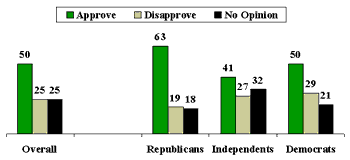
As might be expected, there are some differences in opinion among partisan groups, but the differences are somewhat smaller than what has been measured in previous polls (see paragraphs below). As shown in the chart below, Republicans express the greatest level of support, with 63% approving and just 19% disapproving of Bush's decision. Independents are least supportive and most likely to express no opinion, although they show net approval by 41% to 27%. Democrats show a somewhat larger margin of approval, 50% to 29%.
| Approve or Disapprove of President Bush's Decision on Stem Cell Research? (In Percent) |
 |
| August 9, 2001 |
Public Appears to Support Embryonic Stem Cell Research on "Surplus" Embryos
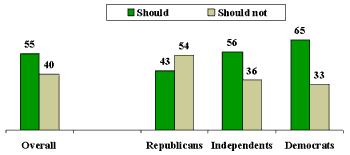
While Bush will not allow the federal government to fund embryonic stem cell research on "extra" embryos that are produced in fertility clinics, a CNN/USA Today/Gallup poll conducted August 3-5 finds that a majority of Americans would approve of such research. When respondents were told that embryos are created as part of a process to help a woman's chances of having a baby, and that the "stem cells are developed from the remaining embryos that the fertility clinics usually discard," 55% said the federal government should fund research on stem cells from this kind of embryo, while 40% said it should not.
Among people who were following the issue closely, representing just over half (55%) of the public, support for this research was somewhat higher. By a margin of 59% to 37%, the relatively attentive public supported government funding for this type of embryonic stem cell research, while those who were not closely following the issue expressed support by a narrower margin of 50% to 44%.
The major divisions in the public over this issue, however, are found among partisan groups. As shown in the chart below, while Republicans oppose this kind of stem cell research by an 11-point margin, Democrats and independents support it by margins of 32 points and 20 points, respectively.
| Should the Federal Government Fund Stem Cell Research From Embryos That Will Be Destroyed Anyway? (In Percent) |
 |
| August 3-5, 2001 |
Public Divided Over Embryonic Stem Cell Research on Embryos Created Specifically for That Purpose
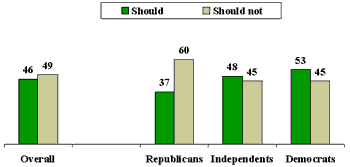
Despite its support for stem cell research on embryos that will be discarded, the public is divided over federal government funding for stem cell research that uses embryos created expressly for research purposes. Overall, 49% of Americans say the government should not fund such research, while 46% take the opposite point of view. Another 5% express no opinion.
Again, these results are highly correlated with party affiliation. As shown below, Republicans oppose such stem cell research by 60% to 37%, while independents are almost evenly divided -- 48% in favor, 45% opposed -- and Democrats show majority support, 53% to 45%.
| Should the Federal Government Fund Stem Cell Research on Embryos That Are Created Specifically for Research? (In Percent) |
 |
| August 3-5, 2001 |
Public Opposed to Stem Cell Research Using Cloned Embryos
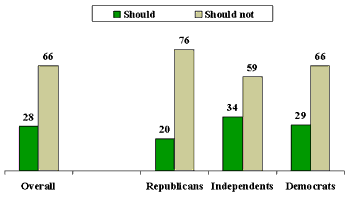
Some researchers have obtained stem cells from embryos that have been cloned from cells of human beings. Americans oppose government funding of that kind of stem cell research by 66% to 28%. As shown below in the chart, despite some differences among the partisan groups, in each case the margin of opposition is substantial -- from 25 percentage points net opposition to 56 points.
| Should the Federal Government Fund Stem Cell Research on Embryos That Are Created By Cloning? (In Percent) |
 |
| August 3-5, 2001 |
Little Opposition to Adult Stem Cell Research
Some stem cell research uses stem cells from adults, and there is little political controversy over whether the government should fund this type of research -- except if the funds for adult stem cell research divert funds that could be used in embryonic stem cell research. Obtaining the stem cells from adults does not harm the person from whom they are taken, and many opponents of embryonic stem cell research point to adult stem cell research as an alternative. In his speech Thursday evening, Bush included this type of stem cell research among those that the federal government would continue to fund.
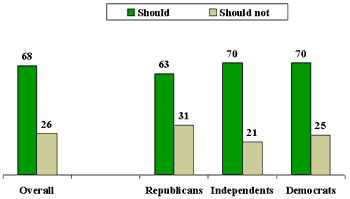
The public may not fully realize the issues involved, however, as 26% of Americans express opposition to government funding for such research, while 68% express support. Whether the opposition comes from those who just generally don't want the government to fund any kind of research, or whether there is some concern specifically about adult stem cells, is unclear.
As the chart below shows, all partisan groups express strong majority support for government funding of adult stem cell research, although there are some slight differences among the groups.
| Should the Federal Government Fund Research on Stem Cells Taken from Adults? (In Percent) |
 |
| August 3-5, 2001 |
Issue More Salient Now Than Last Month
The August 3-5 poll shows that the public's attention to the issue of stem cell research has increased substantially since early July. Now, 55% of Americans say they have followed the issue "very" or "somewhat" closely, compared with 38% who said that in the July poll.
Survey Methods
The results that pertain to President Bush's decision on stem cell research are based on telephone interviews with -- 581 -- adults, aged 18+, conducted August 9, 2001, between 9:30 p.m. and 10:04 p.m. Eastern Daylight Time. For results based on this sample of adults, one can say with 95% confidence that the margin of sampling error is +/- 4 percentage points.
In addition to sampling error, question wording and practical difficulties in conducting surveys can introduce error or bias into the findings of public opinion polls. Polls conducted entirely in one day, such as this one, are subject to additional error or bias not found in polls conducted over several days.
Other results reported here are based on telephone interviews with 1,017 national adults, aged 18+, conducted August 3-5, 2001. For results based on the total sample of national adults, one can say with 95% confidence that the margin of sampling error is +/- 3 percentage points.
In addition to sampling error, question wording and practical difficulties in conducting surveys can introduce error or bias into the findings of public opinion polls.
As you may know, the federal government is considering whether to fund certain kinds of medical research known as "stem cell research."
How closely have you followed the debate about government funding of stem cell research – very closely, somewhat closely, not too closely, or not closely at all?
|
Very |
Somewhat closely |
Not too closely |
Not closely |
No |
|
|
2001 Aug 3-5 |
18% |
37 |
22 |
23 |
* |
|
2001 Jul 10-11 |
9% |
29 |
28 |
32 |
2 |
|
* Less than 0.5% |
|||||
Do you think the federal government should or should not fund this type of research?
|
Should |
Should not |
DEPENDS (vol.) |
No opinion |
|
|
2001 Aug 3-5 |
55% |
29 |
3 |
13 |
|
(vol.) Volunteered response |
||||
How important is the issue of stem cell research to you -- very important, somewhat important, not too important, or not at all important?
|
Very important |
Somewhat important |
Not too important |
Not at all important |
No |
|
|
2001 Aug 3-5 |
25% |
37 |
21 |
12 |
5 |
Now I would like to ask about a few specific types of research on stem cells developed from human embryos that have been created outside a woman's womb. This kind of stem cell research destroys the embryos but may help find treatments for major diseases.
As you may know, fertility clinics increase a woman's chance to have a child by fertilizing several embryos, but only a few are implanted in her womb to enable her to have a baby. Some stem cells are developed from the remaining embryos that the fertility clinics usually discard. Do you think the federal government should or should not fund research on stem cells from this kind of embryo?
|
|
|
DEPENDS (vol.) |
No |
|
|
2001 Aug 3-5 |
55% |
40 |
2 |
3 |
Some stem cells are developed from embryos that are created in laboratories specifically for the purpose of conducting this research and not to help women have a child. Do you think the federal government should or should not fund research on stem cells from this kind of embryo?
|
|
|
DEPENDS (vol.) |
No |
|
|
2001 Aug 3-5 |
46% |
49 |
1 |
4 |
Some stem cells may be developed from embryos produced by cloning cells from a living human being rather than by fertilizing a woman's egg. Do you think the federal government should or should not fund research on stem cells from this kind of embryo?
|
|
|
DEPENDS (vol.) |
No |
|
|
2001 Aug 3-5 |
28% |
66 |
5 |
1 |
There is another kind of research using stem cells that come just from adults and do not come from embryos at all. The research results in no injury to the person from whom the stem cells are taken. Do you think the federal government should or should not fund research on this kind of stem cells?
|
|
|
DEPENDS (vol.) |
No |
|
|
2001 Aug 3-5 |
68% |
26 |
1 |
5 |
(vol.) Volunteered response
STEM CELL RESEARCH SUPPORT SUMMARY TABLE
|
2001 Aug 3-5 |
|
|
|
% |
% |
|
|
From adult stem cells |
68 |
26 |
|
From embryos not used to develop babies |
55 |
40 |
|
From embryos created for research |
46 |
49 |
|
From embryos cloned from human cells |
28 |
66 |
