Residents in all but two of the countries surveyed for Gallup’s Poll of the Islamic World feel that Western nations do not have much interest in improving the coexistence between the West and the Arab/Islamic world. Only in Turkey do respondents credit the West with an interest in improving relations with the Islamic world. Views on this score are mixed in Iran; elsewhere, majorities or strong pluralities believe that the West displays little concern for improving this relationship.
These views are consistent with other responses showing the degree to which respondents believe that Western nations do not have much respect for Arab/Islamic values and do not exhibit fairness toward Arab/Islamic countries.
One issue in the relationship between the Islamic and Western societies is the perceived impact of the Western value system on local value systems within predominantly Islamic societies.
The results show that in all of the countries surveyed, respondents view Western values as having a negative effect on local values. In four of the countries -- Jordan, Pakistan, Saudi Arabia, and Lebanon -- the single most common response to the question on the "impact of Western culture" was the choice on the scale that indicated that the net effect of the West’s value system has been "very negative" on their societies’ value systems.
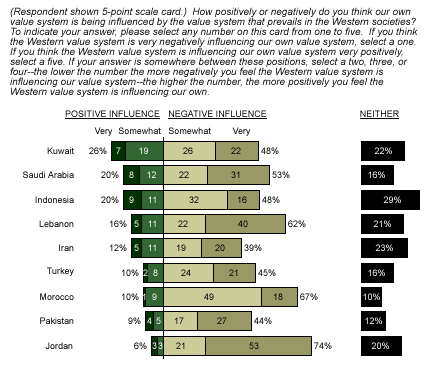
What specific Western influences are identified at the popular level as having negatively affected local value systems? The answer is clear: Western morals and decadent culture. Asked to volunteer their own examples of negative Western influences, the most frequently mentioned items are various cultural and lifestyle factors, rather than political or economic dimensions.
The cultural and lifestyle factors negatively associated with the West by citizens of these predominantly Islamic countries include perceptions of vulgar or immoral activities, such as libertine attitudes toward sex, alcohol consumption, vulgarity and nudity in films and music, and inappropriate dress and/or hairstyles. Majorities of respondents in Jordan, Kuwait, Indonesia, Lebanon, Morocco, and Saudi Arabia give examples that fall into this broad category, as do many respondents in Pakistan, Turkey, and Iran.
The second most frequently given examples of the problems with Western culture relate to perceptions that citizens of the West have a growing indifference to religion or a weakening degree of adherence to religious precepts -- though this category of response is far less widely cited. About one in five Pakistanis and one in nine Saudis, Moroccans, and Jordanians give responses that allude to a perceived fading of religious belief locally.
Other, less widely mentioned negative effects of Western values include insufficient courtesy and deference to elders and an increasing level of crime and violence in these societies.
Given these responses, it is not surprising to find that large majorities in Jordan, Lebanon, and Morocco, plus modest majorities in Turkey, Saudi Arabia, and Iran, all regard "economic, social, and cultural modernity" as experienced in the Western societies to be predominantly or totally in conflict with local traditional value systems. The results for Turkey are particularly noteworthy, given that society’s relatively early and comprehensive integration into numerous Western political and economic institutions.
Kuwait, Pakistan, and Indonesia are exceptions to the overall pattern. Even here, however, sizable pluralities of the adult population share the opinion that these modern aspects conflict with traditional local value systems.
