Editor's Note: Please see also this article's companion piece "Al-Jazeera: Arabs Rate Its Objectivity".
The Sept. 11 terrorist attacks spawned intense interest in how Arab countries perceive the West, which leads to questions about how residents of Arab countries are influenced by the media sources that provide information to them. When it comes to television in the Arab world, one station predominates: Al-Jazeera, the satellite TV network based in the tiny peninsula nation of Qatar. Independent of the government and employing journalists with a wide variety of backgrounds, Al-Jazeera is known for broadcasting content other Arab stations would shy from.
Gallup's study of nine predominantly Islamic countries indicates that in some respects, the attitudes of Al-Jazeera viewers are consistently different from those of other residents of these countries. It isn't possible from this study to determine whether those differences result from the way news is presented on that station, or whether people who hold those views are more drawn to watching Al-Jazeera. However, given the interest in Al-Jazeera's influence on Arab public opinion, it is worthwhile to describe the relationships as they appear in the data.
The results from Gallup's 2002 Poll of the Islamic World suggest that in a world where the major alternative is watching government-run national broadcasts, Al-Jazeera viewers are fairly well-informed, and compared to other news viewers, more open to the West. But they are also more critical of it. These distinctions hold up even when controlling for attention to news (that is, even among the subset of respondents in each country who say they pay close attention to current events, differences persist between Al-Jazeera and non-Al-Jazeera viewers). Specific findings include:
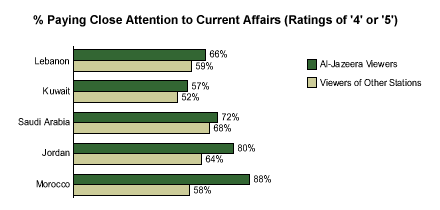
- Compared to other news viewers, Al-Jazeera viewers tend to be more attentive to current affairs, including to the Sept. 11 attack on the United States, the war in Afghanistan and the situation in Palestine. In all five Arab countries surveyed, a higher percentage of Al-Jazeera viewers rate their attention to current affairs as a "4" or "5" on a five-point scale.
- Al-Jazeera viewers are more familiar with world leaders such as U.S. President George W. Bush, British Prime Minister Tony Blair, U.N. Secretary-General Kofi Annan, and Arab League Secretary-General Amr Moussa.
- Al-Jazeera viewers are no more likely than others to say they distrust the news provided by the international media, nor are they more trusting of news that comes from Arab sources.
- They are more likely to appreciate Western culture -- saying it produces enjoyable films and music -- than are those who get their news elsewhere.
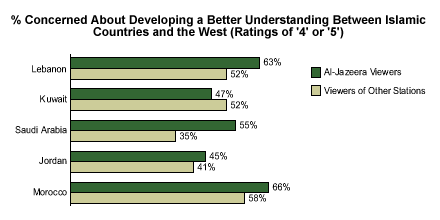
- In Lebanon, Saudi Arabia and Morocco, Al-Jazeera viewers also express more concern than other news viewers about the issue of improved relations between Western and Islamic cultures.
- Except in Lebanon, there is no significant difference between the two groups with regard to their opinions about who is responsible for the Sept. 11 attacks. Al-Jazeera and non-Al-Jazeera viewers alike tend to disbelieve that Arabs were responsible. (The question was not asked in Saudi Arabia or Jordan.)
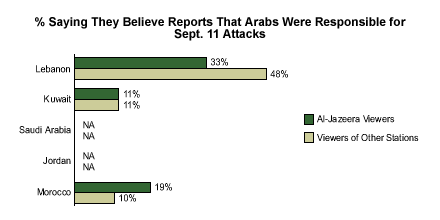
This question was not asked in Saudi Arabia and Jordan.
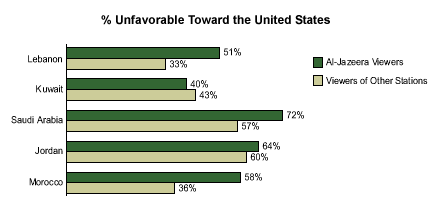
- Finally, Al-Jazeera viewers tend to be more critical of the West than are viewers of other stations. This is evident in their ratings of Bush and Blair, but also in their overall reaction to the United States. The pattern is particularly pronounced in Saudi Arabia, Morocco and Lebanon.