Recent Gallup research* on healthy religious congregations finds that 17% of members of American congregations are "fully spiritually committed." Full spiritual commitment is indicated by a "strongly agree" response to all nine items that measured spiritual commitment in Gallup's fall 2001 Spiritual Engagement Index poll*. Spiritual commitment focuses on the extent to which faith permeates an individual's life. This commitment is reflected in such attitudes as religious faith that gives a sense of inner peace, and the degree to which faith pervades every aspect of a person's life. It is also demonstrated in specific behaviors, such as praying daily, encouraging others and finding the power to forgive.
When spiritual commitment data are filtered through demographic lenses, significant differences emerge among population groups -- between men and women; among whites, African-Americans and Hispanics, among age groups, and among education levels.
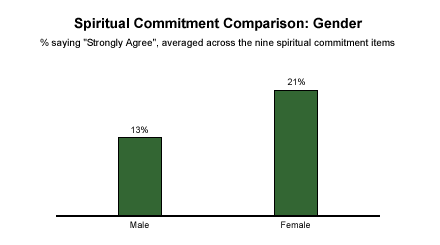
One of the most striking differences with regard to spiritual commitment levels occurs between men and women. As indicated by the graph below, 21% of female congregation members appear to be fully spiritually committed, compared to just 13% of male members.
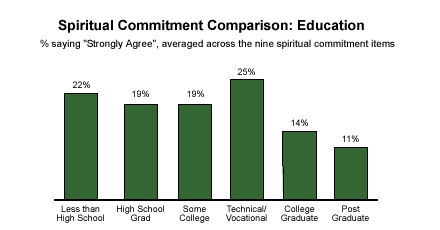
There are also significant differences by education level. Spiritual commitment tends to be significantly less frequent among those who have at least a college degree. In contrast, the group with the highest level of full spiritual commitment -- those with at least some technical/vocational school -- are only marginally more likely to be fully committed than those who did not complete high school.
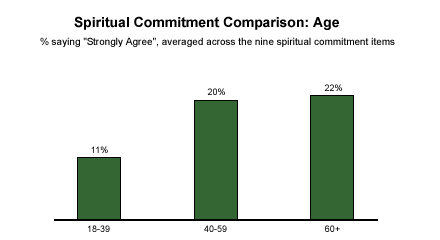
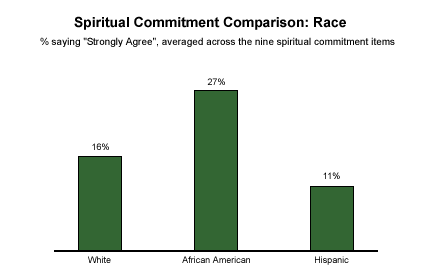
The data also reveal the likelihood to be fully spiritually committed varies by age -- it increases as congregation members get older -- and racial category. Of the racial groups with a large enough sample size to be considered, African-Americans have the highest percentage who are fully spiritually committed, with 27%. Hispanics have 11%, and whites have 16%.
Key Points
The upshot of all these variations for congregational leaders is that programs aimed at increasing spiritual commitment should not take a "one-size-fits-all" approach. Life situation and experience play an important role in forming one's spiritual commitment. Know your people, know their needs, and then find ways to meet those needs person by person.
*Results are based on telephone interviews with 729 adult members of a church, synagogue, or other religious faith community, aged 18+, conducted October through November 2001. For results based on this sample, one can say with 95% confidence that the margin of sampling error is ±3.6%.
