A century ago, it all seemed so simple. Physicians, guided by the Hippocratic oath, sought to treat and cure patients and extend lives. The decision to save someone's life was a simple one.
While there obviously remains room for improvement, the healthcare industry has become increasingly successful at saving lives. Advancements in science and technology have done much to increase Americans' average life expectancy and to improve most health indicators, such as self-rated health status, infant mortality and cancer rates.
But ironically, there are ways in which making such great strides has been like opening Pandora's box. Today the healthcare system is asked to balance the ability to extend life against the quality of life experienced. In 1997, Gallup's "Spiritual Beliefs and the Dying Process" survey* found that 73% of U.S. adults fear "the possibility of being vegetable-like for some period of time" before their deaths, and 67% fear "the possibility of great physical pain" before death. Such concerns have introduced a gray ethical area regarding what the medical community should and should not do to promote the continuation of life, and how to ensure patients' rights to maintain dignity in death. It's an area that will only grow thornier as researchers develop new ways to extend life using stem cells and cloned organs.
Recent Events in the "Right-to-Death" Debate
In October 1997, the Oregon Death with Dignity Act, a law that legalized physician-assisted suicide for terminally ill patients, went into effect. Oregon is thus far the only state to pass such a law. After its passage, 67% of the state's physicians said they would refuse to participate in assisted suicide, according to an Oregon Health Division survey. The Bush administration has also weighed in: The Justice Department announced last month that it would appeal a federal judge's ruling that it does not have the authority to overturn the Oregon law using the Controlled Substances Act.
Last April, the Netherlands became the first country to legalize voluntary euthanasia, though it had already been a common practice in the Dutch medical community for more than 20 years.
Support for Physician-Assisted Suicide Is Growing in the United States
Since 1947, the Gallup Poll has been asking Americans whether they feel doctors should be legally permitted to help patients end their lives.
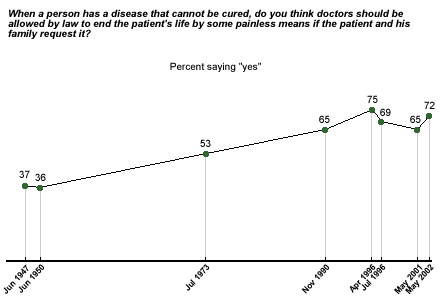
As the graph shows, Americans have become much more likely to accept the idea of euthanasia over the past 55 years. In 1947, only 37% of respondents answered yes to this question, while 72% did so in May 2002**.
Two Paths for End-of-Life Care
Yet though the majority of Americans now believe that physician-assisted suicide should be legal, euthanasia is still against the law in almost every U.S. state, not to mention almost every other country in the world. The tension between current policy and the climate of public opinion will soon force the question: Which is the correct path -- to provide the most compassionate care possible short of offering physician-assisted suicide -- or to offer compassionate care with the option of physician-assisted suicide as a last resort?
There will be no easy answers, but Arthur Caplan, PhD, director of the University of Pennsylvania Center for Bioethics, gives advice in the American Medical News on how we may bring these two divergent paths closer. "Even if you're for assisted suicide, you certainly don't want to say that it's the option of the first resort," Caplan notes. "And even if you're against assisted suicide, you definitely want to see people get as much pain control, palliation, and relief of suffering as possible."
*Results are based on telephone interviews with 1,200 adults, aged 18 and older, conducted May 1997. For results based on the total sample of national adults, one can say with 95% confidence that the maximum margin of sampling error is ±2.9%.
**Results are based on telephone interviews with 475 adults, aged 18 and older, conducted May 6-9, 2002. For results based on the total sample of national adults, one can say with 95% confidence that the maximum margin of sampling error is ±5%.