This is the first of a two-part article on segregation among U.S. churches.
Last month, the Gallup Poll updated its annual trends on race relations in the United States and found reduced levels of animosity toward whites in the black community (see "Fewer Blacks Say Anti-White Sentiment is Widespread in Black Community" in Related Items). But the finding begs the question: Is it still appropriate to speak in terms of black and white "communities"? Which social institutions still remain essentially segregated?
A Gallup Poll Social Audit on black/white relations in 1997* showed that blacks in America had relatively high levels of contact with whites across a variety of settings. Blacks lived with, worked with, and sent their kids to school with whites, and they had close friends who were white. The one exception was worship -- Sunday church service was still the "most segregated hour" in America.
Seventy-three percent of whites, according to this audit, attended mostly white or all-white churches, while 7% attended churches that were approximately half white and half black. Virtually no whites attended churches that were mostly or all black. Among blacks, 71% attended mostly or all-black churches, while 13% attended churches that were equally black and white, and 6% went to churches that were mostly or all white.
These findings undoubtedly reflect, at least to some measure, racist or separatist attitudes. Forty years ago, in a 1962 Gallup poll, 14% of adults nationwide expressed the belief that there is a biblical basis for the separation of races. In view of the dramatically changing attitudes toward intermarriage between black and whites, willingness on the part of whites to vote for blacks for high political office and other measurements, it is likely that this 14% figure is considerably lower today.
Factors that are more likely to explain why Sunday church service continues to be the "most segregated hour" are proximity and styles of worship.
Proximity
People tend to attend churches that are near where they live. Thus, to the extent that blacks and whites still live in different neighborhoods, they are likely to attend different churches. Eight in 10 whites (77%, according to the 1997 audit), lived in mostly or all-white neighborhoods, while another 12% lived in neighborhoods that were equally mixed, and 2% lived in mostly or all-black neighborhoods. Forty-one percent of blacks indicated that they lived in mostly or all-black neighborhoods, 30% in equally mixed neighborhoods and 20% in mostly or all-white neighborhoods.
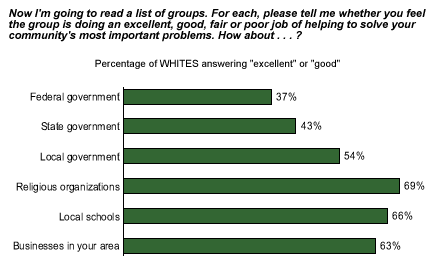
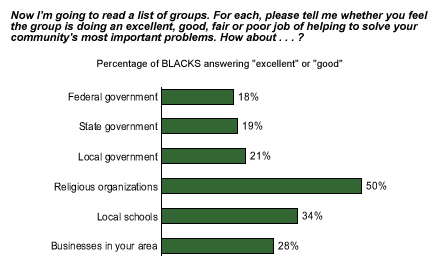
In 2001**, blacks and whites rated the impact of several social institutions in the community in which they live. As the graph below indicates, 50% of black Americans said religious organizations are doing an "excellent" or "good" job helping to solve their community's most important problems, compared to 69% of whites. However, blacks tended to be far more negative about the job any institution is doing in that regard, presumably because they are more likely to live in poorer communities. In that context, ratings of religious organizations stand out among blacks to a greater degree than they do among whites -- the next highest rated group was local schools, rated by 34% of blacks as doing an "excellent" or "good" job at helping their communities.
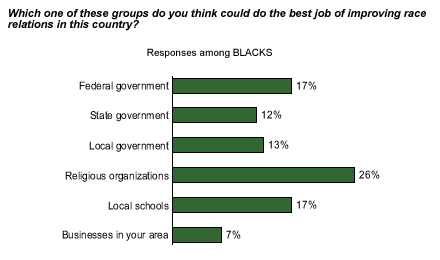
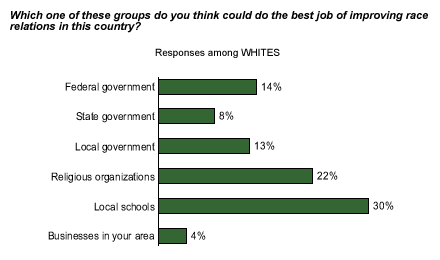
Interestingly, despite their segregated nature, religious organizations are also most likely to be named by blacks as the group that could do the best job of improving race relations in the United States. Many whites (22%) also name religious institutions as having the most potential in this regard, but significantly more (30%) select local schools.
Next week's conclusion will address differing styles of worship among predominantly black and predominantly white congregations.
*Findings are based on telephone interviews with 3,036 adults selected from households in the continental United States. Of the total sample of interviews, 1,269 were conducted with respondents who identified themselves as black. Of the remaining 1,767 respondents, 1,680 identified themselves as white. Interviews were conducted between Jan. 4 and Feb. 28, 1997.
**Findings are based on telephone interviews with 2,004 adults selected from households in the continental United States. Of the total sample of interviews, 1,003 were conducted with respondents who identified themselves as black. Of the remaining 1,001 respondents, 895 identified themselves as white. Interviews were conducted between March 24 and May 16, 2001.
