GALLUP NEWS SERVICE
PRINCETON, NJ -- It is too early to tell how Americans will receive President George W. Bush's Tuesday morning Wall Street speech, during which he reacted to the recent business accounting scandals by outlining a series of proposed remedies. New CNN/USA Today/Gallup polling, however, shows that while the public still gives the president very high job approval ratings, as many Americans say he is interested in protecting the interests of large corporations as say he is interested in protecting the interests of ordinary Americans. At the same time, the public continues to be somewhat skeptical about the value of new government laws and regulations.
Bush Job Approval Remains High at 76%
President Bush delivered his Wall Street speech on Tuesday, at a time when he continues to receive very high job approval ratings. This presumably puts him in as good a position as anyone to have an influence on American confidence in the business world and stock market after the recent spate of revelations of corporate accounting abuses.
The latest CNN/USA Today/Gallup poll, conducted Friday through Monday (but before the Tuesday morning speech) shows Bush with a 76% job approval rating, marking a 10 month period during which his ratings have been at the 70% or higher level. The last president to sustain such high ratings for this long was Lyndon B. Johnson in 1963 and 1964. Presidents have averaged in the 50% range over the last 50 years.
Additionally, a CNN/USA Today/Gallup poll completed at the end of June shows that 65% of Americans are either somewhat or very confident that Bush can take effective action to make sure large corporations act responsibly.
Too Strong an Influence by Big Business?
But Bush is certainly not immune from many Americans' feelings that big business has an undue influence on almost everyone connected with government. A late June poll asked whether big business had too much influence over the decisions made by Bush, Republicans, and Democrats in Congress. In all instances, over six in 10 Americans said "yes" -- 63% in the case of the Bush administration, 64% for Democrats in Congress, and 76% for the Republicans in Congress.
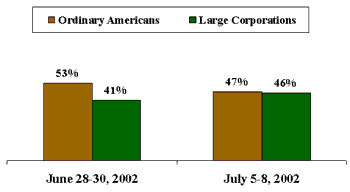
Additionally, in the latest Gallup poll completed Monday night, July 8, 46% of Americans say George W. Bush is interested in protecting the interests of large corporations, while 47% say he is interested in protecting the interests of ordinary Americans. This reflects a slight shift towards the "corporate interests" response to this question compared to just a week ago.
| George W. Bush Interested in Protecting Ordinary Americans or Large Corporations? |
 |
The latest poll also shows a slight drop in the percentage of Americans who approve of Bush's handling of the economy (from 63% two weeks ago to 58% in the latest poll).
Along these lines, it is instructive to review Gallup's recent annual update of Americans' confidence in major institutions. It showed that only 20% of Americans have a great deal or quite a lot of confidence in big business. An eight-point drop from last year's measure, it puts big business in a group near the bottom of the list of the institutions tested in this fashion. Still, big business has never generated a great deal of confidence from the public, suggesting that, to a degree, these latest revelations are not a total surprise to the public.
Public Not Necessarily Clamoring for New Laws to Regulate Business
Despite this skepticism about big business, previous polling suggests that the public is not overwhelmingly convinced that new laws or even more regulation of business is necessary.
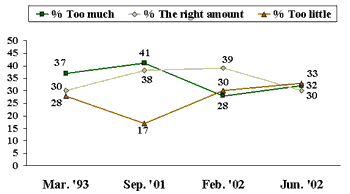
One question included in the late June CNN/USA Today/Gallup poll updated a measure that extends back to the Reagan administration, asking whether or not there is too little, too much, or about the right amount of government regulation of business and industry. Just 33% of Americans say that there is "too little" regulation of big business in this country. While this marks a significant change from the early years of the Reagan administration, when just 18% said there was too little regulation (and 54% said there was too much, compared to 32% today), it still means that the majority of Americans either agree with the current amount of regulation of business or feel that there is too much. Indeed, even now, as many Americans feel there is too much regulation of business as feel there is too little.
| Opinion of Government Regulation of Business and Industry |
 |
Additionally, when given a choice between the concept of passing new laws to regulate business or just enforcing laws that are already on the books, our late June poll found that the public is strongly in favor of increased enforcement of existing laws. Sixty-nine percent of Americans agreed that the current laws are sufficient but need to be enforced more strictly, while just 27% opted for the alternative approach -- that new laws are needed.
| Corporate Regulation Laws: Not Sufficient or Need Stricter Enforcement? |
 |
| June 28-30, 2002 |
A question included in the weekend poll asked a slightly different question:
Which comes closer to your view - we should require tougher standards for large corporations (or) new standards for large corporations are not needed, we just need to get rid of business executives who break the law]?
|
Require tougher standards |
New standards |
No |
|
|
2002 Jul 5-8 |
50% |
48 |
2 |
Here we find higher support for tougher standards, but -- as can be seen -- half of Americans continue to say that no new standards are needed.
Survey Methods
These results are based on telephone interviews with a randomly selected national samples of 1,019 and 1,013 adults, 18 years and older, conducted June 28-39, 2002 and July 5-8 2002, respectively. For results based on these samples, one can say with 95 percent confidence that the maximum error attributable to sampling and other random effects is plus or minus 3 percentage points. In addition to sampling error, question wording and practical difficulties in conducting surveys can introduce error or bias into the findings of public opinion polls.
In general, do you think there is too much, too little or about the right amount of government regulation of business and industry?
|
Too much |
Right amount |
Too little |
No opinion |
|
|
% |
% |
% |
% |
|
|
Gallup Poll |
||||
|
2002 Jun 28-30 |
32 |
30 |
33 |
5 |
|
2002 Feb 8-10 |
28 |
39 |
30 |
3 |
|
2001 Sep 7-10 |
41 |
38 |
17 |
4 |
|
1993 Mar 22-24 |
37 |
30 |
28 |
5 |
|
Los Angeles Times |
||||
|
1991 Apr |
27 |
36 |
29 |
8 |
|
1981 Mar |
54 |
14 |
18 |
14 |
Which comes closer to your view about the laws that regulate corporations in the United States -- [ROTATED: the current laws are not sufficient and new laws are needed, (or) the current laws are sufficient but need to be enforced more strictly]?
|
Not sufficient, |
Sufficient, |
No |
|
|
2002 Jun 28-30 |
27% |
69 |
4 |
In your opinion which of the following will be the biggest threat to the country in the future -- big business, big labor, or big government?
|
Big |
Big |
Big |
No |
|
|
% |
% |
% |
% |
|
|
2002 Jul 5-8 |
38 |
10 |
47 |
5 |
|
2000 Oct 25-28 |
22 |
7 |
65 |
6 |
|
1999 Aug 24-26 |
24 |
8 |
65 |
3 |
|
1998 Dec 4-6 |
24 |
7 |
64 |
5 |
|
1995 Aug 11-14 |
24 |
9 |
64 |
3 |
|
1985 Jun 7-10 |
22 |
19 |
50 |
9 |
|
1983 May 13-16 |
19 |
18 |
51 |
12 |
|
1981 Sep 18-21 |
22 |
22 |
46 |
10 |
|
1979 May 4-7 |
28 |
17 |
43 |
12 |
|
1978 Sep 15-18 |
19 |
19 |
47 |
15 |
|
1977 Jan 7-10 |
23 |
26 |
38 |
13 |
|
1969 Nov 12-17 |
19 |
28 |
33 |
20 |
|
1968 Jul 18-23 |
12 |
26 |
46 |
16 |
|
1966 Dec 8-13 |
14 |
21 |
48 |
17 |
|
1965 Feb |
17 |
29 |
35 |
19 |
Do you think George W. Bush is more interested in -- [ROTATED: protecting the interests of ordinary Americans (or is he more interested in) protecting the interests of large corporations]?
|
Ordinary Americans |
Large corporations |
No opinion |
||
|
2002 Jul 5-8 |
47% |
46 |
7 |
|
|
2002 Jun 28-30 ^ |
53% |
41 |
6 |
|
|
^ |
Asked of a half sample |
|||
