It's no stretch to say the Internet is making the music industry sweat. Last month, the two largest record companies, Universal Music and Sony Music Entertainment, announced plans to let consumers download songs and record them onto blank CDs for a modest fee. The move signals an about-face from the hostile stance the companies previously took toward online music distribution, and indicates that record execs are finally realizing they will have to adapt to a world online or watch sales continue to drop, especially among young people.
Indeed, some have predicted that unauthorized online music-sharing will cause, if not the demise of the giant record companies, at least their radical contraction. Michael Wolff of New York Magazine wrote in a June 5 column that the industry would become "a low-margin, consolidated, quaintly anachronistic business, catering to an aging clientele, without much impact on an otherwise thriving culture awash in music that only incidentally will come from the music industry."
It's undoubtedly troubling for the industry, especially given that music-sharing is so common among teens, a critical age group for record sales. In response to a 2001 Gallup Youth Survey*, 81% of American teens said they were familiar with file-sharing programs like Napster -- and 93% of those who were familiar said they had friends who used such programs to download free music. According to the International Federation of Phonographic Industries (AFPI), global music sales were down 5% last year because of the combined effect of piracy and the economic downturn.
Overreaction?
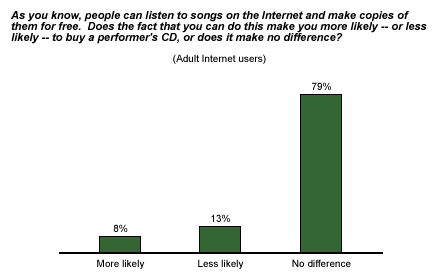
But some survey results suggest the effect of piracy may be overhyped. According to a May Gallup poll, about four in five Americans (79%) say the fact that music can be shared and copied over the Internet has no effect on their likelihood to purchase CDs -- and another 8% say they are actually more likely to buy CDs because of file-sharing. And only 18% of American adults claimed in May** to have ever downloaded music from an Internet site that was not authorized by a record company. While that is not an insignificant percentage, it is perhaps lower than some observers may have thought.
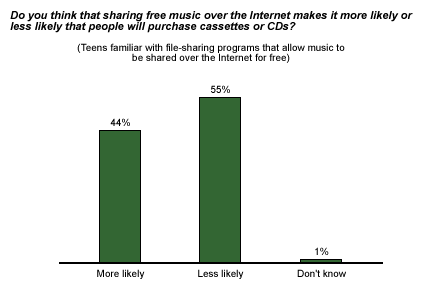
In the same vein, teens were asked last year whether they thought music-sharing made people more or less likely to purchase CDs or cassettes ("no difference" was not given as a response option for that question). A majority, 55%, said people would be "less likely" to purchase music but a substantial minority (44%) said "more likely."
Finding the Middle Ground
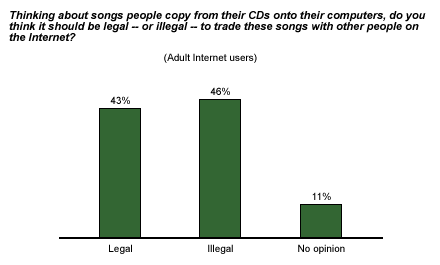
Clearly, the music industry is struggling to come to terms with the increased consumer power ushered in by the new technology. The news is not all bad for them -- Gallup polls show the public is divided about the legality of music-sharing, with 43% of adults saying they think it should be legal to trade downloaded songs over the Internet, while 46% say it should be illegal.
Nor is the importance of creative licensing lost among teens: 76% say they think artists, writers and musicians have a right to be paid for their work shared online.
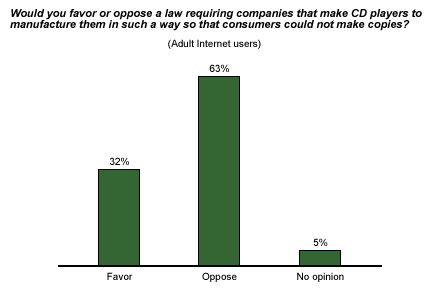
What form is the compromise between the music industry and music consumers likely to take? Poll results indicate that Universal and Sony have taken a step in the right direction by opening the door to authorized copying of digital music. Having been able to make "mix tapes" of their favorites songs for decades, 63% of American adults say they oppose a law requiring that CD players be manufactured so that consumers are unable to make copies.
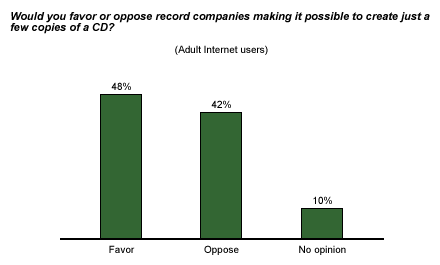
On the other hand, 48% said they would favor a compromise solution: making it possible to create just a few copies of a CD, while 42% are opposed***. However, in the event that CDs were manufactured so that buyers could only make a single copy of them, 64% of Americans said they would still buy the CD, while 24% say they would refuse to buy it even if it was one they would normally buy.
Another piece of good news as record-industry leaders look to the future is that younger adults do not appear more averse to reasonable restrictions than older Americans -- 75% of those aged 18 to 29 say they would buy a CD they could only make one copy of.
Key Points
The music industry has unquestionably been late adapting to the rise in consumer power brought about by the Internet -- but survey data, especially among young people, indicates that it's probably not too late. The record industry adaptations finally in the works should help the entertainment business as a whole as file-sharing spreads to other media such as movies.
*Findings for teens are based on telephone interviews with a representative national sample of 501 teen-agers, aged 13 to 17, conducted December 2000 through February 2001. For results based on this sample, one can say with 95% confidence that the margin of sampling error is ±5%.
**Results are based on telephone interviews with 703 adults with access to the Internet, aged 18 and older, conducted May 28-29, 2002. For results based on the total sample of national adults, one can say with 95% confidence that the maximum margin of sampling error is ±4%.
***Results based on telephone interviews with 1,011 adults with access to the Internet, aged 18 and older, conducted March 22-24, 2002. For results based on the total sample, one can say with 95% confidence that the margin of sampling error is ±3%.