The aspirations of Iranians have attracted international attention lately, as student-led protests have grown in response to the continued blocking by the country's conservative clerics of political reform efforts. On July 9, Ayatollah Jalaleddin Taheri resigned his position and issued a scathing criticism of the policies and tactics adopted by hard-line elements; soon thereafter, the government banned any further media discussion of his resignation speech. On July 12, President Bush expressed support for the protesters, saying the Iranian government should "listen to their hopes," and decrying what he called the "uncompromising, destructive policies" of those Islamic authorities opposing political reform.
How do Iranians view their world, and their prospects for the future? In December and January, prior to the latest protests, Gallup's poll of nine predominantly Islamic countries interviewed a scientifically selected nationwide sample of 1,500 Iranian adults. While the poll did not specifically address attitudes toward Iran's political system -- most key measures assessed attributes of "the Islamic world" more generally -- the responses provide a rare glimpse of political attitudes and expectations in the world's most populous Shi'a society.
The Islamic World, as Seen by Iranians
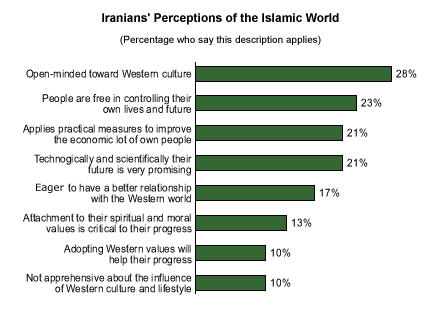
When read a series of statements and asked which ones they thought applied to the Islamic world, only 23% of Iranians selected the assertion that people in Islamic societies "are free in controlling their own lives and futures." This was significantly lower than was the case among Indonesians (32%) and Pakistanis (45%), though higher than among Kuwaitis (10%) and on par with responses given by those asked this question in the other four countries (Jordan 22%, Lebanon 21% Morocco 21%, Turkey 20%).
Similarly, only 21% of Iranians selected the statement "applies practical measures to improve the economic lot of their own people" to describe governments in the Islamic world. And only 21% agreed that the assertion that "technically and scientifically, their future is very promising" is generally applicable to this region.
Although 28% of Iranians said they thought that Islamic world was "open-minded" toward the West, only 10% accepted the statement that the Islamic world was "not apprehensive about the influence of Western culture and lifestyle." Furthermore, just 17% said they thought Islamic societies were "eager to have a better relationship with the Western World," and only 10% felt that "adopting Western values will help their progress."
Interestingly, while Iranians were reluctant to describe the Islamic world as desiring better relations with the West, they were more likely to describe themselves as personally concerned about a better understanding with the West. Among Iranians with a university education, the number saying they were personally concerned about a better understanding with the West (58%) vastly outnumbered those saying they felt no such concern (14%).
Projections for the Future
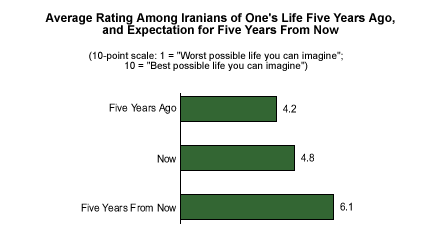
Looking to the future, the poll found a degree of optimism among Iranians for the course their lives would take over the next few years. When asked to rate their own current quality of life on a 10-point scale (1 lowest, 10 highest), the average rating given was a modest 4.8. This was higher, however, than the average rating of 4.2 they gave when asked to rate its quality "five years ago" -- and significantly lower than the average 6.1 rating they said they anticipated for their quality of life "five years from now."
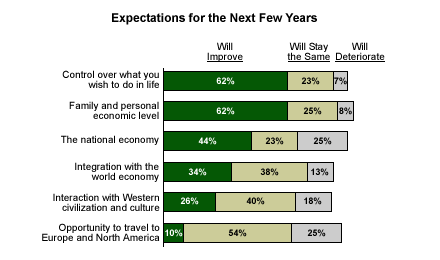
In a dramatic indication of growing political and economic expectations, 62% of Iranians said they felt the level of "control over what you wish to do in life" would improve over the next few years, while 7% said it would deteriorate. And 62% said they felt their personal and family economic situations would improve in the coming years, with just 8% expecting them to decline.
At the microeconomic level, expectations were more guarded: 44% of Iranians said they expected the country's economic condition to improve over the next few years, while 25% thought it would deteriorate. About a third of Iranians said they thought Iran would become more integrated with the world's economy during this period, while just 13% thought it would become less so.
Regarding interaction with the West, expectations were modest. Only 26% of Iranians said that interaction with Western civilization and culture would improve over the next few years, while 18% thought it would actually lessen. No doubt reflecting the more stringent visa and travel restrictions adopted in the wake of Sept. 11, only 10% of Iranians saw their "opportunity to travel abroad to Europe and North America" as improving in the coming years, while more than twice as many (25%) said they thought it would become more difficult for them to travel abroad.