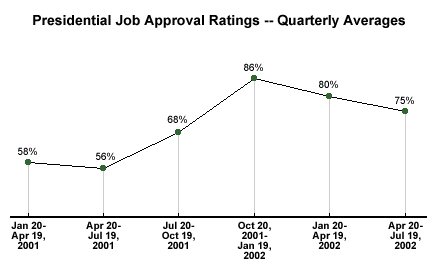
President Bush has found himself under fire in the press lately as the economy continues to struggle and information emerges about possible corporate misconduct during his tenure on the board of Harken Energy Corporation. But Bush's job approval ratings remain remarkably high: for his sixth quarter as president, which began on April 20, 2002, and ended on July 19, 2002, Bush averaged a 74.9% job approval rating*. This rates as the 14th-best quarter for a president since Harry S. Truman's presidency, when Gallup began regularly measuring presidential job approval. Bush previously recorded the second- and fifth-best quarters for presidents. In addition, Bush has maintained an approval rating of 70% or higher for the past 10 consecutive months.
Bush's quarterly average had dropped about five percentage points in each of the last two quarters (see graph). By comparison, his father, George H. W. Bush, had a slightly faster decline from his high quarterly average of 82.7% (measured in the first quarter of 1991, during the Persian Gulf War), losing nine points in the quarter immediately following, and five points the quarter after that. The elder Bush's quarterly average continued to decline for the next four quarters until falling to 35% in late summer and early fall of 1992.
Beginning in late September 2001, when George W. Bush received the highest approval rating recorded by Gallup at 90%, and ending in early March 2002, all of Bush's approval ratings ranked among the top 50 single measurements Gallup ever obtained. Despite the recent decline in his approval ratings, Bush's most recent scores still place among the top 10% Gallup has ever measured. The average rating for all presidents is 56%, while Bush's most recent approval rating was 73%.
For his entire term in office to date, Bush's average approval rating is 70.9%. For the year beginning Jan. 20, 2002 (the start of Bush's second full year in office), he has averaged 77.5%. Both ratings are on pace for the highest overall averages for a president (John F. Kennedy averaged 70.1% for his term) and the highest yearly average for a president (Truman averaged a 77.3% rating in 1945-1946). However, the downward momentum in his ratings over the last two quarters makes both of these outcomes unlikely.
Bush Gets Higher Marks for His Handling of Foreign Policy
Bush's high ratings owe a great deal to the public's positive views on his handling of foreign affairs. The latest measurement from a July 5-8 poll shows that 71% of Americans approve of Bush's handling of foreign affairs. Approval of his handling of the economy is much lower at 58%, and is showing signs of decline, while his foreign affairs' rating has held steady since March.
Bush's term-average ratings on both measures are high compared to those of recent presidents (Gallup has only tracked approval of foreign affairs and the economy regularly since the Ronald Reagan presidency). Bush has averaged 60% approval for his handling of the economy since he has been in office, topping the averages of Bill Clinton (52%), George H.W. Bush (25%) and Reagan (46%). The current president's average foreign affairs' approval rating of 67% is slightly higher than his father's 65% average, and significantly better than that of Clinton (48%), Reagan (43%) and Jimmy Carter (46%).
Key Points
Bush is still on track to make history as one of the highest-rated U.S. presidents of the last 50 years -- but the possibility that his approval ratings will see a decline similar to those of his father following the Gulf War appear increasingly likely. Those ratings have already seen a modest yet steady decline over the last two quarters, and the increasing focus on domestic affairs and the country's ongoing economic troubles do not bode well for the president's popularity.
*These results are based on telephone interviews with randomly selected national samples of approximately 1,000 adults, aged 18 and older. For results based on these samples, one can say with 95% confidence that the maximum error attributable to sampling and other random effects is ±3%. In addition to sampling error, question wording and practical difficulties in conducting surveys can introduce error or bias into the findings of public opinion polls.
