This story, the third in a series of in-depth looks at Iranian public opinion, examines Iranians' views about the Sept. 11 attacks and the U.S. military response in Afghanistan, as well as Iranians' opinions about Western nations.
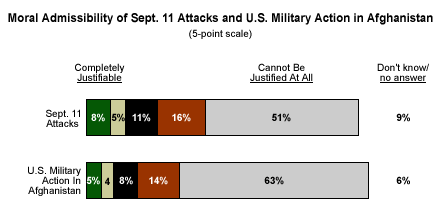
Like much of the world, Iranians were shocked by the Sept. 11 attacks on the World Trade Center and Pentagon. Despite widespread public antipathy toward the United States -- only one Iranian in seven expresses a favorable view of the United States -- reaction to the attacks within Iran was overwhelmingly negative. Only a small minority of Iranians interviewed for Gallup's poll of nine predominantly Islamic countries saw the attacks as morally justifiable, while the vast majority disagreed with this assessment, and at least half said there could be no moral justification for the attacks whatsoever.
It should be noted, however, that Iranians (interviewed in December and January) also expressed strong disapproval of the military response to the attacks taken by the United States and its allies. Only about one Iranian in 10 said that America's military actions in Afghanistan were justified morally, while nearly three quarters felt otherwise.
General Perceptions of the West
Since the formation of the Islamic Republic of Iran following the fall of the shah in 1979, the scope of Iran's cultural contact with Europe and North America has been sharply curtailed. After a generation of relative isolation and increasing economic stagnation, what general impressions do Iranians have of Western societies?
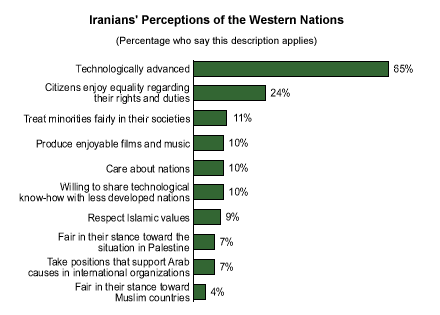
Of 10 positive descriptive statements, the only one that an outright majority of Iranians associate with the West is the assertion that the West is "technologically advanced" (65%). The second most widely associated statement -- selected by 24% -- is that citizens of Western countries enjoy equality regarding their political rights and responsibilities.
These two positive descriptions of the West are most likely to be acknowledged by younger Iranians. Among Iranian adults under the age of 30, 70% think Western countries are technologically advanced, and nearly a third (29%) think citizens enjoy political equality in the West.
It is worth noting that more than 40% of all Iranian adults fall between the ages of 18 and 29 -- a reflection of the huge "baby boom" that was officially encouraged by the late Ayatollah Khomeini. This is the portion of the adult population that has had the least direct experience with the non-Islamic world, as its members were no older than age 4 when the Islamic republic was established. Yet it is precisely this age segment that is most likely to say it associates the West with political equality and technological advancement.
Other attributes tested in the survey are less likely to be seen as generally descriptive of the West. Roughly one in 10 Iranians say they think the West is a region that gives fair treatment to minorities, produces enjoyable films and music, cares about poorer nations, and that is willing to share its technological know-how with others. Only a very small proportion of Iranians associates the West with the tendencies to respect Islamic values (9%), adopt even-handed or supportive diplomatic positions (particularly in regard to the Israeli-Palestinian dispute) (7%), or take a fair approach in general toward predominantly Islamic societies (4%).
Opinion of the United States, Britain, France, Russia and China
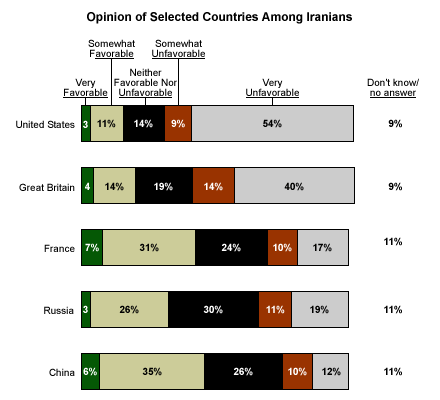
As mentioned earlier, only a small minority of Iranians express a favorable opinion of the United States, while more than half (54%) describe their overall impression of the United States as "very unfavorable." The poll also asked Iranians about their overall impressions of four other countries: Britain, France, Russia and China. Each of these countries hosts a significant Muslim minority, but all are clearly secular and non-Islamic societies from an Iranian perspective.
China and France are the most favorably viewed of these four, with 41% of Iranians expressing a generally favorable view of the China (32% unfavorable), and 38% taking a favorable view of France (27% unfavorable). Great Britain is viewed far less favorably, perhaps not surprisingly because it was America's most active and outspoken ally during the military action in Afghanistan. Just over half of all Iranians (54%) expressed an unfavorable opinion of Great Britain, while only 28% described their opinion of Britain as favorable.
Attitudes toward Russia were divided, with roughly a third expressing a predominantly unfavorable opinion, and virtually the same proportion taking the opposite view. Highly negative assessments of Russia outnumber highly favorable ones by a wide margin, however -- a pattern that holds for each of the other four countries.