GALLUP NEWS SERVICE
PRINCETON, NJ -- The latest CNN/USA Today/Gallup poll shows that few Americans blame either the Bush or Clinton administrations for the recent economic downturn. Instead, they are most likely to say that the greed and corruption among corporate executives, along with the 9/11 terrorist attacks, are the major culprits. Even the "normal business cycle" is not blamed as much as are terrorists and business CEOs. The poll also shows that while most people think corporate corruption is widespread, they are optimistic that government can take steps to correct it.
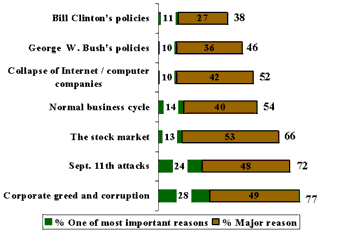
The poll, conducted July 29-31, gave respondents a list of seven reasons for the current state of the economy, and asked them to rate the perceived importance of each. Twenty-eight percent of Americans say greed and corruption among corporate executives are "one of the most important reasons" for the current state of the economy, and another 49% say they are a "major reason." The total of 77% compares with 72% who cite the Sept. 11 attacks as a major or most important reason, and 66% who say that about the stock market.
| Reasons for Current State of the Economy |
 |
| July 29-31, 2002 |
Only about half of Americans (54%) say the normal business cycle is at least a major reason for the economic decline, suggesting that they are divided on whether or not the downturn was inevitable. About the same number (52%) also cite the collapse of Internet companies in the past few years as an important or more serious reason.
While the economy promises to be a major factor in the November elections, the poll shows that relatively few people say either the Bush or Clinton administrations' policies are at fault for the current state of the economy. Only about one in 10 says the policies of either president are one of the "most important" reasons. Close to half (46%), however, say Bush's policies are at least a "major" reason for the state of the economy, compared with 38% who say that about Clinton's economic policies -- percentages that are lower than those for the other factors.
Not surprisingly, Democrats (56%) are much more likely to blame Bush than are Republicans (38%), while Republicans (50%) are much more likely to blame Clinton than are Democrats (28%).
Corruption Seen as Widespread, Enduring
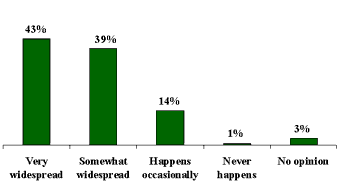
Americans are about evenly divided as to whether corporate corruption has gotten worse in the past few years (47%) or whether "it has always been like this" (50%). But they are not divided as to whether the problem is common: 43% say the practice of top executives at large corporations taking improper actions to help themselves at the expense of the corporation is "very" widespread and another 39% say "somewhat" widespread. Only 14% say that such corruption happens only occasionally, while 1% say it never happens.
| How Widespread Is Corporate Corruption? |
 |
| July 29-31, 2002 |
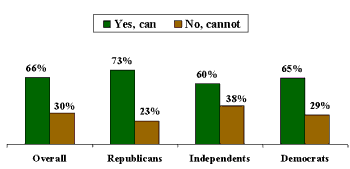
Despite this pessimistic assessment, Americans seem generally upbeat about correcting it. Two-thirds think that new legislation and increased regulation of business can have a major effect in correcting the problem, while 30% disagree. Even people who say that corporate corruption has always been bad express optimism: 62% think new laws and increased regulation can be effective, while just 36% disagree.
There are few differences in these views among partisan groups. About eight in 10 each of Republicans, independents and Democrats say the problem of corporate corruption is widespread. And all three groups are about evenly divided as to whether the problem has gotten worse or whether it has always been this bad. Republicans are a little more likely than independents and Democrats to say that new regulations will be effective in correcting the problem, but by only a few percentage points.
| Can New Business Regulation Laws Correct Corporate Corruption? |
 |
| July 29-31, 2002 |
Survey Methods
The results reported here are based on telephone interviews with a randomly selected national sample of 1,003 adults, 18 years and older, conducted July 29-31, 2002. For results based on this sample, one can say with 95 percent confidence that the maximum error attributable to sampling and other random effects is plus or minus 3 percentage points. In addition to sampling error, question wording and practical difficulties in conducting surveys can introduce error or bias into the findings of public opinion polls.
Just your best guess, please say how important a reason [RANDOM ORDER]is/are for the current state of the economy. Is it/Are they -- one of the most important reasons, a major reason but not the most important, a minor reason, or not a reason at all?
A. Greed and corruption among corporate executives
|
One of |
|
|
Not a |
|
|
|
2002 Jul 29-31 |
28% |
49 |
17 |
3 |
3 |
B. President George W. Bush's economic policies
|
One of |
|
|
Not a |
|
|
|
2002 Jul 29-31 |
10% |
36 |
36 |
12 |
6 |
C. Former President Bill Clinton's economic policies
|
One of |
|
|
Not a |
|
|
|
2002 Jul 29-31 |
11% |
27 |
36 |
19 |
7 |
D. The September 11th terrorist attacks
|
One of |
|
|
Not a |
|
|
|
2002 Jul 29-31 |
24% |
48 |
20 |
5 |
3 |
E. The performance of the stock market
|
One of |
|
|
Not a |
|
|
|
2002 Jul 29-31 |
13% |
53 |
26 |
5 |
3 |
F. The normal business cycle
|
One of |
|
|
Not a |
|
|
|
2002 Jul 29-31 |
14% |
40 |
32 |
7 |
7 |
G. The collapse of many Internet and computer companies in the last few years
|
One of |
|
|
Not a |
|
|
|
2002 Jul 29-31 |
10% |
42 |
36 |
7 |
5 |
SUMMARY TABLE: REASONS FOR CURRENT STATE OF THE ECONOMY
|
|
One of the most important |
|
Most Important/ Major |
|
|
% |
% |
% |
||
|
Greed and corruption among corporate executives |
28 |
49 |
77 |
|
|
The September 11th terrorist attacks |
24 |
48 |
72 |
|
|
The performance of the stock market |
13 |
53 |
66 |
|
|
The normal business cycle |
14 |
40 |
54 |
|
|
The collapse of many Internet and computer companies in the last few years |
10 |
42 |
52 |
|
|
President George W. Bush's economic policies |
10 |
36 |
46 |
|
|
Former President Bill Clinton's economic policies |
11 |
27 |
38 |
|
Now turning to large corporations,
Would you say top executives of a larger corporation taking improper actions to help themselves at the expense of the corporation -- is very widespread, is somewhat widespread, only happens occasionally, or never happens in the business world?
|
Very widespread |
Somewhat widespread |
Happens occasionally |
Never happens |
No |
|
|
2002 Jul 29-31 |
43% |
39 |
14 |
1 |
3 |
Do you think the problem of corporate corruption has gotten worse in the past few years, or has it always been like this?
|
Gotten worse |
Always like this |
No opinion |
|
|
2002 Jul 29-31 |
47% |
50 |
3 |
Do you think that new legislation and increased regulation of business can have a major effect on correcting the problem of corporate corruption, or not?
|
Yes, can |
No, cannot |
No opinion |
|
|
2002 Jul 29-31 |
66% |
30 |
4 |