At the heart of Islam is the land of the Prophet and its holiest sites, Mecca and Medina. They are located today in the Kingdom of Saudi Arabia, a political entity forged 70 years ago and ruled since then by the descendants of Abdul al-Aziz Ibn Sa'ud -- the man who united and founded Arabia's modern nation state.
While the Saudi royal family's wealth is legendary, the standard of living enjoyed by the bulk of the country's rapidly expanding population is far from opulent. The country remains heavily dependent on fluctuating oil revenues, and social strains are rising as a growing number of young adults are unable to find work. Gallup's poll of nine predominantly Islamic countries foundthe typical Saudi household reports an annual income of $19,700 -- not poor when compared to Iranian or Pakistani incomes, but less than half the income of the average American family.
Although the Saudi government maintains close and generally cordial diplomatic ties with the United States, the continuous presence of American troops on Arabian soil since Iraq's invasion of Kuwait in 1990 has angered many Islamic fundamentalists within the region. This presence -- regarded by some as a desecration of sacred soil -- was specifically cited by al Qaeda as a justification for the Sept. 11 attacks. The fact that all but a few hijackers were Saudi citizens remains a matter of deep regret and embarrassment for Saudi officials.
Perceptions of the United States
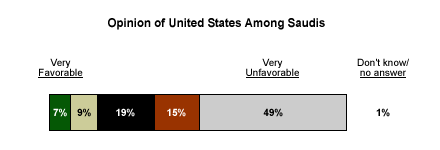
On balance, the view that residents of Saudi Arabia take of the United States is not a positive one.
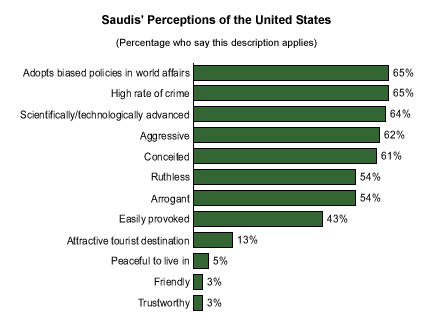
Nearly half (49%) describe their view of the United States as "very unfavorable", and almost two-thirds (64%) say their view of the United States is either mostly or very unfavorable. The United States is typically seen as country that pursues biased diplomatic policies, (65%), is saddled with a high crime rate (65%), and is characterized by aggressive (62%), conceited (61%), ruthless (54%), and arrogant (54%) behavior. Roughly two-fifths (43%) also see the United States as a country that is easily provoked.
The only positive attribute that a majority of Saudi adults ascribe to the United States is that it enjoys a high level of technological and scientific accomplishment (64%). Few view the United States as an attractive tourist destination (13%), and -- despite officially cordial relations -- only a tiny proportion see America as a country that is either friendly (3%) or trustworthy (3%).
Perceptions of the West, and of the West's Interest in Improved Relations With the Islamic World
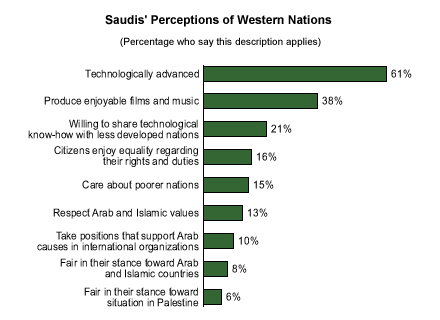
Saudis' perceptions of Western societies in general are scarcely more positive than their assessments of the United States. While the West is seen as technologically advanced (61%), only one in five Saudis (21%) say they think it is willing to share its technological know-how with less developed nations. Relatively few Saudis (16%) say they think of the West as a region in which citizens enjoy political equality with regard to their civic rights and responsibilities.
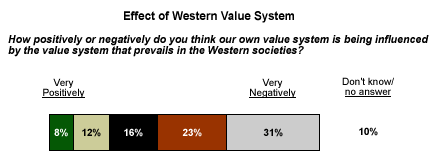
While more than half (54%) of all Saudis view the West's values as having had a negative influence on their own society -- the second most widely praised attribute of the West is the enjoyable quality of its popular entertainment exports (38%).
Both the form and substance of the West's diplomatic efforts draw considerable Saudi criticism. Only one Saudi in nine (11%) thinks the West displays "a lot" of concern for a better coexistence with the Islamic world, while twice as many (23%) go so far as to say the West demonstrates "no concern at all" in this regard. Only a small proportion thinks the West cares about poorer nations (15%), and a mere 13% of Saudis say they think the West demonstrates respect for Arab and Islamic values. Fewer still say they think Western nations are fair in the diplomatic stance they take toward Arab and Muslim countries in general (8%), or toward the Israeli-Palestinian conflict in particular (6%).
Personal Interest in Improved Understanding With the West
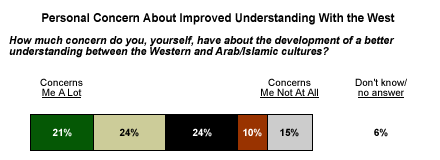
If there is a bright spot in this otherwise bleak picture, it is that Saudis are more likely to say they feel a personal concern for better relations between the West and the Islamic world. Nearly half (45%) of all Saudi adults express either some (24%) or "a lot" (21%) of personal concern for an improved understanding between the Islamic world and the West, while one in four takes a contrary view. Contrary to what might be expected (given the rigidly defined role proscribed to women within Saudi society), Saudi men (51%) are actually more likely than Saudi women (37%) to say they feel a personal concern for a better understanding between the world of Islam and the West.
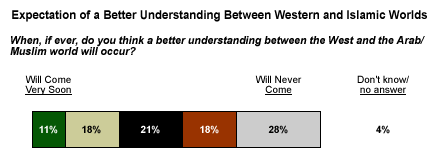
This empathy is tempered by skepticism about what the future holds, however. Only about a third of the kingdom's adults say they think a better understanding between Western societies and the Arab and Islamic world will come fairly (18%) or very (11%) quickly, while virtually as many (28%) say they think such an understanding will never come.