Economic policy-makers are in the public eye this week. The Federal Open Market Committee (FOMC) meets today to consider interest rate policy. The president is meeting today with business owners, policy-makers, industry experts and economists at an economic forum in Waco, Texas. On Wednesday, a majority of corporate leaders are required to certify the accuracy of their companies' financial reports. The key decision facing policy-makers as they gather this week is whether to take strong actions to stimulate the economy, or instead, further defer actions and continue to try to "talk up" the economy.
The strength of the stock market last week may be encouraging to those who promote the "talk-up" strategy and continue to maintain that the underlying economy is fine. But my guess is that many investors bought stocks last week because they think the Fed is going to lower interest rates. Many were probably also thinking that with congressional elections not far away, there will be much talk about new tax cuts and other federal efforts to stimulate economic activity.
In fact, a good case can be made based on economic fundamentals that a significant monetary and fiscal stimulus is needed to support the current economy. Economic growth has slowed significantly. There are indications that many companies are now experiencing a real liquidity crunch. Although it hasn't attracted much attention, the IMF's bailout of Brazil is a clear indication that the South American economic crisis has reached critical proportions. And Gallup data show that the confidence of investors, employees and consumers has dropped significantly during the past few months.
Stimulus Needed to Boost Investors
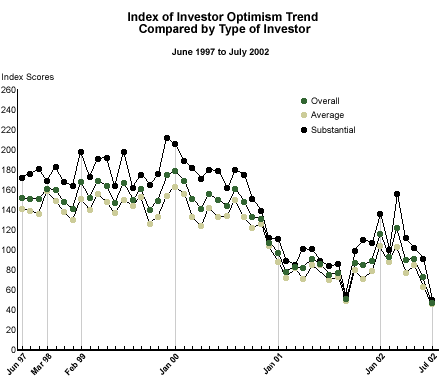
Investor optimism reached its lowest point ever in July, according to the Index of Investor Optimism* -- a joint effort of UBS and The Gallup Organization. The Index is now at 46 -- below its previous September 2001 low of 50. In July, overall optimism among "substantial" investors also reached a new low since the Index's inception in 1996. It fell from 155 in March, to 111 in April, to 101 in May and then to 90 in June. In July, substantial investor optimism fell to 49 -- its lowest level ever and below its September 2001 low of 54. Overall, average investor optimism fell to a new low of 45 in July. It plunged from 102 in March to 76 in April. It then moved up to 84 in May before falling again in June to 62 and then to its current level.
Stimulus Needed to Boost Employees
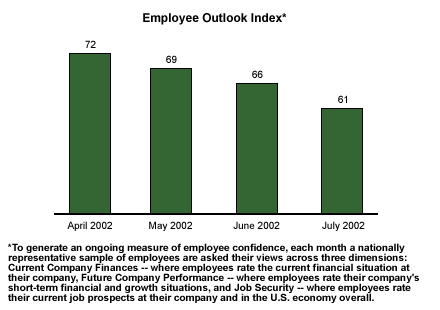
Employee confidence -- like that of investors -- continued to decline in July, according to the Gallup/UBS Employee Outlook Index survey**. The Employee Outlook Index decreased for the third straight month in July, reaching 61 -- down from 66 in June, 69 in May and 72 in April.
Stimulus Needed to Boost Consumers
Consumer perceptions of the economy -- like those of investors and employees -- continued to decline in July and remain low during early August***. During July and early August, 28% of the nation's consumers rated the economy as good or excellent. This is down from June when 36% of consumers rated the economy as good or excellent, and the lowest such rating since February 2002, when 28% of the public gave a good or excellent rating.
Key Points
I believe that to maintain public confidence, it is essential that the president, Congress and the Fed acknowledge the growing weakness of the U.S. economy and take strong actions -- lowering interest rates and proposing tax cuts -- to stimulate the economy. Declining investor optimism, employee confidence and consumer perceptions show that the rally effect has not only dissipated, but that corporate corruption has seriously damaged the current economic climate. Adopting a wait-and-see attitude now risks not only delaying the recovery, but also significantly increases the chances that the economic stagnation of the months ahead will turn into a double-dip recession by year's end.
*Results for the Gallup/UBS Index of Investor Optimism -- U.S. are based on telephone interviews with a randomly selected U.S. sample of 1,006 adult investors, aged 18 and older, with at least $10,000 of investable assets, conducted April 1-14, 2002. For results based on the total sample of 1,000, one can say with 95% confidence that the maximum margin of sampling error is ±3%. For substantial investor results based on the total sample of 400, one can say with 95% confidence that the maximum margin of sampling error is ±5%.
**Results for the Employee Outlook Index are based on telephone interviews with a randomly selected national sample of 660 adults, aged 18 and older, conducted July 9-11, 2002, and July 22-24, 2002. For results based on the total sample of 660, one can say with 95% confidence that the maximum margin of sampling error is ±4%.
***Results are based on telephone interviews with 1,007 national adults, aged 18 and older, conducted Aug. 5-8, 2002. For results based on the total sample of national adults, one can say with 95% confidence that the maximum margin of sampling error is ±3%.