It's summertime, the living is easy, and the movies are … violent? While dramas and Oscar nominees may reign during the winter movie season, summer releases are typically action movies or light comedies. With young people out of school and in the theaters, moviemakers tend to try to lure the lucrative teen market by producing high-budget films, light on story line but heavy on sex and violence. Although violent movies have been around for decades, we have become more accepting of them in recent years -- or at least our teens have.
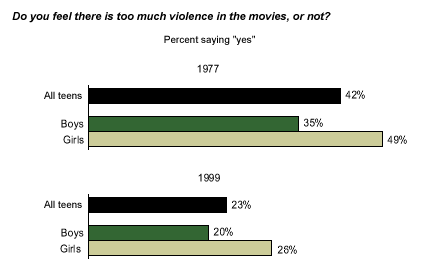
In 1977, when Gallup asked teens between the ages of 13 and 17 whether they felt there was too much violence in the movies, more than four out of 10 (42%) said yes, they did*. While few people would dispute the idea that movies have become more violent rather than less in the past quarter century, in 1999 less than a quarter (23%) of teens answered yes when asked the same question**. A similar trend emerges with regard to sex in the movies, with 44% of teens in 1977 saying that there was too much sex in the movies and only 28% agreeing with this statement in 1999. Given all the forms of media currently available to teens, including the Internet, video games, and a plethora of cable and satellite television channels, they appear to have become considerably more desensitized to graphic depictions of violence and sex than their parents were at their age.
Teen-age girls are slightly more likely than boys to feel that there is too much violence and sex in movies. About a quarter (26%) of girls compared to 20% of boys believe there is too much violence in movies. The more striking difference occurs in their opinions regarding sex in movies, with about a third (34%) of girls and only 22% of boys believing there is too much.
Overall, however, teens are quite positive about the influence of movies on their own lives and on American society as a whole. In 1999, a majority (70%) of teens felt that movies have a very or somewhat positive effect on their ethics and morals. Despite the fact that girls were more likely than boys to feel that there is too much sex in the movies, more girls than boys believed that the effect of movies on their ethics and morals was very or somewhat positive (74% of girls versus 66% of boys). Almost two-thirds (63%) of teens said that the effect of movies on the ethics and morals of the American people has been very or somewhat positive.
It is difficult to discern exactly what young people consider a "positive" influence. According to a 1999 Senate Judiciary Committee report, "Since the 1950s, more than 1,000 studies have been done on the effects of violence in television and movies. The majority of these studies conclude that children who watch significant amounts of television and movie violence are more likely to exhibit aggressive behavior, attitudes and values." The conflicting messages are somewhat disconcerting and raise the question: are such studies overhyped, or are teens simply unable to recognize the negative influence excessive movie violence may be having on them?
*Findings are based on interviews with 502 American teens, aged 13 to 17, conducted from September through November 1977. For results based on this sample, one can say with 95% confidence that the maximum error attributable to sampling and other random effects is ±5%.
**Findings are based on interviews with 502 American teens, aged 13 to 17, conducted from January through April 1999. For results based on this sample, one can say with 95% confidence that the maximum error attributable to sampling and other random effects is ±5%.