Dr. Jack Kevorkian, the man most closely associated with the debate on physician-assisted suicide, was sentenced in 1999 to 10 to 25 years in prison for helping a patient die by lethal injection. Even though Kevorkian is out of the limelight and won't be eligible for parole until 2007, the debate won't die. Gallup research from the past few years indicates that the issue of doctor-assisted suicide is destined to be a hot topic for years to come, given the deep division of opinion observed between the religious and non-religious segments of the U.S. populace.
A May 2002 Gallup survey* asked U.S. adults, "When a person has a disease that cannot be cured, do you think doctors should be allowed by law to end the patient's life by some painless means if the patient and his family request it?" Overall, 72% of the population said yes, but among those who attend church weekly, results were almost evenly split. Fifty percent of regular churchgoers said doctors should be allowed to end patients' lives, compared to 47% who said they shouldn't.
A survey about death and the dying process, conducted by the George H. Gallup International Institute for the Nathan Cummings Foundation and the Fetzer Institute in 1997**, reveals an even sharper division of opinion about physician-assisted suicide. When asked about their views on the subject, 33% of respondents said they supported it under a wide variety of circumstances, 32% said they supported it under a few circumstances but opposed it in most cases, and 31% opposed legalizing physician-assisted suicide for any reason.
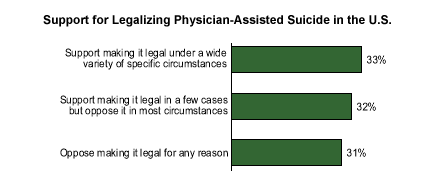
The three-way split in opinion about legalizing physician-assisted suicide became an even split when the respondents were asked about how they would feel if they were put in such a situation. Could they "imagine any situation where you, yourself, might want a doctor to end your own life intentionally by some painless means if you requested it"? Fifty percent said yes and 47% said no.
Dramatic differences were found according to levels of religiousness or spirituality. According to the 1997 survey, those most opposed to legalizing physician-assisted suicide were people who place the highest importance on their religious faith as an influence in their lives; those who say their life belongs to God or a higher power rather than to themselves, their families or the community around them; and those who say they are "born-again."
Legalizing physician-assisted suicide was opposed by 68% of those who said that their religious faith is the most important influence in their lives, but by only 11% of those for whom their religious faith is not an important influence in their lives. Similarly, legalizing physician-assisted suicide is opposed by 46% of those who say that their life belongs to God or a higher power but by only 13% of those who say their life belongs them themselves. Fifty percent of those who describe themselves as born-again oppose making physician-assisted legal for any reason, compared to 19% of those who do not describe themselves that way.
There are also significant differences in the opinions of those who believe and do not believe in heaven and/or in hell, and some differences, although not so dramatic, between those with varying opinions on existence in some form after death.
- Those who believe in some form of existence after death were more likely to oppose legalizing physician-assisted suicide for any reason and were less likely to imagine being able to apply physician-assisted suicide to themselves.
- Among those who believe in some form of existence after death, those who agree that their faith or beliefs lead them to think that they themselves will exist in some form after death are likely to oppose legalization and to say that they cannot imagine physician-assisted suicide for themselves.
- However, respondents who agree that they think of their existence in the afterlife as being "a journey" are less likely to oppose legalization for any reason and are more likely to be able to imagine a physician-assisted suicide for themselves.
Key Points
The difference of opinion on physician-assisted suicide between religious and non-religious Americans may lie in the fact that this is part of a larger issue concerning the right to die. Defenders of personal liberty maintain that everyone is morally entitled to end their lives when they see fit. For these people, suicide is morally permissible. While suicide in any form is generally regarded as a sin among Christians and those of many other religions, there is nevertheless a broad range of views among religious Americans.
*Results are based on telephone interviews with 475 national adults, aged 18 and older, conducted May 6-9, 2002. For results based on the total sample of national adults, one can say with 95% confidence that the maximum margin of sampling error is ±5%.
**Results are based on telephone interviews with 1,200 national adults, aged 18 and older, conducted May 1997. For results based on the total sample of national adults, one can say with 95% confidence that the maximum margin of sampling error is ±3%.
