Immediately after Sept. 11, Pakistani President Pervez Musharraf promised his country's "unstinting support" for the West's war on terrorism. This commitment, accompanied by important logistical assistance in the ensuing military action in Afghanistan, constituted a reversal in Pakistan's policy toward the Taliban government in Kabul -- a regime that had assumed power with considerable Pakistani backing.
In the eyes of much of the West, Musharraf underwent a remarkable transformation -- from a strongman who had overthrown a democratically elected government to an invaluable ally. In exchange for Pakistan's support, the United States lifted sanctions that had been imposed in response to Pakistan's 1998 testing of nuclear weapons, rescheduled Pakistan's public debt, and committed significant flows of financial assistance.
But as this diplomatic rapprochement took place, how strong was support at the popular level within Pakistan for the United States and its allies?
Not very, according to the views expressed by the nationwide sample of more than 2,000 Pakistanis interviewed as part of The 2002 Gallup Poll of the Islamic World. In fact, Pakistanis' views of the United States and Britain are less likely to be positive than those expressed in any of the other eight nations surveyed.
Pakistanis Hold Sharply Negative Views of United States and Britain
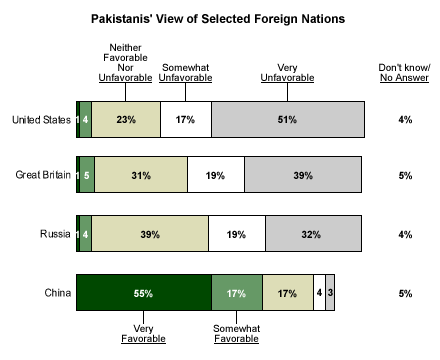
Despite the dramatic warming in official relations, only 5% of Pakistanis express a predominantly positive view of the United States, and a mere 1% describe their impression of the United States as very favorable. At least two-thirds of all Pakistanis hold a negative impression of the United States, with a majority (51%) describing their opinion as very unfavorable.
Views of America's most prominent ally in the military response to Sept.11 are similarly negative. Just 6% of Pakistanis hold a favorable view of Britain, while nearly three in five (58%) have a negative one. As with the United States, only 1% has a very favorable impression of Britain.
In no other country surveyed -- not even Iran or Saudi Arabia -- is the number of adults expressing a favorable view of either the United States or Britain fewer than one in 10.
Views of a number of other nations were also tested, and it is interesting to note that Pakistanis express extraordinarily different views of China and Russia -- nations that historically have backed Pakistan and India, respectively, in the latter two's long-standing intra-regional power struggle. Pakistani views of Russia are nearly as negative as those expressed toward Britain, with an overall majority (51%) expressing a negative view, and just 5% a positive one. Perceptions of China, however, are extraordinarily positive -- 55% of Pakistanis describe their impression of China as very favorable, with an additional 17% holding a mostly favorable opinion.
Specific Attributes Associated With the United States and Other Selected Nations
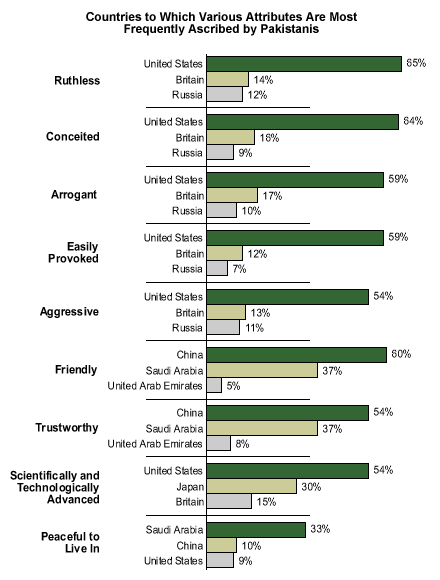
What specific negative traits do Pakistanis associate with the United States and to a lesser extent with Britain and Russia? What positive associations do Pakistanis typically have with America?
On the negative side, a majority of all Pakistanis say that "ruthless" (65%), "conceited" (64%), "arrogant" (59%), "easily provoked" (59%), and "aggressive" (54%) are all characteristics that they associate with the United States. In contrast, only a minority -- fewer than one in five in each instance -- sees these same traits as descriptive of Britain (arrogant: 17%, conceited: 16%, ruthless: 14%, aggressive: 13%, easily provoked: 12%). Associations of these traits with Russia are rarer still -- generally on the order of one in 10 (ruthless: 12%, aggressive: 11%, arrogant: 10%, conceited: 9%, easily provoked: 7%). Thus, while perceptions of Britain and Russia are strongly negative, Pakistanis are not nearly as willing to ascribe specific negative characteristics to these two nations as to the United States.
The sole positive trait associated with the United States by a majority of all Pakistanis is "technologically and scientifically advanced" (54%). Despite the recent warming in diplomatic relations, only a tiny minority of the Pakistani public says it views either the United States or Britain as friendly (United States: 2%, Britain: 1%) or trustworthy (United States: 1%, Britain: 1%).
In contrast, three-fifths of all Pakistanis (60%) say they view China as friendly, and 54% see it as trustworthy -- no doubt a reflection of China's record of military and diplomatic support in earlier decades.