"For all present-day mathematicians and scientists are children of Islam."
-- Keith Devlin, "How Islam kick started science" -- The Guardian (U.K.), Sep. 5, 2002
"By all the standards of the modern world -- economic development, literacy, scientific achievement -- Muslim civilization, once a mighty enterprise, has fallen low."
-- Bernard Lewis, "What Went Wrong?" (introduction to excerpt – The Atlantic Monthly, January 2002)
In the centuries before Europe's Renaissance and Enlightenment, the Islamic world was a global center of scientific and intellectual discovery. Islam's universities were centers of innovation in mathematics and science. Such words as "alkaline", "algebra" and "algorithm" indicate the directness of this connection – the latter two were derived, respectively, from the Arabic phrase "al jabr" ("the reduction") and the surname of the ninth- century Arab astronomer and mathematician, al-Khwarizmi.
This flowering of scientific and technological creativity within the Islamic world peaked prior to the discovery of the New World. Then a slow but inexorable decline commenced, as the pursuit of knowledge in the hard sciences was eclipsed by a curriculum devoted overwhelmingly to religious instruction.
New York Times columnist and Pulitzer Prize-winner Tom Friedman who visited a madrasa (religious school) in Pakistan last year, recorded the following observation in one of his columns:
"It was at once impressive and disquieting … impressive because the madrasas provide room, board, education and clothing for thousands of Pakistani boys -- who would otherwise be left out on the streets because of the gradual collapse of Pakistan's secular state education system … disquieting because their almost entirely religious curriculum was designed by the Mogul emperor Aurangzeb Alamgir, who died in 1707. There was only one shelf of science books in the library -- largely from the 1920s."
The scientific and technological capabilities of Islamic countries will surely have a huge impact on future economic prospects for this region. How do residents of the region view its scientific and technological potential -- and how does this contrast with their perceptions of the West's technological capabilities?
Little Optimism Expressed Regarding Islamic World's Scientific and Technological Prospects
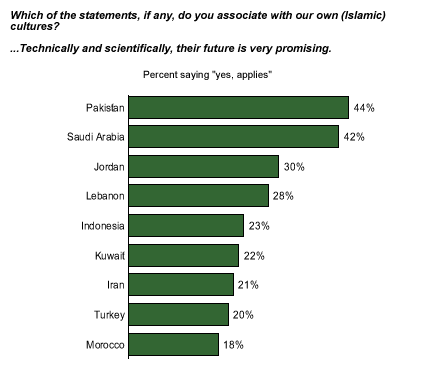
In none of the nine countries surveyed in the 2002 Gallup Poll of the Islamic World does a majority think the Islamic world has a technologically and scientifically promising future. In fact, only in Pakistan (44%) and Saudi Arabia (42%) do as many as three in five express optimism in this regard, while in the seven remaining countries, less than a third of those interviewed share this view.
West Seen as Technologically Advanced, but Unwilling to Share Its Knowledge With Developing Countries
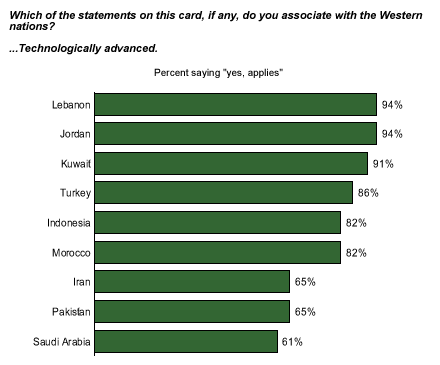
In sharp contrast, strong majorities view the West as technologically advanced. In each country, no less than three-fifths of those interviewed accept this as an appropriate characterization of the West, and endorsement of this description is overwhelming in several countries.
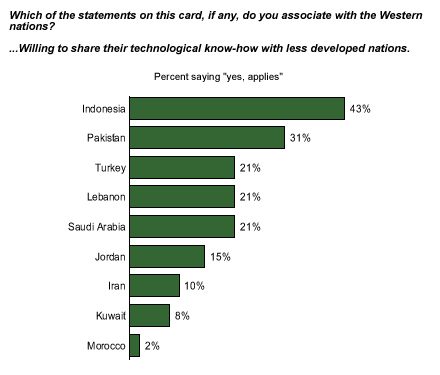
Respondents are less generous, however, when assessing whether the West is willing to share its technological expertise with underdeveloped countries. Only in Indonesia (43%) do as many as two in five respondents say they see the West as willing to share its technical know-how, and in seven of the nine countries fewer than one in four believe this to be true.
Region's Own Governments Seen as Insufficiently Committed to Economic Progress
A final damper on prospects for economic growth is the skepticism the region's inhabitants express as to whether the Islamic realm's own governments are sufficiently committed to achieving economic prosperity on a broad basis. When asked if the description "applies practical measures to improving the lot of its own people" pertains to the governments of the Islamic world in general, in none of the nine countries surveyed did a majority answer affirmatively.
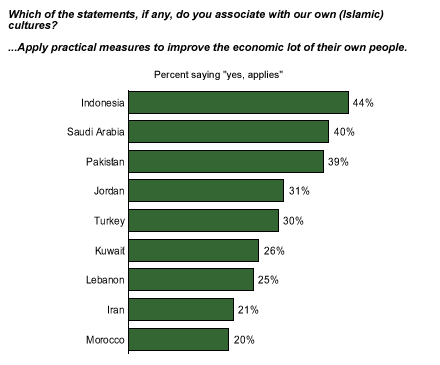
Thus, even if sufficient technological and scientific expertise can be developed and/or imported, residents of these societies express considerable doubt regarding the level of governmental commitment to broad-based economic development.
Key Points
With regard to future technological and scientific advancement in their region, inhabitants of the predominantly Islamic countries included in Gallup's survey are far from hopeful. Their pessimism consists of three distinct, though mutually reinforcing, components:
- Progress from within: The region's prospects for internally generated scientific and technological advances are seen as poor.
- Transfer from without: The West is viewed as unwilling to share its own technological skills.
- Political will: As a general characterization, governmental authorities within the Islamic world are not seen as strongly committed to the economic advancement of their societies.