Since representatives of Clonaid announced on Dec. 27 that they had successfully engineered the birth of the first cloned human baby, the subject of human cloning has re-emerged as a major topic for public debate. The Clonaid claim has yet to be verified -- but in the meantime, legislatures and courts around the world are scrambling to address the legality of human cloning efforts.
Americans are largely unified in their agreement that cloning efforts designed to result in the birth of a human being should be illegal in the United States, but levels of agreement differ between men and women, and by age group. The public is not, however, universally opposed to all kinds of cloning efforts. Many distinguish between cloning human cells for medical research and organs and body parts for medical transplants, and that designed to result in the actual birth of a human being.
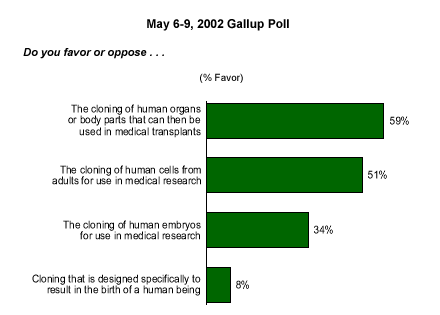
In a May 6-9, 2002, Gallup Poll*, a majority of Americans (59%) said they favor the cloning of human organs or body parts for use in medical transplants. A majority (51%) also favored the cloning of human cells from adults for use in medical research. Support for cloning of human embryos for use in medical research was somewhat lower, with 34% in favor. Support for cloning to result in the birth of a human being was even lower (only 8% were in favor).
Women and Older People Oppose in Greater Numbers
A Jan. 3-5, 2003, Gallup Poll** found that just 11% of Americans believe that cloning designed specifically to result in the birth of a human being should be legal in the United States, while 86% think it should be illegal. Women, however, are less likely than men to say that human cloning should be legal (7% compared to 15%).
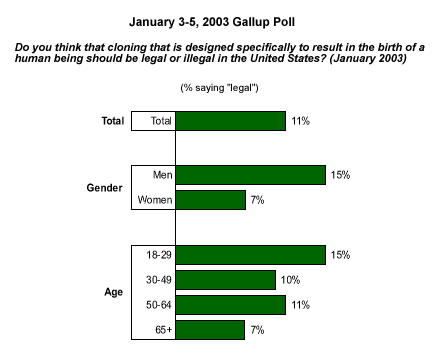
Younger people -- those aged 18 to 29 -- favor the legality of human birth cloning at about twice the rate of people aged 65 and older (15% versus 7%). Middle-aged Americans (those 30 to 49 and 50 to 64) fall in the middle, with 10% and 11%, respectively, supporting human cloning. Younger people tend to feel more comfortable with technology and innovation than older people do, which may help explain such age group differences. Given those differences, support for cloning could increase as the younger generations age.
Key Points
The vast majority of Americans do not favor cloning efforts designed to result in the birth of a human being, and almost all would like to see such efforts made illegal in the United States. Yet, a majority of Americans feel that making all cloning research illegal would create missed opportunities for medical research. In the scramble to establish laws regulating cloning technology, it seems that most Americans would want to see regulations that carefully differentiate between different types of cloning efforts, rather than simply banning all types of cloning regardless of its intended purpose.
*Results are based on telephone interviews with 1,012 national adults, aged 18 and older, conducted May 6-9, 2002. For results based on the total sample of national adults, one can say with 95% confidence that the maximum margin of sampling error is ±3%.
**Results are based on telephone interviews with 1,000 national adults, aged 18 and older, conducted Jan. 3-5, 2003. For results based on the total sample of national adults, one can say with 95% confidence that the maximum margin of sampling error is ±3%.