The current challenges to the University of Michigan's affirmative action program, which the Supreme Court will review in April, have drawn comparisons to the last major ruling by the high court on racial diversity programs in higher education. That ruling occurred in 1978, when white medical school applicant Allan Bakke said the University of California at Davis had practiced unfair discrimination by denying him admission two years in a row while accepting less qualified minority applicants.
The court's 5-4 ruling may have set the stage for some of the ambiguity still reflected in public opinion today. The court ruled that inflexible quota systems like the one used by UC Davis were illegal. But it also stated that race can be a valid consideration in admissions programs if factors other than race are similarly considered, thereby upholding the legality of affirmative action per se.
Huh? If nine Supreme Court justices have so much trouble being decisive about an issue, it's no wonder the opinions of the general public have been so tenuous over the last quarter-century. Poll results vary widely, for example, according to specific question wordings. In general, historical polling data show that Americans have an overall positive view toward "affirmative action" and programs that increase opportunities for minorities, so long as these do not confer an unfair advantage for minorities in the form of "preferential treatment" or "lower standards." Consider the following results from June 2001:
Now we'd like you to think about programs aimed at helping racial minorities in education and the workplace. For each of the following approaches, please say whether you would favor or oppose it as a way to help racial minorities in these areas. How about...
- Establishing training courses or policies which raise people's awareness about fairness in hiring racial minorities (82% favor, 16% oppose)
- Establishing policies requiring that special efforts are made to advertise job and admissions opportunities to racial minorities in order to increase the number of minority applicants (63% favor, 33% oppose)
- Setting quotas for the number of racial minorities hired or accepted, but requiring them to meet the same standards as others (66% favor, 32% oppose)
Looks fairly promising for affirmative action advocates, right? But the results were dramatically different when the word "quotas" was coupled with the idea of lowering standards for minority applicants.
- Setting quotas for the number of racial minorities hired or accepted even if it means lowering the standards in order to make up for past discrimination (18% favor, 79% oppose)
Thus, similar to the Supreme Court's stance on Bakke, it seems the public isn't necessarily opposed to the idea of affirmative action programs in principle, but feels that in practice such programs must be very narrowly defined to avoid overt injustice toward whites.
Looking Back at Bakke
Having established a huge caveat regarding question wording, let's look at the public opinion climate surrounding the 1978 Bakke case.
Like today, many Americans were troubled by the state of the U.S. economy that year: in July 1978, 60% named inflation/the high cost of living as the country's most important problem, while another 14% named unemployment/recession. The Democratic Party had more political muscle: 48% of Americans considered themselves Democrats, while 22% identified as Republicans and 27% as independents. (Today, those percentages tend to be split much more evenly among the three groups.)
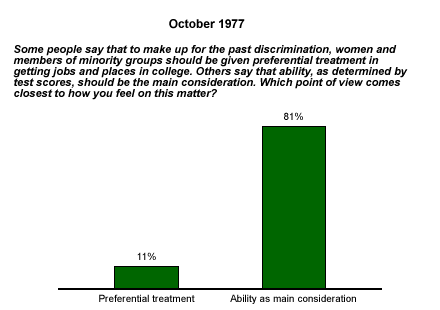
A 1977 question that set "preferential treatment" against "ability" in hiring and college recruitment practices found more than 8 in 10 Americans in favor of the latter:
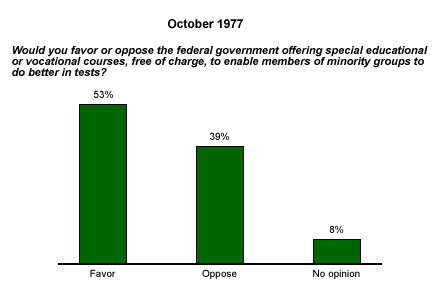
On the other hand, a majority of Americans said they would favor federally funded education or vocational programs geared to help minorities do better on tests:
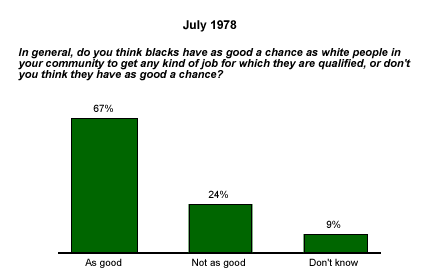
Respondents weren't asked specifically about the need for affirmative action, but two-thirds felt that, at least in their community, blacks did not face employment discrimination:
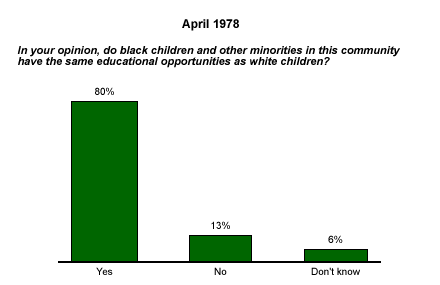
Americans were even more unified in their belief that black children and white children in their communities had the same educational opportunities:
Bottom Line
There is perhaps no better subject than affirmative action to illustrate the murkiness of public opinion generated by highly complex issues. The Supreme Court's decision in the University of Michigan case has the potential to eliminate some of the ambiguity introduced by Bakke, which may in turn promote the solidification of Americans' opinions about affirmative action in the future. On the other hand, the decision may also introduce whole new sets of questions that further complicate the issue.
One new factor, for example, is legal brief filed by 30 companies claiming racially diverse campuses are good for business because they produce graduates who are more creative and have a broader perspective on consumer needs. It's an argument that relies more on practicality than principle, and adds a dimension to the Michigan case that was largely overlooked in 1978. Such a development suggests Americans still have plenty of thinking to do before we arrive at a stable consensus on affirmative action.
