"I don't need to belong to a church to be a good Christian" is something almost every pastor of every congregation -- regardless of denomination -- has heard at least a dozen times. And rabbis have heard "I don't need to belong to a synagogue to be a good Jew" just as often. But the latest Gallup research confirms that those who are members of faith communities tend to be more spiritually committed than those who are not.
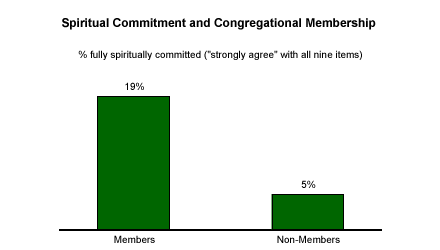
In a study conducted in November and December 2002*, Gallup measured the spiritual commitment level of a representative sample of adults in the United States. Nineteen percent of members of congregations are "fully spiritually committed" -- that is, they "strongly agree" with all nine spiritual commitment items -- as do only 5% of non-members. The nine items that measure spiritual commitment are:
- I spend time in worship or prayer every day.
- My faith is involved in every aspect of my life.
- Because of my faith, I have forgiven people who have hurt me deeply.
- Because of my faith, I have meaning and purpose in my life.
- My faith has called me to develop my given strengths.
- I will take unpopular stands to defend my faith.
- My faith gives me an inner peace.
- I speak words of kindness to those in need of encouragement.
- I am a person who is spiritually committed.
Copyright © 2001 The Gallup Organization, Princeton, NJ. All rights reserved.
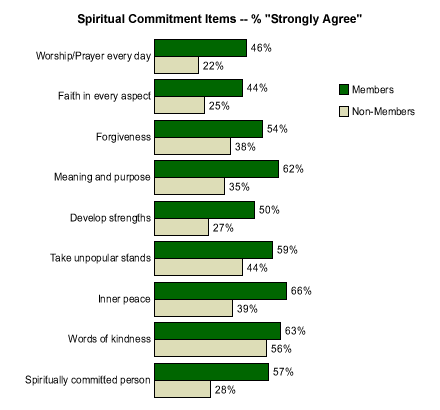
Members of faith communities outscored non-members on every item, in many cases almost doubling the percentage of "strongly agree" responses of non-members. The only item for which difference is fewer than 10 points is "I speak words of kindness to those in need of encouragement."
Bottom Line
These data indicate that belonging to a faith community is a critical component of spiritual commitment, which exposes the oft-heard statement in the opening paragraph for what it is: an excuse. While it is possible for an individual to be spiritually committed without belonging to a congregation, it is highly unlikely. The implications for spiritual leaders of faith communities are threefold:
- Raise the bar. Make spiritual growth an expectation of membership. When members are challenged to grow, most of the time they respond positively, making new personal discoveries and accomplishing things they once thought impossible.
- Focus on the outcomes. In your tradition, what does a spiritually committed person look like? Communicate that ideal to your members so they will know the end result they are trying to achieve.
- Emphasize the importance of faith in everyday life. The lowest scores among both members and non-members were on the spiritual commitment items that reflect the integration of faith with daily life: "I spend time in worship or prayer every day" and "My faith is involved in every aspect of my life." People need to see the relevance of their faith in all that they do. Faith communities that do a good job of connecting faith and life will not only produce more committed members, but will also be more attractive to non-members.
*Results are based on telephone interviews with 1,000 adult members of a church, synagogue, or other religious faith community, aged 18 and older, and 500 non-members, conducted in November and December 2002. For results based on this sample, one can say with 95% confidence that the margin of sampling error is ±2.6%.
