If you think you have a sharp mind for facts on world affairs, then you might want to try these questions on for size: Who's the current U.S. Secretary of State? Who's the prime minister of Canada? How about the leader of Cuba? Can you name the Russian president? A February Gallup Poll* put Americans' knowledge to the test, by asking them if they know the names of various foreign leaders. While knowledge of specific leaders varies greatly, public awareness of foreign leaders has generally improved since the last time Gallup asked these questions in May 2000.
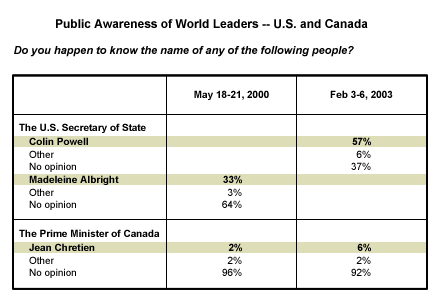
Current foreign policy tensions have helped raise the public visibility of some figures. When asked to name the U.S. Secretary of State, more than half the public (57%) correctly answered Colin Powell, 6% named someone else, and 37% didn't have an answer. The percentage correctly naming Powell is significantly higher than it was for his predecessor, Madeleine Albright. Just 33% correctly named her as Secretary of State in 2000. This may be due, at least in part, to Powell's general popularity.
However, Americans do not do nearly as well when they are asked to identify the leader of their neighbor to the north. Just 6% of the public correctly named Jean Chretien as the prime minister of Canada, although this is an improvement over the 2% who named Chretien in 2000.
Improved Awareness of Other International Leaders
The survey also asked Americans to name the leaders of Russia, England, Israel, and Cuba. The percentage correctly naming Vladimir Putin of Russia (40%) and Tony Blair of England (51%) both increased dramatically since 2000. The percentage identifying Fidel Castro as the leader of Cuba dipped slightly (from 76% to 71%), while 37% correctly cited Ariel Sharon as the prime minister of Israel.
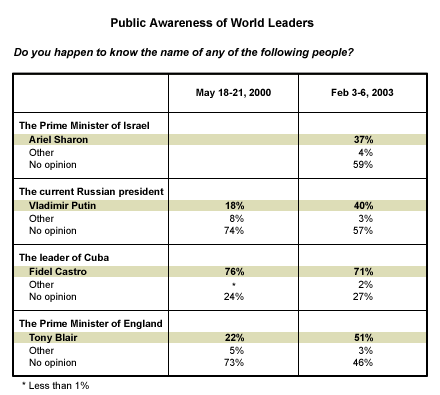
The rise in awareness of Putin as the Russian president is not surprising, considering the fact that he had been president for fewer than two months when Gallup first asked the question in May 2000. The 29-point increase in the public's awareness of Blair as the prime minister of England is more likely attributable to Blair's recent backing of the United States and President Bush in both the war on terrorism and the stand-off with Iraq.
Increased Interest in News From Foreign Countries
The general increase in the public's knowledge of foreign leaders is reflective of an increase in how closely Americans follow news about foreign countries. Specifically, the percentage saying they follow news about foreign countries "very closely" has doubled since May 2000, while the percentages saying "not too closely" have been cut nearly in half.
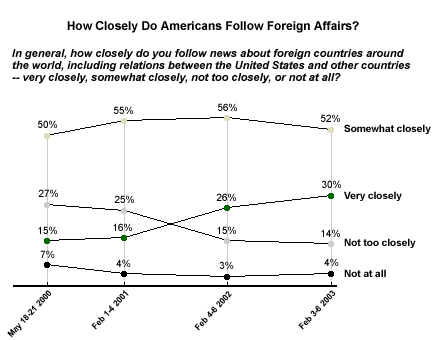
The most substantial increase in the American public's following of foreign news came between February 2001 and February 2002, no doubt a result of the explosion in news coverage of U.S. foreign policy following the Sept. 11 terrorist attacks.
Bottom Line
The terrorist attacks of 2001, the war on terrorism, and the increased tension around the world have significantly contributed to an increase in public awareness of foreign countries. The fact that Americans are far more likely to identify the leaders of England, Russia, and Israel than to identify the leader of Canada, their closest neighbor, suggests Americans' awareness of foreign leaders is driven more by the extent of each country's role in world affairs than by their geographic proximity to the United States.
*Results are based on telephone interviews with 1,001 national adults, aged 18 and older, conducted Feb. 3-6, 2003. For results based on the total sample of national adults, one can say with 95% confidence that the maximum margin of sampling error is ±3%.
