Decades ago, Americans were told that drinking in moderation was healthy. Then moral and medical leaders noted that alcohol has many ill effects, and we were warned alcohol was bad for us. Later, researchers noticed that the French live on butter and wine, and have a much lower rate of heart disease. Next thing you know, a little red wine is good for us.
A couple of weeks ago, a Harvard School of Public Health study reported that one or two drinks a day -- of any kind of alcohol -- can reduce heart disease among men by as much as 37%. Aggregated results from Gallup surveys conducted from 2000 to 2002* show that of the 64% of Americans who drink, most consume far less than the quantity recommended by this study. And when Gallup asks Americans what type of alcohol they prefer -- beer, wine, or liquor -- beer usually wins out.
Chug-a-lug
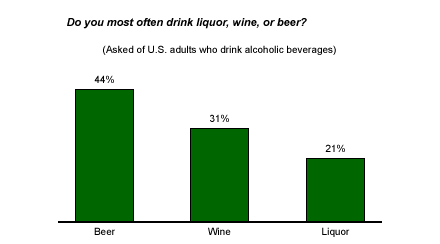
The finding that red wine isn't the only beneficial form of alcohol is good news to beer drinkers. Of those Americans who say they imbibe, 44% say they drink beer most often, 31% say wine, and 21% say hard liquor.
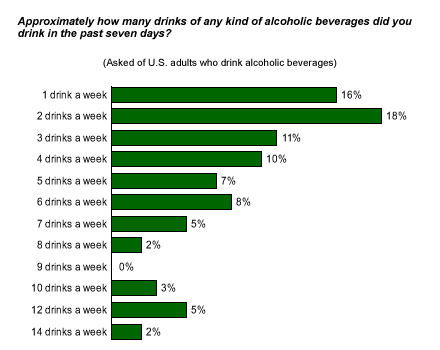
The data show that most Americans who drink alcohol consume relatively little -- 18% say they have two drinks a week, 16% have one, 11% have three, and 10% have four. Seventeen percent of U.S. drinkers consume somewhere between 7 and 14 drinks per week -- the amount recommended in the Harvard study.
Are Wine Drinkers Healthier?
Now that all types of alcohol are said to be healthy in moderation (as opposed to just red wine), wine makers have to share the "healthy drinking" market with brewers and liquor distillers. More bad news for wine marketers: wine drinkers' self-reported health status is no better than any other drinkers'. Eighty-four percent of those who drink beer most often say their health is good or excellent, as do 84% of wine drinkers and 78% of liquor drinkers**.
However, Gallup results suggest that wine drinkers are less likely than beer and liquor drinkers to engage in at least one high-risk health behavior: smoking. According to the 2002 poll, only 11% of drinkers who prefer wine report having smoked cigarettes in the past week. This compares to 31% of both beer and liquor drinkers.
The Aging Process
Different age groups enjoy different types of alcohol, and beer is definitely dominant among the younger generations. Fifty-two percent of 18- to 29-year-olds most often drink beer, 21% drink wine and 20% drink liquor. (Although alcohol consumption is usually illegal in America for anyone under 21, Gallup's surveys include adults 18 and older.) Among 30- to 49-year-olds, 53% drink beer most often, 26% choose wine, and 16% drink liquor. The gap between beer and wine closes among 50- to 64-year-olds -- 42% drink beer most often, 37% drink wine, and 16% choose liquor. Wine surpasses beer only among those 65 and older -- 45% of whom prefer wine, 24% prefer liquor, and 22% prefer beer.
Bottom Line
Many healthcare professionals are concerned about the consequences of the Harvard study. Some people, particularly those who already have problems with alcoholism, may consider the news license to drink. But the fact is that most Americans drink in moderation, and they can't be blamed for feeling happy that something that many used to consider a guilty pleasure is actually beneficial to one's health. Those who enjoy a glass of wine with dinner, a cocktail in the evening, or a beer during a football game can be comforted by the fact that they are drinking to their heart's content.
*Data are taken from an aggregate of Gallup Polls conducted July 9-11, 2002, July 19-22, 2001, and Nov. 13-15, 2000, consisting of 3,070 adults, aged 18 and older. For the combined sample of national adults, one can say with 95% confidence that the maximum margin of sampling error is ±2%.
**Results are based on telephone interviews with 673 national adults, aged 18 and older, who drink alcoholic beverages, conducted July 9-11, 2002. For results based on the total sample of national adults, one can say with 95% confidence that the maximum margin of sampling error is ±4%.