The Supreme Court's much-anticipated ruling last week on affirmative action in higher education upheld the right of colleges and universities to consider an applicant's race as an admission factor, while placing limits on how racial diversity goals can be achieved. The central question of the affirmative action debate is whether minority students are entitled to advantages intended to put them on equal footing with their white peers. Do black children and white children in America have the same opportunities to succeed? And if systematic inequalities do exist, is affirmative action the appropriate way to address them?
Gallup's 2002 social audit of race relations in the United States* set aside the contentious details of specific affirmative action programs and asked Americans how they perceived the educational opportunities of black children and white children. Responses show that the majority of Americans believe black children have as good a chance as white children to get a good education in their communities. But a closer examination of the results reveals that this question sharply divides the public along racial lines.
Do Black Children and White Children Have Equal Opportunities for a Good Education?
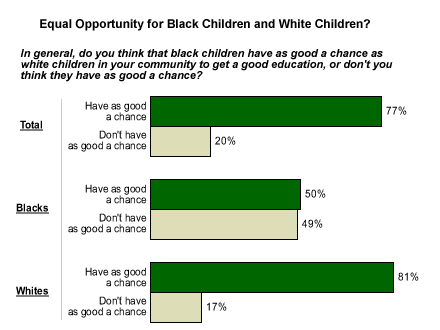
Gallup asked, "In general, do you think that black children have as good a chance as white children in your community to get a good education, or don't you think they have as good a chance?" More than three in four Americans (77%) said that black children have as good a chance for a good education, and 20% said they don't have as good a chance.
At first glance, this appears to be a strong vote of confidence in the egalitarianism in community schools. But the data show a rather large disparity among blacks' and whites' opinions on the matter -- just half of blacks said that black children have the same chance as white children in their communities for a good education, compared to 81% of whites who said the same.
These perceptions are strongly related to one's policy preferences on affirmative action. Among U.S. adults who think black children don't have as good a chance at a good education, 44% think affirmative action programs should be increased, and only 9% think affirmative action should be decreased. Among people who think black children do have as good opportunities, 24% want affirmative action programs to increase and 30% want them decreased.
Perceptions of Equal Opportunity Moving Downward Among Blacks
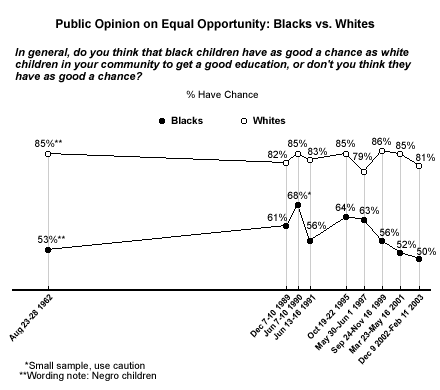
Black Americans are currently as pessimistic about educational opportunities for black children as they have ever been in over 40 years. When Gallup first asked this question in 1962, 53% of blacks thought black children had as good an opportunity as white children to get a good education. By 1995, that percentage had climbed to 64%. But since then, the percentage has moved steadily downward to its current level of 50%. During the same period, white opinion on this question has remained consistent, with about 8 in 10 believing blacks have equal educational opportunities.
According to a former New Jersey Commissioner of Education, Dr. Saul Cooperman, the escalating concern among black Americans about educational opportunities for black children is justified. Cooperman cites several barriers that today's black students face, the first being their greater likelihood to attend school in urban -- rather than suburban -- areas. In addition to receiving less funding per pupil, urban schools have trouble attracting and retaining good teachers. "Talented teachers go to urban areas, teach for a year or two, and then go to the suburbs, where there are fewer problems," Cooperman said.
Bottom Line
The U.S. Supreme Court has now upheld the idea that affirmative action in higher education has the potential to increase educational opportunities for minorities and their classmates. But what can be done at the elementary and high school levels to reverse the declining optimism among blacks about the chances black children have to get a good education?
According to Cooperman, responsibility falls on the shoulders of schools and school districts, parents, and the federal government. Schools (especially those in poor and urban areas) need to establish order and create an atmosphere sensitive to learning. Parents need to realize that education is the key to success, and become more involved in their children's educations. And the federal government needs to hold schools accountable for giving children a quality education -- a process already begun with the passage of the No Child Left Behind (NCLB) Act. In Cooperman's opinion, "NCLB is on the right track. It says, ‘We're going to test kids, and if schools are failing the children . . . we're going to shut them down.'"
*Gallup conducted 1,044 telephone interviews from Dec. 9, 2002, through Feb. 11, 2003, with a randomly selected sample of adults in the continental United States. We interviewed roughly equal numbers of black and white respondents, permitting more reliable estimates of black opinion than would be possible in a standard national sample of a similar size. For our total sample of 1,044, one can say with 95% confidence that the margin of sampling error for percentages is not greater than ±5%. The parallel margins of sampling error are ±6% for the sample of 505 white respondents, and ±6% for the sample of 501 black respondents.