GALLUP NEWS SERVICE
PRINCETON, NJ -- About one out of four Americans have used a hospital emergency room within the last year. Those with lower incomes, those with lower education levels, younger Americans, and those whose primary insurance is Medicare or Medicaid are among those most likely to have used an emergency room. Despite some reports indicating that Americans may be increasingly using hospital emergency rooms for their primary care, most Americans say they routinely go to a doctor or clinic rather than an ER when they are sick, and most visits to the ER were prompted by an urgent need for care, according to a new Gallup Poll.
Background
A report from the U.S. Department of Health and Human Services released in early June of this year showed a slight increase in the use of hospital emergency rooms over the last nine years, from 35.7 visits per 100 persons in 1992 to 38.4 visits per 100 persons in 2001 (the last year for which the data are available). The report highlighted the fact that the number of emergency departments in the United States has decreased by about 15% over this same period. This means, of course, that existing hospital emergency rooms now have higher volumes of patients on average than they did 10 years ago. There has also been discussion of the possibility that in an environment in which managed care, bureaucratic hurdles, and lack of health insurance may discourage the public from the usual routes to medical care, Americans are increasingly using the ER as their source for non-emergency health problems.
Emergency Room Use Within Last Year
Although there are about 38 ER visits per 100 people in the U.S., the figures don't mean that 38% of the population has gone to an ER annually -- because one person may have multiple visits to an emergency room in a given year.
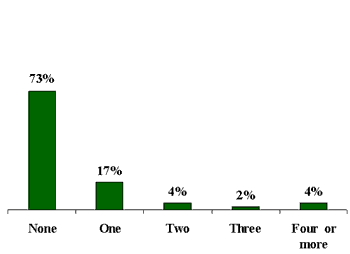
In fact, the results from a recent Gallup Poll allow us to estimate that about one-quarter of the population visits an ER in a given year. The data show that 27% of American adults 18 years of age and above say they have been to a hospital emergency room within the last year, including 10% who have been there at least twice:
| Using your best estimate, in total, how many times have you been treated at a hospital emergency room in the last 12 months? |
 |
| Jun. 27-29, 2003 |
Although government statistics suggest a slight increase in the overall use of ERs (by about 8% over the last decade, on a per capita basis), a review of the available survey data over the last 12 years does not indicate a substantial increase in the percentage of Americans who use the ER in a given year. As can be seen below, the estimate that a quarter of Americans use the emergency room on an annual basis has held true over the last decade. In fact, a 1991 estimate of ER use that employed question wording identical to that of the current survey shows remarkably similar results across this 12-year span:
Using your best estimate, in total, how many times have you been treated at a hospital emergency room in the last twelve months?
|
2003 Jun 27-29 |
1991 June |
|
|
% |
% |
|
|
None |
73 |
75 |
|
One |
17 |
15 |
|
Two |
4 |
5 |
|
Three or more |
6 |
4 |
|
No opinion |
* |
1 |
|
* Less than 0.5% |
||
Why and Who
Medical professionals and others concerned with healthcare coverage and healthcare access are interested in exactly who is using the emergency room and why they are using it.
We can help answer these questions by looking at the reported use of the ER within a number of different demographic groups in the U.S. population:
Using your best estimate, in total, how many times have you been treated at a hospital emergency room in the last twelve months?
|
At least once in last 12 months |
|
|
% |
|
|
45 |
Under $20K |
|
34 |
Rural |
|
34 |
Female 18-49 |
|
32 |
18-29 yrs. old |
|
32 |
HS or less |
|
32 |
Nonwhite |
|
31 |
West |
|
30 |
Urban |
|
29 |
30-49 yrs. |
|
29 |
$30K-$49.9K |
|
28 |
Female |
|
28 |
South |
|
27 |
National Average |
|
26 |
Midwest |
|
26 |
Some college |
|
25 |
Male |
|
25 |
White |
|
25 |
Male 18-49 |
|
25 |
Male 50+ |
|
24 |
65+ yrs. |
|
23 |
College grad only |
|
23 |
Total college |
|
21 |
Suburban |
|
21 |
$20K-$29.9K |
|
21 |
East |
|
20 |
50-64 yrs. |
|
19 |
Female 50+ |
|
19 |
$75K+ |
|
19 |
$50K-$74.9K |
|
16 |
Postgrad |
The data suggest that emergency room use is more prevalent among:
- Americans with lower socioeconomic status as defined by their income and education
- Those living in both urban and rural areas of the country (as opposed to the suburbs), and
- Younger Americans
Conversely, those who are least likely to have been in an emergency room include Americans with higher socioeconomic status (as defined by income and education), Americans 50-64 years of age, and those living in the suburbs.
Some of the discussion about healthcare access today has focused on the possibility that those with no other medical resources (i.e., those with no health insurance) may be increasingly turning to ERs as their primary source of routine medical care.
But the data from the recent Gallup Poll suggest that emergency room use among Americans who report having no health insurance at all (about 12% of those in the poll sample) is the same as the national average of 27%.
Those who say their health insurance coverage is through either Medicare or Medicaid (29% of the sample) are somewhat more likely than the rest of the sample to report having being treated in the emergency room in the year before the interview. Those with private medical insurance (59% of the sample) are slightly below the national average, with 22% saying they visited the emergency room.
Using your best estimate, in total, how many times have you been treated at a hospital emergency room in the last twelve months?
|
% At least once in the last 12 months |
|
|
National average |
27% |
|
Those with private insurance |
22 |
|
Those with Medicare/Medicaid |
36 |
|
Those with no health insurance coverage |
27 |
The poll followed up with those who had been to the emergency room and asked why they went to the emergency room rather than to a doctor's office or a clinic.
Perhaps not surprisingly, half said their medical problem was an emergency or the result of an accident. Another third said they needed medical attention after hours or when the doctor's office was closed. That left 6% who went because their doctor recommended it (many doctors' answering machines advise patients to go to the emergency room if they have doubts about their condition), 4% who said they went because it was easier or they could be seen more quickly, and 1% who did not have a doctor.
Think for a moment about your last visit to a hospital emergency room. What would you say was the main reason you sought treatment in the emergency room rather than going to a doctor's office or clinic? [OPEN-ENDED]
BASED ON -- 241 -- ADULTS WHO HAVE GONE TO A HOSPITAL EMERGENCY ROOM IN THE PAST TWELVE MONTHS
|
2003 Jun 27-29 |
|
|
Emergency or accident |
50% |
|
Office closed/after hours |
31 |
|
Doctor recommended |
6 |
|
Easier/faster to get seen |
4 |
|
Do not have a doctor |
1 |
|
Other |
6 |
|
No opinion |
2 |
The data show that most ER users believe they have an acute or emergency reason for using the ER, and certainly don't suggest that ER users are going to the emergency room for their routine medical care.
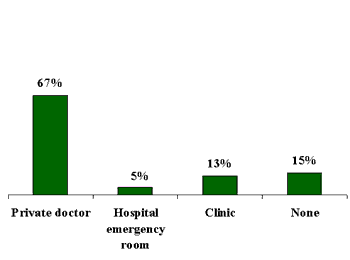
In fact, only 5% of Americans say that their usual practice when they are sick is to go to the emergency room. Most say they see a private doctor or go to a clinic, or they don't go to any of the above.
| When you're sick, do you usually see a private doctor, do you use a hospital emergency room, do you go to a clinic, or do you tend to do none of these? |
 |
| Jun. 27-29, 2003 |
This same question has been asked twice by the CBS News/New York Times poll since 1991, and the current data are very close to the results found in those two polls. In short, there is little evidence on this broad scale that routine use of an ER as the primary source of basic healthcare is expanding to a great degree:
When you're sick, do you usually see a private doctor, do you use a hospital emergency room, do you go to a clinic, or do you tend to do none of these? Is that a clinic or a doctor's office?
Trend for Comparison: (Source: CBS News/New York Times Poll)
|
|
Hospital emergency room |
|
|
|
|
|
1997 May 19-22 |
69% |
7 |
18 |
5 |
1 |
|
1991 Aug 18-22 |
69% |
6 |
13 |
10 |
2 |
Survey Methods
These results are based on telephone interviews with a randomly selected national sample of 1,003 adults, 18 years and older, conducted June 27-29, 2003. For results based on this sample, one can say with 95 percent confidence that the maximum error attributable to sampling and other random effects is ±3 percentage points. In addition to sampling error, question wording and practical difficulties in conducting surveys can introduce error or bias into the findings of public opinion polls.
Turning now to your health,
When you're sick, do you usually see a private doctor, do you use a hospital emergency room, do you go to a clinic, or do you tend to do none of these? Is that a clinic or a doctor's office?
|
|
Hospital emergency room |
|
|
|
|
|
2003 Jun 27-29 |
67% |
5 |
13 |
15 |
* |
Trends For Comparison: (Source: CBS News/New York Times Poll)
|
|
Hospital emergency room |
|
|
|
|
|
1997 May 19-22 |
69% |
7 |
18 |
5 |
1 |
|
1991 Aug 18-22 |
69% |
6 |
13 |
10 |
2 |
|
* Less than 0.5% |
|||||
Using your best estimate, in total, how many times have you been treated at a hospital emergency room in the last twelve months?
|
2003 Jun 27-29 |
|
|
None |
73 |
|
One |
17 |
|
Two |
4 |
|
Three |
2 |
|
Four or more |
4 |
|
No opinion |
* |
|
* Less than 0.5% |
|
Think for a moment about your last visit to a hospital emergency room. What would you say was the main reason you sought treatment in the emergency room rather than going to a doctor's office or clinic? [OPEN-ENDED]
BASED ON -- 241 -- ADULTS WHO HAVE GONE TO A HOSPITAL EMERGENCY ROOM IN THE PAST TWELVE MONTHS
|
2003 Jun 27-29 |
|
|
Emergency or accident |
50% |
|
Office closed/after hours |
31 |
|
Doctor recommended |
6 |
|
Easier/faster to get seen |
4 |
|
Do not have a doctor |
1 |
|
Other |
6 |
|
No opinion |
2 |
Do you currently have medical coverage through Medicare or [Medicaid/Medi-Cal]?
Do you currently have medical coverage through some other form of health insurance?
COMBINED RESPONSES
|
Private |
Medicare/ Medicaid |
No |
No |
|
|
2003 Jun 27-29 |
59% |
29 |
12 |
* |
|
2002 Nov 11-14 |
61% |
27 |
12 |
-- |
|
2001 Nov 8-11 |
62% |
26 |
11 |
1 |
|
* Less than 0.5% |
||||
