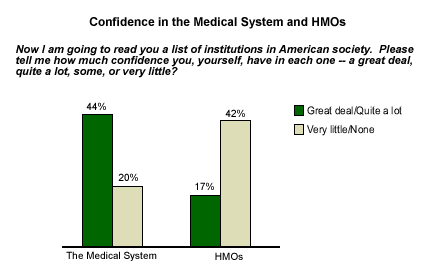
HMO executives may, at times, wonder how it came to this. Their health maintenance organizations currently rank dead last on a Gallup confidence-level list of 15 institutions. Americans are more likely to say they have confidence in "big business" (22%) than in HMOs (17%) -- which is saying a great deal, considering last year's corporate scandal epidemic (even last year, in the midst of the corporate scandals, HMOs ranked below big business).
That's all the more ironic given that managed care enjoyed spectacular growth in the 1980s as a prospective means of "curing" America's ailing fee-for-service health system. Under that system, healthcare providers priced each of their services and billed based on the units of work they did -- the more services one used, the more money one paid. Insurance companies' biggest costs came from services rendered at the most expensive places (hospitals), and as their costs grew, so did their premiums. Finally, the system emphasized fixing health problems (restorative care) rather than preventing them (preventative health maintenance, or wellness).
The strict fee-for-service system invited huge and unnecessary expenses, and it didn't do much to help people stay healthy. The most logical solution seemed to be the development of a system that promoted preventative care so that costly restorative care could be avoided. The ideal system also promoted cost control, encouraging people to seek care in the least expensive setting by covering the costs of outpatient and physician office care. For the sake of efficient care, the system reimbursed with a fixed fee, rather than with itemized payments for units of treatment. Thus, the healthcare maintenance organization (HMO) was conceived.
What Went Wrong?
But it didn't turn out as planned. June 2003 Gallup Poll results* indicate that confidence in HMOs is significantly lower than confidence in the medical system overall and could be dragging down Americans' confidence in the healthcare system as a whole. Women are the key healthcare decision-makers in most families -- and only 14% of them have either a great deal or quite a lot of confidence in HMOs.
How have HMOs lost the confidence of the American public? First, instead of controlling costs, HMOs seem to have lost control of them. According to a recent article in the American Medical News, healthcare expenditures increased 9.6% in 2002, an increase nearly four times the rate of the overall U.S. economy. Increasingly, costs are shifted to individuals through higher co-pays and deductibles. Even so, health insurance premiums have increased 15% in 2003.
Second, the shift to all-inclusive coverage and preventative care -- the original vision of HMOs -- has failed to materialize. Many people still lack prescription drug coverage, and preventative programs, such as exercise training, are not covered by most HMOs.
Finally, the HMO dream of reducing inefficiency and encouraging healthier lifestyles to control costs has not been realized. Accessing HMO care is anything but efficient. It has become a bureaucratic jungle of approvals and denials. Services are rationed based on institutionally defined, and sometimes irrational, criteria. Treatment for a life-threatening illness or injury may be approved, but getting relief for excruciating (but not life-threatening) pain may be deemed an elective procedure and denied. Going to an emergency room with chest pains may not be covered if a diagnosis of a heart attack is not confirmed.
Bottom Line
In a healthcare system administered by the private sector (most HMOs are privately run), decisions about the prioritization and rationing of healthcare may be driven not by need or quality, but by profit. Despite these concerns, much of the healthcare legislation now in Congress proposes to increase private-sector HMO participation.
Aggregated healthcare data from 2000-2002** indicate that 62% of Americans think it's the federal government's responsibility to ensure that all Americans have health coverage. Furthermore, results from a September 2000 poll reveal that three in four Americans thought the government should do more to regulate the costs of healthcare in this country -- still, Americans generally oppose a government-run healthcare system. But, given support for some government involvement in the healthcare system, achieving an appropriate balance between public- and private-sector involvement in meeting Americans' healthcare needs may help to increase public confidence in HMOs and the medical system in general.
*Results are based on telephone interviews with 1,029 national adults, aged 18 and older, conducted June 9-10, 2003. For results based on the total sample of national adults, one can say with 95% confidence that the margin of sampling error is ±3%.
**Results are based on an aggregate of telephone interviews with 2,006 American adults, aged 18 and older, conducted from 2000 through 2002. For results based on the total sample, one can say with 95% confidence that the maximum margin of sampling error is ±2.4%.