Are healthcare organizations making optimal use of the wealth of data available for improving physician office patient satisfaction? To the extent that results from individual patient satisfaction questions are being analyzed and applied piecemeal, the answer is no. To efficiently use data to improve physician office patient satisfaction, a coherent strategy for making sense of the results is needed -- that is, a framework must be built from the data.
Building a Framework: Identifying the Components
Using an investigative statistical technique to group results from Gallup's aggregated database of physician office surveys from 2002, we sought to identify patterns and relationships among satisfaction question items. The resulting groupings formed the following five core question areas:
- Wait time for care
- The physician
- Wait time communication
- Office staff
- Nursing/caring
A closer look at these areas and the relationships between them indicates that they fall fairly neatly into the hierarchy that Gallup has previously identified for patient loyalty within the inpatient, outpatient, and emergency departments of hospitals.
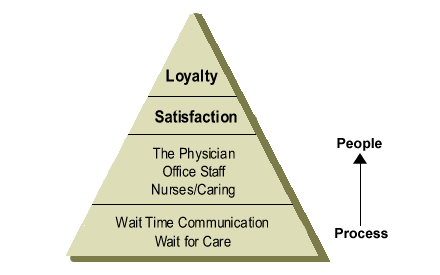
The lowest level of the hierarchy includes "process" issues, including the amount of time spent waiting for care and wait. Satisfaction items that fall into this process factor are related to the efficiency of office operations. Patients have the prior expectation that their physician's office will function efficiently; if that expectation is not met, frustration ensues. Process items are the types of questions Gallup has termed "dissatisfiers": positive results are a prerequisite for success, but they alone are not sufficient to build satisfaction and loyalty.
Satisfaction and loyalty can be achieved by developing emotional attachment with patients. Patients become emotionally attached to an office through contact with the people working there. This "people factor" includes question items in the areas of "the physician," "nursing/caring," and "office staff."
Building a Framework: Assembling the Pieces
Once patient satisfaction items have been grouped together as component "factors," it remains only to determine how patients tend to prioritize those components in assessing their office visit. To do so, we analyzed the results of individual question items to determine which are most predictive of overall patient satisfaction. Ranked in order of the degree to which the correlate with overall satisfaction, the question items are:
|
Question |
Component Area |
|
Physician care and compassion |
The physician |
|
Physician skill in providing care |
The physician |
|
Physician ability to explain things |
The physician |
|
Satisfaction with nurses and clinical staff |
Nursing/caring |
|
How quickly you were able to see someone |
Wait time for care |
|
How easy it is to schedule a routine appointment |
Wait time for care |
|
Kept informed about reasons for wait |
Wait time |
|
Satisfaction with clerical and business staff |
Office staff |
At least one question from each component "factor" identified in the prior analysis is significant in predicting patient satisfaction. However, two aspects emerge as most important: 1) items relating to the physician him or herself, and 2) items relating to patients' wait time.
Bottom Line
The factors that drive high patient satisfaction and loyalty scores in a physician office setting are somewhat similar to those driving such outcomes in the emergency department of a hospital. Quick contact with a caring, technically skilled physician is key; contact with other office staff members is less important. Such prioritization is crucial in developing a comprehensive strategy to improve physician office patient satisfaction, and maximizing the odds for success.