GALLUP NEWS SERVICE
According to the cancer research group of the World Health Organization, "Nonsmokers are exposed to the same carcinogens as active smokers. Even the typical levels of passive exposure have been shown to cause lung cancer among never smokers. Secondhand tobacco smoke IS carcinogenic to humans."
PRINCETON, NJ -- Although medical warnings about the risks of inhaling other people's smoke are a matter of record -- in fact, a 1986 U.S. Surgeon General's report declared that secondhand smoke can cause lung cancer in nonsmokers -- only half of Americans consider secondhand smoke to be "very harmful" to adults. This is far less than the percentage that believes smoking is very harmful to smokers themselves.
Still, public concern about the issue has increased over the past 10 years, as has public intolerance for smokers lighting up in restaurants and the workplace. Most Americans are against prohibiting smoking in all public places, although a third favor this. Only 16%, however, would make smoking totally illegal.
Gallup's Consumption Habits poll conducted each July provides an annual update of many issues related to smoking. The latest installment, conducted July 7-9, finds no change in the percentage of American adults who smoke compared to the last several years. One in four adults (25%) say they have smoked a cigarette in the past week. This includes 26% of men and 24% of women. The prevalence of smokers decreases with age, going from 34% among the 18- to 29-year-old age category to 27% among those 30-49, 24% among those 50-64, and just 13% among those 65 and older.
Barely Half View Secondary Smoke as "Very Harmful"
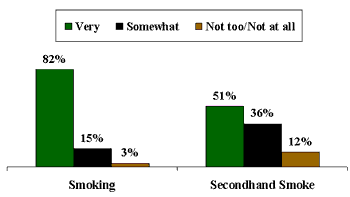
The vast majority of Americans consider both smoking and secondhand smoke to be harmful to some degree. But there is a large difference in the percentage saying each is "very harmful" as opposed to only "somewhat harmful." Fifty-one percent of Americans believe secondhand smoke is very harmful to adults. Another 36% rate it as "somewhat harmful," while 9% call it "not too harmful" and 3% say it is "not at all harmful." By comparison, 82% of Americans consider smoking very harmful to those who smoke, and another 15% call it somewhat harmful.
| How Harmful Is Each to Adults? |
 |
| Jul. 7-9, 2003 |
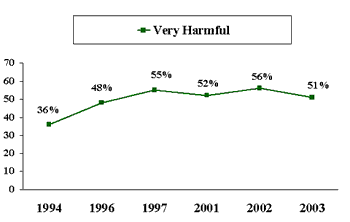
The Gallup Poll first asked Americans about the effects of secondhand smoke on adults in 1994. At that time only 36% felt it was very harmful, while another 42% said it was somewhat harmful. Public recognition of the risk of secondary smoke jumped over the next few years, with the percentage rating it very harmful rising from 36% in 1994 to 48% in 1996 and 55% in 1997. Since then, concern has leveled off in the low to mid 50s.
| Perceived Risk of Secondhand Smoke |
 |
Across this period, Gallup has observed a persistent difference in the views of men and women, and smokers and nonsmokers on this issue.
- In the latest poll, 62% of women, but only 38% of men, consider secondhand smoke to be very harmful to adults.
- The gap is even greater between smokers and nonsmokers: 58% of nonsmokers consider secondhand smoke very harmful, vs. only 28% of smokers.
Few Would Ban Smoking in Bars
Legislators in numerous cities across the country, as well as in California, Delaware, and New York state, have recently seen fit to institute sweeping bans on smoking in almost all restaurants and bars.
Gallup data suggest that most Americans do not embrace the campaign to make public establishments completely smoke free. When given the alternative of establishing special smoking areas in each location, less than a majority would ban smoking altogether in restaurants, the workplace, hotels, or bars.
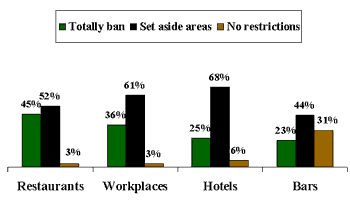
Support for stiff limits is highest for smoking in restaurants (45% favor a total ban and 52% favor areas that are set aside for smoking) and workplaces (36% favor a total ban). Only 25% favor a total ban in hotels, while two-thirds believe these should have special smoking areas.
The lowest support is seen for restrictions on smoking in bars; only 23% believe there should be a total ban in these establishments and just 44% favor special smoking areas. Nearly a third of the public, 31%, says there should be no restrictions on smoking in bars.
About half of smokers (52%) favor no restrictions in bars, but 24% of nonsmokers also favor this.
| Preference for Smoking in Each Location |
 |
| Jul. 7-9, 2003 |
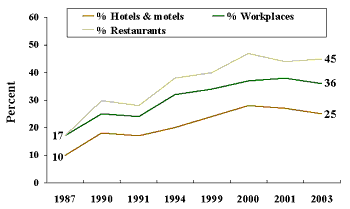
Americans' support for bans on smoking in public places -- especially in restaurants -- grew more widespread through the 1990s, but has leveled off since 2000. Even for restaurants, public support for a complete ban remains under 50%, while a majority favors making some accommodation for smokers in the form of special smoking sections, or having no restrictions at all on smoking.
| Support for Smoking Bans in Each Location |
 |
Tobacco Prohibition?
Very few Americans, just 16%, would put smoking on par with illicit drugs, making it totally illegal in the United States. Smokers and nonsmokers share this sentiment almost equally.
|
Should smoking in this country be made totally illegal, or not? July 7-9, 2003
|
||
|
Yes, made illegal |
No, not made illegal |
|
|
% |
% |
|
|
National adults |
16 |
84 |
|
Nonsmokers |
18 |
81 |
|
Smokers |
7 |
92 |
Americans' opposition to this is most likely based on the fact that the public sees smoking as a matter of personal responsibility. If smokers want to take the risk and consequences that come with their habit, the choice should be theirs. However, public opposition to such a law also speaks to the level of concern, or lack thereof, that people have about secondhand smoke. Unless or until Americans believe that smoking poses a very serious health risk to the nonsmoking public, and to the family and coworkers of smokers, Americans are likely to oppose a total prohibition on tobacco.
Several steps short of a complete ban on smoking would be a ban on smoking in all public places -- including public parks, city streets, and the little stretches of sidewalk in front of office buildings where workers are now compelled to go for their cigarette breaks. In fact, the World Health Organization has called for a worldwide ban on public smoking.
In spite of Americans' recognition that there is a health risk associated with secondhand smoke -- or perhaps because barely half consider it a very serious risk -- only 31% of the public favors making smoking in all public places totally illegal. Two-thirds (68%) oppose this.
Those who rate secondhand smoke as "very harmful" are about evenly divided over whether all public smoking should be illegal, but even a slight majority of this group (53%) opposes the idea. Overwhelming opposition to the proposal is found among those who consider secondhand smoke only somewhat harmful or not particularly harmful.
Although the views of smokers and nonsmokers about prohibiting smoking altogether are similar, their reactions to prohibiting smoking in all public places differ somewhat. Nearly four in 10 nonsmokers, but only 8% of smokers, would ban all public smoking.
|
Should smoking in all public places be made totally illegal, or not? July 7-9, 2003
|
||
|
Yes, made illegal |
No, not made illegal |
|
|
% |
% |
|
|
National adults |
31 |
68 |
|
Nonsmokers |
39 |
60 |
|
Smokers |
8 |
90 |
Survey Methods
These results are based on telephone interviews with a randomly selected national sample of 1,006 adults, 18 years and older, conducted July 7-9, 2003. For results based on this sample, one can say with 95 percent confidence that the maximum error attributable to sampling and other random effects is ±3 percentage points. In addition to sampling error, question wording and practical difficulties in conducting surveys can introduce error or bias into the findings of public opinion polls.
13. Have you, yourself, smoked any cigarettes in the past week?
|
Yes |
No |
|
|
% |
% |
|
|
2003 Jul 7-9 |
25 |
75 |
|
2002 Jul 9-11 |
24 |
76 |
|
2001 Jul 19-22 |
28 |
72 |
|
2000 Nov 13-15 |
25 |
75 |
|
1999 Sep 23-26 |
23 |
77 |
|
1998 Jun 22-23 |
28 |
72 |
|
1997 Sep 25-28 |
26 |
74 |
|
1997 Jun 26-29 |
26 |
74 |
|
1997 Jun 23-24 |
26 |
74 |
|
1997 May 6-7 |
25 |
75 |
|
1997 Mar 24-26 |
27 |
73 |
|
1996 May 9-12 |
27 |
73 |
|
1994 Jul 15-17 |
27 |
73 |
|
1994 Mar 11-13 |
27 |
73 |
|
1991 Nov 7-10 |
28 |
72 |
|
1990 Jul 6-8 |
27 |
73 |
|
1989 May 15-18 |
27 |
73 |
|
Yes |
No |
|
|
% |
% |
|
|
1989 Apr 4-9 |
29 |
71 |
|
1988 Jul 1-7 |
32 |
68 |
|
1987 Mar 14-18 |
30 |
70 |
|
1986 Jun 9-16 |
31 |
69 |
|
1985 Jun 7-10 |
35 |
65 |
|
1983 |
38 |
62 |
|
1981 Jun 26-29 |
35 |
65 |
|
1978 Jan 20-23 |
36 |
64 |
|
1977 Aug 19-22 |
38 |
62 |
|
1974 May 10-13 |
40 |
60 |
|
1972 Apr 21-24 |
43 |
57 |
|
1971 May 14-17 |
42 |
58 |
|
1969 Jul 24-29 |
40 |
60 |
|
1957 Jun |
42 |
58 |
|
1954 Jun |
45 |
55 |
|
1949 Oct |
44 |
56 |
|
1944 Nov |
41 |
59 |
19. In general, how harmful do you feel secondhand smoke is to adults -- very harmful, somewhat harmful, not too harmful, or not at all harmful?
|
|
Some- |
|
|
|
|
|
|
% |
% |
% |
% |
% |
% |
|
|
2003 Jul 7-9 |
51 |
36 |
9 |
3 |
* |
1 |
|
2002 Jul 9-11 |
56 |
31 |
7 |
4 |
* |
2 |
|
2001 Jul 19-22 |
52 |
33 |
9 |
5 |
* |
1 |
|
1997 Jun 26-29 |
55 |
29 |
9 |
5 |
* |
2 |
|
1996 May 9-12 |
48 |
36 |
9 |
5 |
* |
2 |
|
1994 Mar 11-13 |
36 |
42 |
12 |
6 |
1 |
3 |
|
(vol.) Volunteered response |
||||||
|
* Less than 0.5% |
||||||
20. In general, how harmful do you feel smoking is to adults who smoke -- very harmful, somewhat harmful, not too harmful, or not at all harmful?
|
|
Some-what harmful |
|
|
|
|
|
|
2003 Jul 7-9 |
82% |
15 |
2 |
1 |
* |
* |
|
2002 Jul 9-11 |
80% |
15 |
2 |
1 |
1 |
1 |
|
(vol.) Volunteered response |
||||||
|
* Less than 0.5% |
||||||
21. What is your opinion regarding smoking in public places? First, in [ITEMS A-C ROTATED, THEN ITEM D READ] -- should they SET ASIDE certain areas, should they totally BAN smoking, or should there be NO RESTRICTIONS on smoking? How about in … ?
A. Hotels & motels
|
Totally ban |
Set aside areas |
No restrictions |
No opinion |
|
|
% |
% |
% |
% |
|
|
2003 Jul 7-9 |
25 |
68 |
6 |
1 |
|
2001 Jul 19-22 |
27 |
66 |
6 |
1 |
|
2000 Nov 13-15 |
28 |
65 |
7 |
* |
|
1999 Sep 23-26 |
24 |
70 |
6 |
* |
|
1994 Mar 11-13 |
20 |
68 |
10 |
2 |
|
1991 Oct 24-27 |
17 |
70 |
12 |
1 |
|
1990 Jul 6-8 |
18 |
73 |
8 |
1 |
|
1987 Jun |
10 |
67 |
20 |
3 |
|
* Less than 0.5% |
||||
B. Workplaces
|
Totally ban |
Set aside areas |
No restrictions |
No opinion |
|
|
% |
% |
% |
% |
|
|
2003 Jul 7-9 |
36 |
61 |
3 |
* |
|
2001 Jul 19-22 |
38 |
58 |
3 |
1 |
|
2000 Nov 13-15 |
37 |
57 |
6 |
* |
|
1999 Sep 23-26 |
34 |
61 |
4 |
1 |
|
1994 Mar 11-13 |
32 |
63 |
4 |
1 |
|
1991 Oct 24-27 |
24 |
67 |
8 |
1 |
|
1990 Jul 6-8 |
25 |
69 |
5 |
1 |
|
1987 Jun |
17 |
70 |
11 |
2 |
|
* Less than 0.5% |
||||
C. Restaurants
|
Totally ban |
Set aside areas |
No restrictions |
No opinion |
|
|
% |
% |
% |
% |
|
|
2003 Jul 7-9 |
45 |
52 |
3 |
* |
|
2001 Jul 19-22 |
44 |
52 |
4 |
* |
|
2000 Nov 13-15 |
47 |
48 |
5 |
* |
|
1999 Sep 23-26 |
40 |
56 |
4 |
* |
|
1994 Mar 11-13 |
38 |
57 |
4 |
1 |
|
1991 Oct 24-27 |
28 |
66 |
5 |
1 |
|
1990 Jul 6-8 |
30 |
66 |
4 |
-- |
|
1987 Jun |
17 |
74 |
8 |
1 |
|
* Less than 0.5% |
||||
D. Bars
|
Totally ban |
Set aside areas |
No restrictions |
No opinion |
|
|
2003 Jul 7-9 |
23% |
44 |
31 |
2 |
23. Should smoking in this country be made totally illegal, or not?
BASED ON -- 509 -- NATIONAL ADULTS IN FORM A
|
Yes, made illegal |
No, not made illegal |
No opinion |
|
|
% |
% |
% |
|
|
2003 Jul 7-9 |
16 |
84 |
* |
|
2001 Jul 19-22 |
14 |
84 |
2 |
|
1994 Mar 11-13 |
11 |
86 |
3 |
|
1990 Nov Jul 6-8 |
14 |
84 |
2 |
|
* Less than 0.5% |
|||
24. Should smoking in all public places be made totally illegal, or not?
BASED ON -- 497 -- NATIONAL ADULTS IN FORM B
|
Yes, made illegal |
No, not made illegal |
No opinion |
|
|
2003 Jul 7-9 |
31% |
68 |
1 |
|
2001 Jul 19-22 |
39% |
60 |
1 |
