July 25 marked the 25th birthday of "test-tube baby" Louise Brown -- the English woman who was the first baby born after being conceived through in vitro fertilization. In vitro fertilization (IVF), a process in which an embryo is created outside a woman's body and then implanted in her uterus, is a relatively common procedure today among couples who have difficulty conceiving. Although couples using IVF still have only about a one in four chance of conceiving a child, more than 1 million such babies have been born worldwide over the past 25 years.
But IVF created much controversy in 1978, for both ideological and health reasons. Similar to some people's views about human cloning today, many felt that the IVF process was "unnatural." There was also debate in the health community as to whether a normal baby could be produced using IVF, because of the cell manipulation that occurs during the process.
In August 1978*, immediately after Brown's birth, Gallup asked Americans a series of questions about their views on IVF. Results indicate that, despite some vocal opposition to IVF and the media frenzy over Brown, public reaction to the decision her parents made was mostly favorable.
Awareness and Favorability of IVF
In the 1978 survey, Gallup asked Americans if they had "heard or read about the baby born in England from an egg fertilized outside her mother's body." The response reflects the extensive media coverage this event received at the time; the vast majority of Americans (93%) were aware of the story, and most were able to describe the IVF process in their own words with relative accuracy.
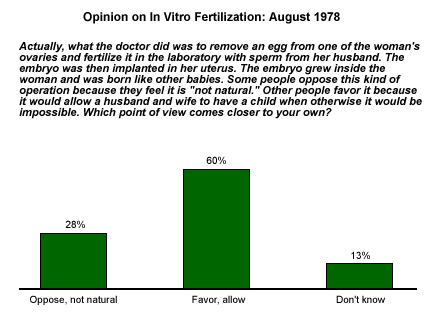
Respondents were then asked if they opposed the procedure because it was "not natural," or whether they favored it because it would make having a child possible for couples who would be otherwise unable to have one. Sixty percent of Americans said they favored IVF, while less than a third (28%) opposed it.
Willingness to Undergo IVF
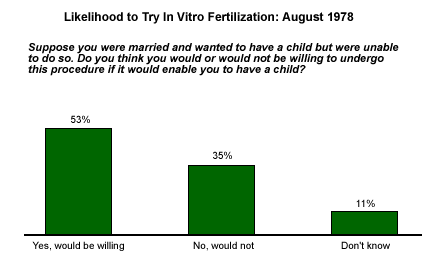
It is one thing to be generally in favor of a health procedure such as IVF, but quite another to be willing to try that procedure yourself. However, in August 1978, just days after the first "test-tube" baby was born, 53% of Americans said they would be willing to undergo IVF if they wanted a child and were unable to have one otherwise. Thirty-six percent said they would not have the procedure and 11% said they didn't know.
Bottom Line
In a July 28, 1978, Washington Post article, National Conference of Catholic Bishops then-general secretary Rev. Thomas C. Kelly commented about the IVF controversy, "The fact that science now has the ability to alter this [process] does not mean that, morally speaking, it has the right to do so."
While some Americans may have shared Thomas' opinion about IVF at that time, most did not. Not only did a majority of Americans favor the use of IVF in 1978, but a slight majority even said that they would use it themselves under the right circumstances.
*Results are based on telephone interviews with 2,684 national adults, aged 18 and older, conducted Aug. 4-7, 1978. For results based on the total sample of national adults, one can say with 95% confidence that the margin of sampling error is ±2 percentage points.