"Superman" star and stem cell research champion Christopher Reeve reportedly remarked during a visit to Israel last week that he stands a good chance to walk again if "politics and religion will not interfere with progress for a cure." Reeve, who was left paralyzed after a 1995 horseback riding accident, is right in his observation that politics and religion are entwined with the issue of stem cell research. Given proposed legislation and division observed among Americans in recent Gallup surveys on the issue, they are not likely to part ways soon.
Scientists have studied the potential medical uses of stem cells, which are simply "blank" cells that may become specialized cells, for decades. Currently, adult and umbilical stem cells are used to treat leukemia and some blood disorders. Scientists are hopeful that with continued research on adult and embryonic stem cells, they could be used to cure and treat Parkinson's disease, spinal cord injuries, strokes, diabetes, and a host of other disorders and diseases. However, where those cells come from is where the debate starts, and where politics and religion enter the picture.
Adult stem cells can be retrieved from "adult" tissue and umbilical cords, while embryonic cells are culled from leftover embryos created by in vitro fertilization, the organs of aborted fetuses, or cloned embryos. The use of embryos -- considered by some to be human life or potential human life -- is the most divisive aspect of this research.
After President George W. Bush's announcement in 2001 that the federal government would fund research only on stem cells that come from existing cell lines, and that no government money would assist research on stem cells from newly destroyed embryos, embryos created specifically for research purposes, or cloned embryos, Gallup began asking Americans for their views on the moral acceptability of this research.
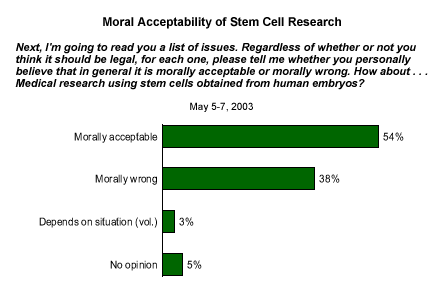
Over the past two years, a slim majority of Americans has found medical research using embryonic stem cells acceptable. In May 2003*, 54% of Americans said that this research was morally acceptable, while 38% said it was morally wrong. Real division among Americans, however, traces to differences in ideology, religiosity, and attitudes toward abortion. The results further reinforce the idea that the stem cell research debate is largely a religious one.
Religion and Ideology
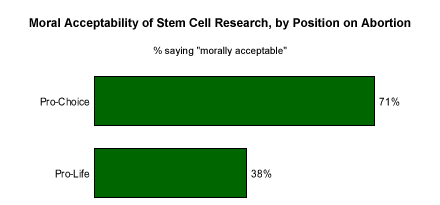
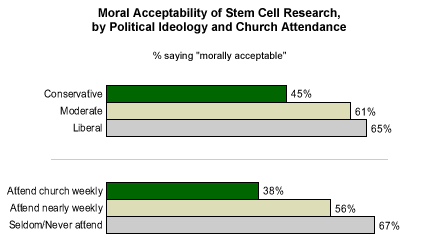
Americans who attend church weekly and those who identify with the pro-life position on abortion are the least likely to find medical research using embryonic stem cells morally acceptable. According to the May 2003 survey, 38% in each group said that this research was morally acceptable, while slightly more than half in each group said it was morally wrong. Those who attend church weekly are substantially less likely than those who attend church nearly weekly (56%) or seldom attend (67%) to feel it is morally acceptable. Seventy-one percent of those who identify with the pro-choice position said embryonic stem cell research is morally acceptable, versus 38% of pro-lifers.
Division on this issue is also apparent in Americans' ideological preferences, which are related to religiosity. Conservatives are considerably less likely than either moderates or liberals to feel that this research is morally acceptable. Forty-five percent of Americans who identify themselves as conservatives said it is morally acceptable, compared with 61% of moderates and 65% of liberals.
Although a Republican president placed limits on research funding, views on the moral acceptability of this research don't manifest partisan distinctions. Republicans, Democrats and independents don't vary much in their views. Roughly half of Americans who identify themselves with one of these three groups finds medical research with embryonic cells morally acceptable. In fact, the latest proposed legislation on stem cell research -- a bill on umbilical cords introduced July 24 -- was sponsored by both Republican and Democratic legislators.
Bottom Line
The U.S. stance on embryonic stem cell research may seem unreasonable to American scientists, but similar debates are developing elsewhere around the globe. Early last month, the European Commission proposed guidelines on embryonic stem cell research in EU countries, and opposition is expected from member countries where the practice is banned for moral or ethical reasons. As medical technology advances worldwide and the issue of stem cell research becomes more prominent, it could be an interesting barometer of religious and ideological mores in different countries.
*Results are based on telephone interviews with 1,005 national adults, aged 18 and older, conducted May 5-7, 2003. For results based on the total sample of national adults, one can say with 95% confidence that the margin of sampling error is ±3 percentage points.
