For a country in which separation of church and state is a founding principle, religious mentions are fairly omnipresent in the state. References to God appear on U.S. currency. President Bush talks openly about his faith and punctuates his speeches with "God Bless America."
Religion's presence in British and Canadian culture is somewhat subdued in comparison to the United States. Though Britain has an official church, public displays of faith like Bush's are discouraged -- its prime minister has been dissuaded from discussing his faith or referring to God in speeches. In Canada, religion is also more of a private matter, which Canadian historians attribute to the country's lack of a tradition of "civil religion" common to the United States.
Is the visibility of religion in one's culture related to people's attitudes about its importance, and, in turn, worship service attendance? Data from Gallup's recent survey of religious attitudes in Canada, Britain, and the United States* indicate that although the United States shares a border with Canada, and is a former British colony, American religious attitudes are worlds apart from the other two countries.
God? Save the Queen
When asked about the importance of religion in their own lives, 83% of Americans said it is either "very important" (60%) or "fairly important" (23%). Those numbers take a dive north of the border: 62% of Canadians said religion is very important (28%) or fairly important (34%) to them. In Great Britain, however, less than a majority -- 47% -- said that religion is important in their lives. Only 17% of Britons consider it very important, and 30% feel it is fairly important.
Why the differences in importance? Al Winseman, Gallup's Global Practice Leader for Faith Communities, points to the historical separation of church and state in the United States as a possible answer. "State-run religion [in Britain] has had the opposite effect of its intended effect -- it caused religion to die," Winseman said. "Separation [in the United States] helped it to flourish by creating a marketplace of faith. It has done far more for promoting religiosity in the United States within the culture."
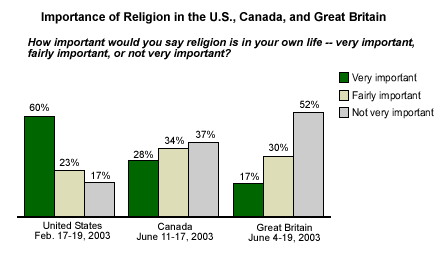
But while the differences in these overall measures are stark, some commonalities exist. In all three countries, women and people over the age of 65 were among the most likely to say religion is important in their lives. In the United States, 89% of women said that religion is important in their lives, and 68% of Canadian women and 56% of British women share this sentiment. Religion also plays an important role in the lives of older Americans (88%), Canadians (76%), and Britons (60%).
Open the Doors and See All the Americans
Although most Americans say that religion is important in their lives, that doesn't mean that all of them attend religious services. The same holds true with the other two countries. However, self-reported church attendance is still significantly higher in America than either Canada or Britain. Thirty-eight percent of Americans said they had attended a church or synagogue in the last week, and 26% of Canadians and 17% of Britons said they had attended a religious service at a place of worship in the last seven days. (The U.S. wording was slightly different from that used in the other countries, which could influence the results.)
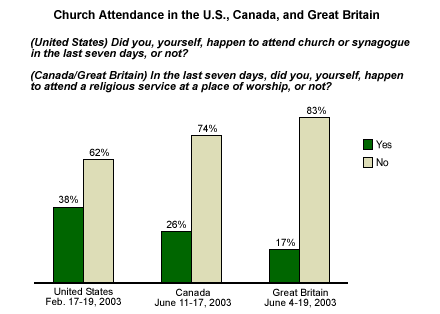
Worship service attendance in the United States has remained fairly constant since the 1950s, but it has dramatically declined in Canada. In 1955, 58% of Canadians said they had attended church or a synagogue in the past week. Since 1991, the percentage had been stable at 31%, before dropping to its current level of 26% (with a different question wording).
As with religious importance, age is a key factor in worship service attendance in the United States, Canada, and Britain. Differences between the percentages of men and women in each country who reported attending services are slight. The largest difference occurs between age categories, with attendance much higher among older people than among the young.
Bottom Line
Religion's importance in America, when compared to that in Britain and Canada, may reflect its role in each of these cultures. The declines in Britain and Canada may be a sign of gradual secularization, and may foretell where American religiosity could head in the future. However, Winseman said he isn't convinced that it will happen to Americans anytime soon and Gallup data don't indicate a hastening decline. "We are secular society with a spiritual culture," he said. "And that culture has a very spiritual core."
*Results in the United States are based on telephone interviews with 1,018 national adults, aged 18 and older, conducted April 7-9, 2003. For results based on the total sample of national adults, one can say with 95% confidence that the maximum margin of sampling error is ±3 percentage points.
Results in Canada are based telephone interviews with 1,001 national adults, aged 18 and older, conducted June 11-17, 2003. For results based on the total sample of national adults, one can say with 95% confidence that the maximum margin of sampling error is ±3 percentage points.
Results in Great Britain are based telephone interviews with 1,009 national adults, aged 18 and older, conducted June 4-19, 2003. For results based on the total sample of national adults, one can say with 95% confidence that the maximum margin of sampling error is ±5 percentage points.
Results for the Canada and Great Britain surveys may not equal 100% due to rounding error.
In addition to sampling error, question wording and practical difficulties in conducting surveys can introduce error or bias into the findings of public opinion polls.
