Two landmark studies published last week in the Journal of the American Medical Association demolish one of the canons in cardiology -- that half of all heart attacks result from genetics, as opposed to health-related risk factors. The new studies indicate that about 90% of people with severe heart disease have one or more of four classic risk factors: smoking, diabetes, high cholesterol, and high blood pressure.
It comes as no surprise to Americans that smoking is harmful to their health. According to Gallup's annual Consumption Habits survey*, 92% of Americans feel that smoking is at least a "somewhat serious" problem for society. However, just 21% rate smoking as an "extremely serious" problem (36% rate the problem as "very serious" and 35% feel it is "somewhat serious"). Do Americans realize the true enormity of the problems caused by smoking, and the devastating cost consequences they will continue to experience with the rising expense of smokers' healthcare?
The Burden of Tobacco Use
Cigarette smoking has proven to be a great economic boon to the companies that produce tobacco products, but this financial success comes into direct conflict with the vast costs of smoking.
Although smoking has slowly but steadily declined in the last 20 years, an estimated 46.5 million adults in the United States smoke cigarettes, according to the U.S. Centers for Disease Control and Prevention (CDC). Cigarette smoking causes death or disability for half of all regular users, and it is responsible for more than 440,000 deaths each year (one in every five deaths).
In addition to the enormous personal, social, and emotional toll of tobacco-related diseases, there is the economic burden of tobacco use. According to the CDC, tobacco use costs more than $75 billion in medical expenditures and another $80 billion in indirect costs resulting from lost productivity.
Because rates of smoking are highest among people living in poverty, the negative health effects of tobacco use are of major concern for state Medicaid programs. Medicaid recipients have approximately 50% greater smoking prevalence than the overall U.S. population. Fourteen percent of all Medicaid expenditures are related to smoking.
Where Does Culpability Lie?
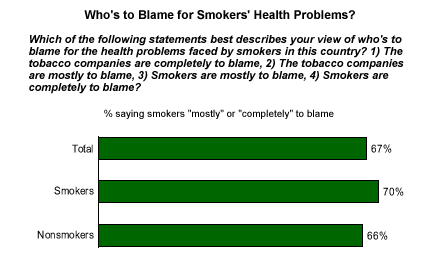
When asked to reflect on who is to blame for smokers' health problems -- the smokers themselves or tobacco companies -- 67% of Americans think smokers are completely (37%) or mostly (30%) to blame. When you separate the responses between smokers and nonsmokers, 40% of smokers accept most of the blame and 30% say they are completely to blame for the healthcare problems their smoking produces. Interestingly, nonsmokers are no more likely than the smokers themselves to blame smokers for their health problems. Thirty-six percent of nonsmokers characterize smokers as mostly to blame for their own health problems, and 30% say they are completely to blame.
Nearly two-thirds (65%) of Americans believe it is reasonable to set higher insurance rates for people who smoke. A full three-fourths of nonsmokers believe it is justified to set higher rates for smokers, but only slightly more than a third (36%) of smokers agree.
Bottom Line
The cigarette advertising influence notwithstanding, most Americans (smokers and nonsmokers alike) don't see smokers as unwitting victims of the tobacco companies. But although most Americans blame smokers for their own healthcare problems, they may not realize the full financial impact that smoking is having (and will continue to have) on all Americans -- both smokers and nonsmokers.
It will be interesting to see how the views of nonsmoking Americans change as smoking-related healthcare expenditures grow, and they begin to recognize the costs incurred from being part of the same risk pool as smokers.
*Results are based on telephone interviews with 1,006 national adults, aged 18 and older, conducted July 7-9, 2003. For results based on the total sample of national adults, one can say with 95% confidence that the margin of sampling error is ±3 percentage points.
For results based on the sample of 219 smokers, the maximum margin of sampling error is ±7 percentage points.
For results based on the sample of 787 nonsmokers, the maximum margin of sampling error is ±4 percentage points.