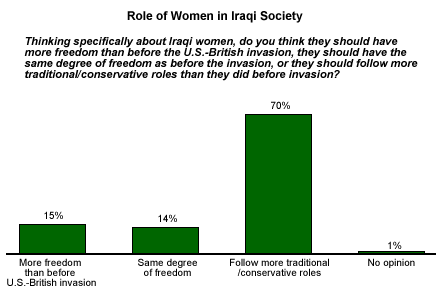
It may shock women's rights advocates to learn that the large majority of Baghdad residents (70%) say that in the future, women should follow more traditional/conservative roles than they did before the invasion -- a sentiment echoed nearly equally by both men (72%) and women (67%). The remaining Baghdad residents are split between favoring more freedom for women (15%) and favoring the same degree of freedom for women (14%).
In comparison to some other Middle Eastern countries, the status of women in Iraqi society was relatively liberal under Saddam Hussein. According to one Islamic scholar in the United States, the difference between women's roles in Saudi Arabia and Iraq is that in Saudi Arabia, the women cannot drive cars; in Iraq, they drive buses. The difference reflects the largely secular basis from which women's rights were determined under Hussein, as well as the pragmatic need for female labor in Iraq during the long Iran-Iraq War.
So what will become of women's rights in Iraq once the people of Iraq have the chance to craft their own system? The findings from a question in The Gallup Organization's landmark survey in the city of Baghdad* offer insight on this subject. This question was posed to respondents: Thinking specifically about Iraqi women, do you think they should have more freedom than before the U.S.-British invasion, they should have the same degree of freedom as before the invasion, or they should follow more traditional/conservative roles than they did before invasion?
Responses to this question are highly similar across various segments of the Baghdad population. Most women, as well as men, believe that women should adopt more traditional/conservative roles. Women are only slightly more likely than men to say that women should have more freedom (18% vs. 13%). Two-thirds or more of all age categories favor a more traditional role for Iraqi women.
Formal education is one factor that does seem to increase support for women's "freedom." The percentage saying women should have more freedom in the future rises from 11% among those with only an elementary education, to 26% among those who have attended a university. But even a majority of those with university-level education prefer a traditional role for women.

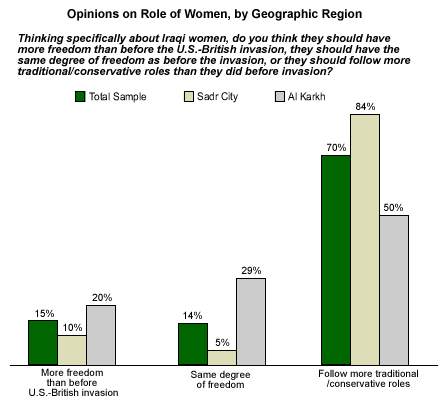
These educational differences on this question are reflected in the differences by geographical region within Baghdad. Support for maintaining or increasing women's freedom is greatest in Al Karkh -- the most secular and prosperous district in Baghdad, where the residents are more educated and also the least likely to think the invasion has made things better. By contrast, inhabitants of the predominantly poor and Shiite district of Sadr City are the least likely to favor continued or expanded freedom for women, with 84% saying they should follow more traditional roles.
Insights From Scholars of Islam and the Middle East
The status of women's rights under Hussein was somewhat mixed, but it is clear that educational and career opportunities for women were fairly advanced relative to regional norms. Do the Gallup findings on this question mean that Iraqis would actually like to reduce public roles for women, or do they mean merely that in a time of war and upheaval, the notion of "tradition" has particular resonance with the public?
More research will need to be done to say for sure. In the meantime, Gallup presented these data to several U.S. scholars with expertise on Islam and Iraq. The consensus was that these results do not necessarily reflect a rejection of civil rights for women by the public in Baghdad.
Yvonne Haddad, professor of history at the Center for Muslim-Christian Understanding at Georgetown University, believes that in the context of this question, the concept of freedom -- "hurriya" in Arabic -- may have been interpreted as personal licentiousness rather than political and economic freedom. This interpretation would conjure up American stereotypes of sexually loose and immodest women -- to which even the most progressive Iraqi female intellectuals might object on cultural and religious grounds. On this basis, Haddad cautions against reading this result as a repudiation of women's rights.
Peter Sluglett, professor of Middle Eastern history at the University of Utah, believes that the status of women under Hussein was not nearly as advanced as many outsiders have assumed, given the widespread repression, but points out that Iraq does have a long tradition of advancement for women, dating back to the 1950s and 1960s when the Iraqi representative to the United Nations was a woman. For this, and a variety of other reasons, Sluglett does not believe that a majority of Iraqis would accept or want women's rights to be restricted.
"Saddam, unlike the Shah, could not so easily be denounced as anti-religious," Sluglett says, "although his overtures toward religion were not taken very seriously." He notes that reactionary forces will have less opportunity to take hold in Iraq than they did in Iran; there is no sense of over-modernization having taken place, and also no sense of the country having sold out to the West.
Bottom Line
The new Gallup data reveal the importance of language in determining Iraqi opinion on the issue of women's rights. If the debate is waged as a battle between "freedom" and a return to traditional Islamic values, tradition is likely to prevail. But if a future program of civil rights for women in Iraq can be separated from the social culture of the West, presented as part of the unique historical culture of Iraq, and somehow defined as not entirely incompatible with Islamic values, then it may become a reality.
