Scanning the AM radio dial and tuning in to any one of a number of politically oriented national radio talk shows, one might get the impression -- from hosts and callers alike -- that "activist" judges and "radical" civil rights organizations are steering the country toward godlessness. But how prevalent is that perspective among the general public? That is, do most Americans really think that the aim of most religion-related lawsuits is to promote a godless society?
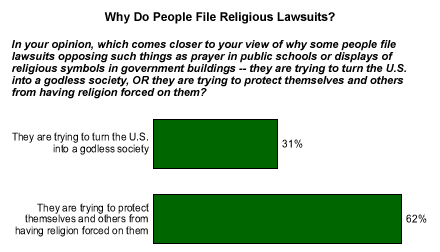
Recent Gallup Poll results suggest that they don't. In September*, Gallup asked respondents, "In your opinion, which comes closer to your view of why some people file lawsuits opposing such things as prayer in public schools or displays of religious symbols in government buildings -- a) they are trying to turn the United States into a godless society; or b) they are trying to protect themselves and others from having religion forced on them?" Americans are twice as likely to think that those who file lawsuits are trying to protect themselves (62%) as they are to think that people filing lawsuits are trying to create a godless society (31%).
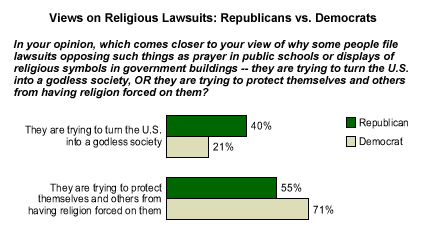
When broken down into demographic groups, the preference for "self-protection" remains fairly consistent. Even in the South, where the controversy over the Ten Commandments monument in Alabama's state judicial building hit closest to home, a majority of Southerners (55%) say they think the people filing such lawsuits are trying to protect themselves. Three groups appear to have some ambivalence about the issue: Rural Americans, ideological conservatives, and weekly churchgoers are fairly evenly split in their responses to this question. Both Republicans and Democrats agree that lawsuits are for protection, although Republicans are about twice as likely to say they believe that these efforts are intended to turn the United States into a godless society.
Opinions differ considerably by age. Older Americans, those aged 65 and older, are about evenly divided in their views of whether the lawsuits are brought about to protect the plaintiffs (45%) or create a godless society (41%). But the younger they are, the more Americans are likely to believe the lawsuits are done to protect the filers from making religious observances they do not want to -- 57% of 50- to 64-year-olds hold this view, as do 65% of 30- to 49-year-olds and 75% of 18- to 29-year-olds.
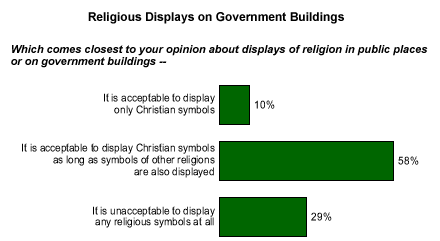
With regard to a related issue, Americans were asked, "Which comes closest to your opinion about displays of religion in public places or government buildings -- a) It is acceptable to display only Christian symbols; b) It is acceptable to display Christian symbols as long as symbols of other religious traditions are also displayed; or c) It is unacceptable to display any religious symbols at all?" A resounding 87% of Americans responded with either the second or third option -- that more than just Christian symbols should be displayed or no symbols should be displayed at all. The majority (58%) said that it is OK to display religious symbols as long as they are not confined to Christian symbols.
Bottom Line
Most Americans (more than 6 in 10) have a sympathetic attitude toward those who bring lawsuits with the intent to keep religion out of government. They also, perhaps indirectly, believe that the majority should protect the rights of the minority -- a basic principle of democracy. However, a sizable percentage of Americans (3 in 10) are much more distrusting of those who file lawsuits, a reality that could lead to increased resentment and hostility toward religious minority groups who seek to protect their rights.
Though Americans deeply believe that religion plays an important part in public life, they are not quite sure what role that should be or how it should be reflected in public policy. One point of consensus may serve as a touchstone in this complex debate: Americans firmly believe that the government should not even appear to promote one religion over another, and that all should have equal protection.
*Results are based on telephone interviews with 1,003 national adults, aged 18 and older, conducted Sept. 19-21, 2003. For results based on the total sample of national adults, one can say with 95% confidence that the margin of sampling error is ±3 percentage points.
