Lee Boyd Malvo was 17 when he and John Allen Muhammad, then 41, were arrested at a Maryland rest area on suspicion of carrying out the sniper-style shootings in the Washington, D.C., area last fall. Now 18, Malvo is on trial in Virginia, where he could face the death penalty if convicted.
The possibility of a death sentence for Malvo, considered a juvenile at the time of the shootings, has renewed the debate between advocates and opponents of death penalty sentences for juveniles who kill. While a recent Gallup Poll* indicates that most Americans feel that juveniles who commit violent crimes should be treated the same as adults, other polling suggests they draw the line when it comes to sentencing juveniles to death.
According to National Center for Juvenile Justice statistics, in 2000, an estimated 270,000 cases involved 14- to 17-year-old teens who were charged with violent crimes, which typically include murder, rape, robbery, and assault. Of those 270,000, less than 1% (1,855) were waived to criminal court. Most Americans probably wouldn't mind seeing that percentage increased. In October, Gallup asked Americans how juveniles between the ages of 14 and 17 who commit violent crimes should be treated in the criminal justice system. A majority, 59%, said they should be treated the same as adults, while 32% said they should be given more lenient treatment in juvenile court.
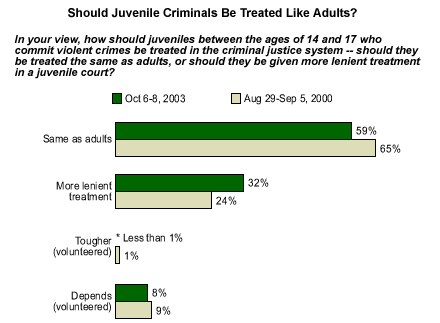
When Gallup first asked this question in 2000, Americans were somewhat less likely to favor lenient treatment for juveniles. At that time, just 24% said juveniles should be given more lenient treatment, while 65% said they should be treated the same as adults.
The current data show that Americans' preference to see young, violent offenders treated as adults in the criminal justice system crosses demographic categories, with a few exceptions. For example, responses vary greatly by respondents' level of education. Among those with a high school education or less, more than two in three (68%) said juveniles should be treated the same as adults. The percentage in favor of similar treatment for juvenile offenders declines to 61% among those with some college education and 51% of those with a four-year degree. Among those with a postgraduate education, a plurality (49%) said that juveniles should be given more lenient treatment, while just 42% said they should be treated the same as adults.
Half of ideological liberals said juveniles should be given more lenient treatment in the criminal justice system, while 66% of conservatives took the opposing view and said that juveniles should be treated the same as adults.
Sentencing
Whether juveniles tend to receive harsher or longer sentences in adult court than they would in juvenile court is unknown, but in 22 states (including Virginia), juveniles may receive the harshest penalty of all -- the death penalty. According to the American Bar Association, as of Oct. 15, 2003, 74 inmates on death rows across the country were juveniles when they committed their crimes. Although most Americans are comfortable with treating juveniles who commit violent crimes as adults, they are not comfortable meting out death sentences to them. In May 2002, only 26% of Americans told Gallup they support the death penalty for juveniles, while 69% said they oppose it. Currently, 64% of Americans express support for the death penalty in general.
Bottom Line
To combat rising juvenile crime in the late 1980s and early 1990s, a majority of states and the District of Columbia enacted laws that made it easier for juveniles to be charged as adults, a trend that seems in line with current public opinion.
Has that strategy worked? So far the results appear to be mixed. Juvenile crime, including violent crime, has declined since hitting its peak in 1994. However, studies from a number of states such as Idaho, New Jersey, Florida, and Minnesota indicate that the juveniles who were transferred to an adult criminal court have higher recidivism than those who went through the juvenile courts. In Florida, the picture is even bleaker: Not only were juveniles prosecuted as adults in that state more likely to commit additional crimes, they were more likely to commit crimes that are more serious.
*Results are based on telephone interviews with 1,017 national adults, aged 18 and older, conducted Oct. 6-8, 2003. For results based on the total sample of national adults, one can say with 95% confidence that the margin of sampling error is ±3 percentage points.