In response to a rising death toll and increased attacks on American troops in Iraq, the U.S. military went back on the offensive last week. The goal is to curtail Iraqi insurgence as the country undergoes transition to a new government. To date, more than 420 American soldiers have been killed in Iraq -- 281 since President Bush declared an end to major combat in May.
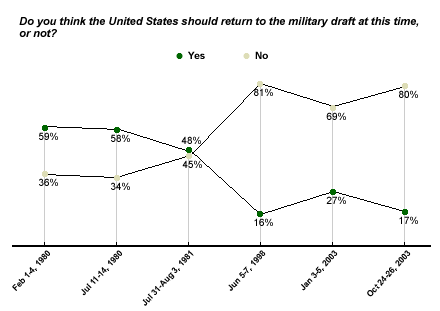
The possibility of a prolonged, guerrilla-style military conflict in Iraq, combined with the continued U.S. military efforts in the war on terrorism, are straining American military reserves -- and raising some speculation about the necessity of reinstating the military draft. However, a recent CNN/USA Today/Gallup poll* shows a vast majority (80%) feel the United States should not return to the military draft at this time. Just 17% say the United States should return to the draft.
The Trend in Context
Gallup has asked Americans this question several times over the last 20 years; the resulting trend data reveal several interesting points about support for the draft. First, it seems that support for the idea was stronger just prior to the current war with Iraq than it is now. The 17% of Americans who currently say that the United States should return to the military draft is a significant decrease from the 27% who felt this way in January 2003.
The most recent findings are closer to the results from the summer of 1998, when 16% of the population wanted to bring back the draft. The United States and Iraq were at odds even then over allowing U.N. weapons inspectors into Iraq.
In 1980, more than half of Americans (59%) thought a return of the draft was necessary, probably in response to the Soviet invasion of Afghanistan that prompted President Jimmy Carter to reinstate Selective Service registration that year.
Who's Most Likely to Support the Draft?
The idea of returning to the military draft is more likely to be supported by Americans over age 50 -- those most likely to remember the draft, but least likely to have to serve today. Twenty-five percent of Americans over the age of 50 support the draft. On the other hand, only 11% of 30- to 49-year-olds want to see the draft return, as do just 9% of 18- to 29-year-olds**, the age group most likely to be affected by a reinstitution of the draft.
*These results are based on telephone interviews with a randomly selected national sample of 1,006 adults, aged 18 and older, conducted Oct. 24-26, 2003. For results based on this sample, one can say with 95% confidence that the maximum error attributable to sampling and other random effects is ±3 percentage points. In addition to sampling error, question wording and practical difficulties in conducting surveys can introduce error or bias into the findings of public opinion polls.
**These results are based on telephone interviews with 421 national adults aged 18 to 29, conducted Oct. 24-27, 2003. For results based on the total sample of 18- to 29-year-olds, one can say with 95% confidence that the margin of sampling error is ±5 percentage points. These include 192 interviews with 18- to 29-year-olds done as part of random national samples Oct. 24-27, 2003, and 229 interviews with 18- to 29-year-olds conducted Oct. 24-27 who had previously participated in national Gallup Polls in 2003 and who agreed to be re-contacted by Gallup for future polls. The combined data from these samples are weighted to be demographically representative of the 18- to 29-year-old population in the United States.
