For many people, everything is better at home. The meals taste better. The beds are more comfortable. One grows accustomed to everyday surroundings, like the weather, and that familiarity provides comfort. Regardless of where they live, Americans tend to develop a sense of community pride, cheer for the home team, and embrace their hometown's imperfections.
This tendency illustrates a macrosociological effect, referred to as local proximity bias. It's an effect that is apparent when comparing public satisfaction with conditions at the national, state, and local levels. Gallup polling consistently shows that people tend to be more satisfied with circumstances in their local communities than they are with those in the country at large.
A Jan. 12-15 Gallup Poll* provides a broad example. Just under half of Americans (46%) say they are satisfied with the way things are going in the United States at this time, while 53% are dissatisfied. When asked about the way things are going in their states, the numbers are significantly more positive, with 53% saying they are satisfied and 45% dissatisfied. And when it comes to their local communities, the percentage saying they are satisfied jumps to roughly three-quarters (76%), while just 23% are dissatisfied with the way things are going locally.
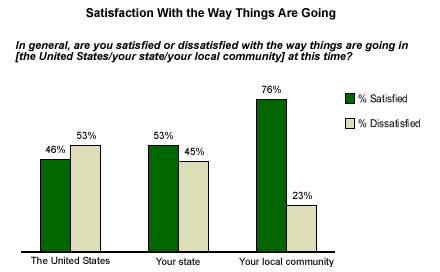
Incidentally, satisfaction with the way things are going in one's state has dropped 12 percentage points (from 65% to 53%) since Gallup last asked the question in January 2001. This decreased level of statewide satisfaction probably reflects the poor economic conditions of the last three years, and the well-publicized budget crises that are occurring in many states. However, the number of Americans saying they're satisfied with the way things are going in their local communities remains unchanged since that January 2001 poll, at 76%.
Satisfaction with the way things are going in the United States as a whole, a trend that Gallup measures on a monthly basis, has seesawed substantially during the tumultuous events of the past three years, but currently stands 10 percentage points lower than its January 2001 level of 56%.
Other Satisfaction Factors
Satisfaction with the way things are going in America varies according to demographic characteristics such as gender, age, and income, and those factors interact with the local proximity effect in different way.
Men are somewhat more likely than women to report being satisfied with the way things are going in this country -- 52% to 41%. The gender gap narrows with regard to satisfaction at the state level (56% for men, 50% for women) and essentially disappears when it comes to men's and women's satisfaction with the way things are going in their local communities.
Stereotypes about the optimism of youth and cynicism of older people may have some support in these data. Six in 10 Americans aged 18 to 29 say they are satisfied with the way things are going in the United States. Among those aged 65 and older, just a third (33%) are satisfied. The youngest age group is also significantly more satisfied than the oldest group with the way things are going in their states (64% compared with 49%), but the two groups are equally satisfied with the way things are going in their local communities.
Can money buy happiness? Maybe not, but the survey results do imply that higher incomes lead to higher levels of satisfaction with the way things are going in the United States. Among Americans in the highest income group ($75,000 or more), 62% report being satisfied. No other income group reports those levels of satisfaction. Those with household incomes of less than $20,000 are least satisfied at 32%. The income gap diminishes somewhat when looking at satisfaction with conditions at the state level, but reappears to some degree when respondents are asked about the way things are going in their local communities. Eighty-one percent of people in the highest income bracket are satisfied with their local communities, as are 63% of people in the lowest income bracket.
*Results are based on telephone interviews with 1,004 national adults, aged 18 and older, conducted Jan 12-15, 2004. For results based on the total sample of national adults, one can say with 95% confidence that the maximum margin of sampling error is ±3 percentage points.
