Despite the turbulence of war and ongoing economic struggles last year, it appears that faith communities continue to serve as a source of stability in many Americans' lives. Results from Gallup's third annual National Congregational Engagement Index* indicate that members of American faith communities are engaged in their own religious congregations at about the same level they were the previous year.
The new data, collected during October and November 2003, reveal that the percentage of "engaged" members of congregations (including all faiths) is at 28%, the same percentage as in 2002. The percentages of "not engaged" and "actively disengaged" members also remained relatively stable, and are currently at 56% and 16%, respectively.
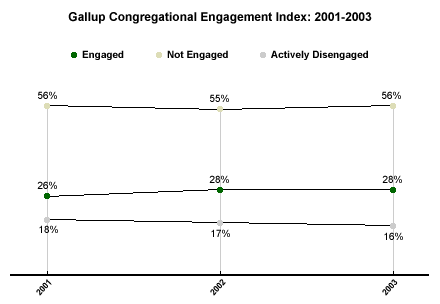
Gallup's congregational engagement survey measures the degree to which members of faith communities are actively involved in their congregations. Engaged congregation members are intensely loyal and have a strong psychological connection to their congregations. Those who are not engaged may attend services regularly, but they are not psychologically connected to their congregations. Actively disengaged members are unhappy with their congregations and insist on sharing that unhappiness with just about everyone.
Engagement levels are reflected in four of the most relevant outcomes of a congregation's spiritual health: inviting others to one's congregation, life satisfaction, community service, and financial contributions. Engaged congregation members are more likely to invite others to their congregations, be satisfied with their lives, serve their communities, and contribute financially. The new figures are quite similar to those from previous years, a testament to the stability and reliability of the survey instrument, methodology, and analysis.
- Engaged members are 1½ times more likely than those who are not engaged, and more than twice as likely as those who are actively disengaged, to "strongly agree" that they are satisfied with their lives.
- Engaged members are more than twice as likely to have invited someone to visit their congregations in the past month than members who are not engaged, and about eight times as likely to have done so than actively disengaged members.
- Engaged members spend a median of three hours per week taking part in community service. For members who are not engaged, the median number of hours per week is two; among actively disengaged members, the median is one.
- While overall giving is down slightly this year (perhaps because of the tough economic times), the giving trends remain the same. Engaged members give 1½ times as much money to their congregations as those who are not engaged, and more than three times as much as those who are actively disengaged.
Bottom Line
In a time of rapid social change and political polarization, it's comforting to know Americans' levels of religious engagement are remarkably stable. Engagement, however, doesn't imply complacency: Engaged members of congregations are the lifeblood of their communities' volunteer networks. The security provided by their congregations empowers members to reach beyond their comfort zones and help those in need.
*Results are based on telephone interviews with 1,000 adult members of a church, synagogue, or other religious faith community, aged 18 and older, and 500 nonmembers, conducted in October and November 2003. For results based on this sample, one can say with 95% confidence that the margin of sampling error is ±2.6 percentage points.
