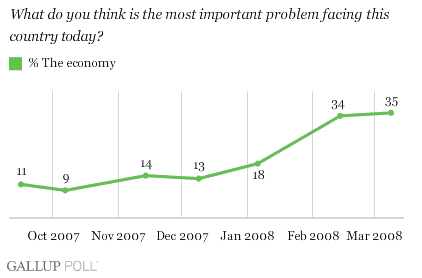
PRINCETON, NJ -- In March, the percentage of Americans mentioning the economy as the most important problem facing the country almost doubled the January mentions.
Consumer Is Being Squeezed
Increasing food and energy prices, falling housing prices, declining job growth, and financial market chaos have created an extremely negative consumer psychology. As a result, it is not surprising that in Gallup's March 6-9 poll, 35% of Americans, when asked (without prompting) to name the most important problem facing the nation, simply said "the economy" -- matching the high level of February (34%) but nearly double the January level. Nor is it surprising that, all told, 55% of Americans -- up from 49% in February -- now mention some aspect of the economy, such as fuel and oil prices, unemployment, and the high cost of living. As recently as last October, only 22% of Americans mentioned some aspect of the economy as the most important problem.
Instead, the surprise may be that an even higher percentage of Americans aren't pointing to the economy right now. Indeed, a review of Gallup's historical records shows that as recently as 1993, two-thirds of Americans mentioned some aspect of the economy as the nation's top problem. Gallup's daily economic measures now show 86% of Americans saying current economic conditions are getting worse, with 40% rating the economy as poor -- both of these are historically high numbers. Similarly, Thursday morning's consumer spending report showed a sharper drop in consumer purchases last month than was generally expected. Thus, it is possible that mentions of the economy as the nation's top problem will increase even further.
Non-Economic Problems
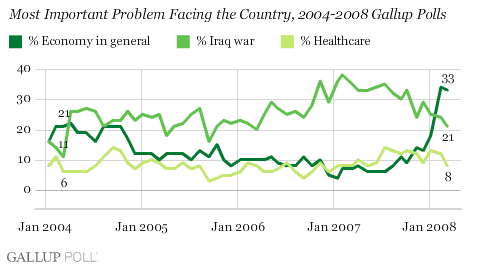
As mentions of some aspect of the economy as the most important problem have increased, the percentage pointing to non-economic issues has declined. For example, the percentage of Americans saying poor healthcare is the most important problem fell to 8% in March from 12% in February and 13% in January. Similarly, the percentage pointing to illegal immigration fell to 6% in March from 9% in February and 11% in January.
While the percentage of Americans pointing to the Iraq war as the most important problem has also declined, the decline has been proportionally more modest than in other areas: mentions were at 25% in January and 24% in February before declining to 21% in March.
Financial Turmoil
While Gallup's polling reflects the latest in consumer economic perceptions, the current economic turmoil in the financial markets has most likely not been fully reflected in recent poll results. The Federal Reserve's action earlier this week to make liquidity more available to financial institutions and, in particular, to investment banks was initially cheered as the stock market rallied, but that initial enthusiasm has quickly dissipated.
Now, the most notable financial issues are probably the historically low level of the U.S. dollar, surging oil and commodity prices, and the turmoil in the financial markets. The full impact of these somewhat complex financial issues on the average American may take some time to be fully realized. At the same time, the ability of monetary authorities and the Treasury to ameliorate their impact on the average consumer is essentially unknown. Gallup's daily polling in the days and weeks ahead will allow for the measurement, monitoring, and reporting of this fallout on the consumer as it unfolds.
Survey Methods
Results are based on telephone interviews with 1,012 national adults, aged 18 and older, conducted March 6-9, 2008. For results based on the total sample of national adults, one can say with 95% confidence that the maximum margin of sampling error is ±3 percentage points.
Interviews are conducted with respondents on land-line telephones (for respondents with a land-line telephone) and cellular phones (for respondents who are cell-phone only).
In addition to sampling error, question wording and practical difficulties in conducting surveys can introduce error or bias into the findings of public opinion polls.