Self-assessment can be a tricky business at any age, but it is especially so for adolescents. Teens want to see themselves in the best possible light at school -- typically the main stage on which they succeed or falter with their peer groups and authority figures. But perceptions are not always grounded in reality.
A recent Gallup Youth Survey* asked respondents aged 13 to 17 to rate their own academic and school-related performance. A slight majority of teens (51%) consider themselves to be good at most school subjects and activities, and 44% say they are good at just a few. Only 4% of teens believe that there is nothing in school that they do well.
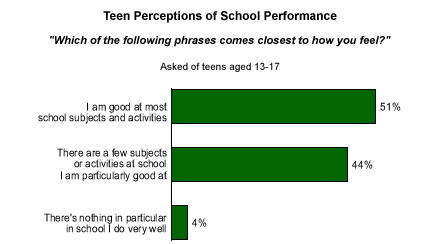
The finding that most teens are confident in their abilities in at least some school subjects is positive. However, thinking oneself "good" at something may be relatively subjective. Does being good mean that one meets or exceeds personal standards or academic standards? And, are either of those high enough?
The American Diploma Project released a report last week titled, Ready or Not: Creating a High School Diploma That Counts, that assessed the skills necessary for employment and college-level work. It found that a high school diploma is "little more than a certificate of attendance." For high school graduates who go directly to work after school, many employers say they lack basic skills necessary to do the job. The ADP report cites startling 2001 Public Agenda survey figures: More than 60% of college professors rate freshman and sophomore students’ abilities in grammar, spelling, writing, and basic math as "fair" or "poor."
Furthermore, according to National Center for Education Statistics figures, 28% of high school graduates must take remedial English or math courses immediately upon entering a two- or four-year college, and that at some point during their college years, 53% of students take at least one remedial English or math class.
Self-Ratings of School Performance Vary by Race
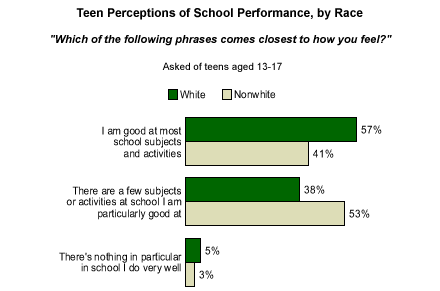
Gallup’s data show that in terms of classifying their academic performance, teenagers’ opinions vary significantly by race. White students are considerably more positive about their academic performance than nonwhite students are. Nearly three in five white teens, 57%, believe that they are good at most school subjects and activities, as do 41% of nonwhite students. A slight majority of nonwhite students, 53%, think there are a few subjects or activities at school that they are particularly good at.
Younger Teens More Confident Than Older Teens
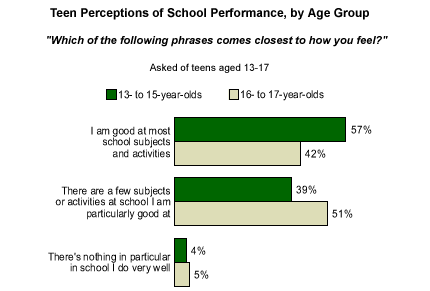
Teens between the ages of 13 and 15 are more likely than those slightly older to believe that they are good at most school subjects and activities. A majority of younger teens (57%) say they are good at most subjects and activities, compared with 42% of 16- and 17-year-olds. Older teens are inclined to give their performance a more modest rating, with 51% saying they are only good at a few school subjects or activities. One possible explanation why older teens may feel this way is that many older teens have more -- and often tougher -- academic courses available to them than younger teens do. With a broader range of courses, older teens may feel less confident than they did in earlier grades when they had fewer course options and less to master.
Bottom Line
Although it’s good news that 95% of teens feel they excel in at least a few subjects, the American Diploma Project study seems to suggest that even those who do well at most subjects may not be adequately prepared for work or college upon graduation. In order to satisfy future employers and professors, the study recommends that high school students undertake and achieve proficiency in rigorous math courses, develop strong oral and written communication skills, and acquire analytical and research skills in the language arts curriculum.
*The Gallup Youth Survey is conducted via an Internet methodology provided by Knowledge Networks, using an online research panel that is designed to be representative of the entire U.S. population. The current questionnaire was completed by 517 respondents, aged 13 to 17, between Aug. 1 and Aug. 29, 2003. For results based on the total sample, one can say with 95% confidence that the maximum margin of sampling error is ±5 percentage points.