At a time when institutional and individual investors are often looking to emerging markets for higher returns and the declining dollar makes a compelling case for overseas investing, a new UBS/Gallup Index of Investor Optimism survey* asked U.S. investors for their opinions about foreign investments and currency markets.
While America led the global recovery in 2003, it was foreign equity markets such as India and Thailand that surprised investors by reporting stellar returns. The S&P 500 closed at 1111.92, posting a 22% return in 2003, and the Dow posted a not-too-shabby 17% gain for the year. But the Indian benchmark index -- the Sensex -- grew by an astonishing 82% in dollar terms during the same period.
Overall returns on core foreign funds have also been higher than their domestic counterparts, according to Morningstar, a mutual fund research firm. Morningstar reports that while the average domestic large-growth, large-blend, large-value mutual fund saw returns of 27% to 29% in 2003, the average foreign mutual funds in this category saw returns of 33% to 39%.
Investors Underweight Foreign Assets
At several points over the last few years, Gallup has asked investors to describe the extent of their foreign investments. Invariably, more than 60% of investors have reported that foreign investments make up less than 5% of their portfolios. In fact, in the most recent February 2004 survey, 67% of investors said they have less than 5% of their investment holdings in foreign assets. The trend over the last three years suggests that the number of investors with more than 5% of their portfolios in foreign investments has recently declined slightly.
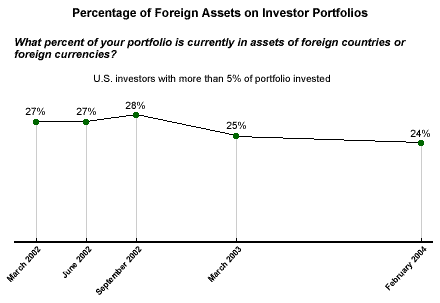
Despite the declining dollar and the enthusiasm in the media about overseas investing, Gallup data indicate that by and large, investors are hardly positioned to benefit from the returns that foreign markets may be poised to deliver. Standard & Poor recommends that investors allocate 15% of their portfolios to foreign equity. In contrast, the survey shows that foreign investments account for only 4.4% of the average investor's portfolio.
Bottom Line
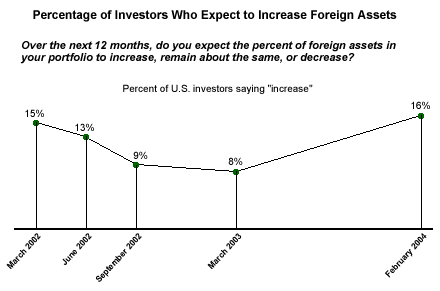
Investor portfolios may be underweight in foreign assets, but Gallup research also shows that the percentage of investors who are ready to increase their exposure to overseas investments over the next 12 months is on the rise. While the majority of investors (73%) say that they expect the percentage of foreign assets in their portfolios to remain the same, the percentage of investors who expect to increase their foreign investments in the next 12 months has doubled from 8% a year ago to 16% today.
It appears that financial advisers still have some work to do in helping investors jump on board the overseas investment bandwagon. But as investors recover their appetites for risk, foreign investment products could be the next big thing.
*Results for the total dataset are based on telephone interviews with 863 investors, aged 18 and older, conducted Feb. 1-15, 2004. For results based on the total sample of investors, one can say with 95% confidence that the margin of sampling error is ±4 percentage points.