WASHINGTON, D.C. -- In 10 of 14 former Soviet republics Gallup surveyed, residents' likelihood to say most or many people in their country are afraid to openly express their political views rose significantly between 2006 and 2007. In seven countries, the proportion responding this way now represents a majority.
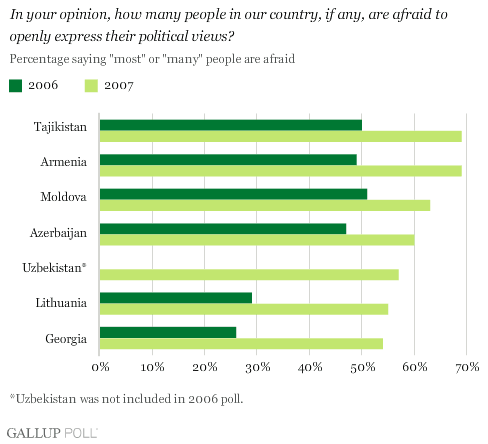
The most dramatic increases occurred in Georgia and Lithuania; in each country residents were about twice as likely in 2007 as they were in 2006 to say many or most of their fellow citizens are afraid to express their political views. But substantial increases were also seen in countries where this perception was already common. In Tajikistan and Armenia, for example, the figures rose from about half of residents to about 7 in 10.
The "opening up" of former Soviet republics has at its heart civil liberties such as freedom of speech. However, social norms in these transitional countries remain unsettled, and public perceptions can swing dramatically when leadership performances or political processes fail to match changing expectations. In several of the countries where freedom of expression ratings have dropped, it's possible to identify specific trends or events that reflect an ongoing climate of fear and intimidation.
- In Georgia, Mikhail Saakashvili was overwhelmingly elected president in 2004 following the peaceful "Rose Revolution" that ousted President Eduard Shevardnadze over charges of election fraud. Since 2006, however, concerns about Saakashvili's consolidation of power and repression of political opponents have grown, leaving many Georgians disillusioned. In 2007, just 14% said they were "very" or "somewhat" satisfied with the way democracy works in their country.
- Imomali Rahmon became president of Tajikistan in 1994, and he has gradually consolidated power and sidelined political opposition since then. In neighboring Kyrgyzstan, mass demonstrations took place in late 2006 by those seeking to limit presidential power; the Tajik government may have sought to curb free expression in Tajikistan to preclude a similar uprising there. In late 2006, Rahmon was overwhelmingly elected to a third term in office -- but he faced no serious challenger, and the vote did not meet OCSE (Organization for Security and Co-operation in Europe) standards. Following the election, Rahmon made personnel changes to increase the presence of officials from his home region in the government.
- During the Armenian presidential election last February, opposition candidate Levon Ter-Petrosian said President Robert Kocharian and Prime Minister Serzh Sarkisian had run an "institutionalized, mafia-style regime." After Sarkisian won the election in the first round, thousands of demonstrators protested the results as fraudulent, and clashes with police left eight people dead. The rancor reflects a deep mistrust of politicians among Armenians; in 2007, 92% said the wrongdoing and corruption of political leaders is a "very serious" (68%) or "rather serious" (24%) problem.
In several of the former Soviet republics where the perception that people are afraid to express themselves is less common, residents were nonetheless more likely to feel this way in 2007 than in 2006. However, these changes were generally less dramatic than the changes described in the previous paragraphs.
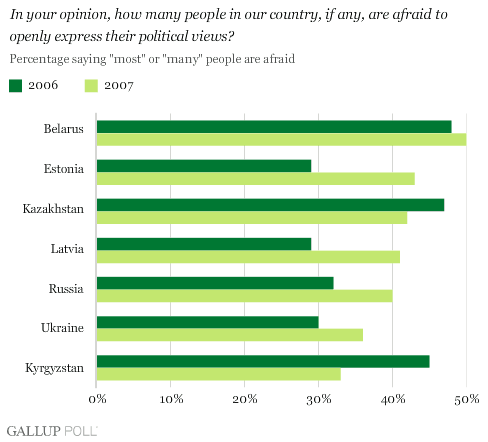
Kyrgyzstan was the only former Soviet state in which fewer residents said many or most people are afraid to express their political opinions in 2007 (33%) than in 2006 (45%). In that country, mass demonstrations in January and April 2007 played a pivotal role in triggering political reform. In both instances, the president was compelled to agree on constitutional compromises that ceded more power to parliament. Respondents in Kyrgyzstan are also far more likely than those in most former Soviet republics to say they are satisfied with the way democracy works in their country.
Survey Methods
Results are based on face-to-face interviews conducted in 2006 and 2007 with approximately 1,000 residents, aged 15 or older, in each country. (Uzbekistan was not included in the 2006 poll.) For results based on samples of this size, one can say with 95% confidence that the maximum margin of sampling error is ±3 percentage points. In addition to sampling error, question wording and practical difficulties in conducting surveys can introduce error or bias into the findings of public opinion polls.