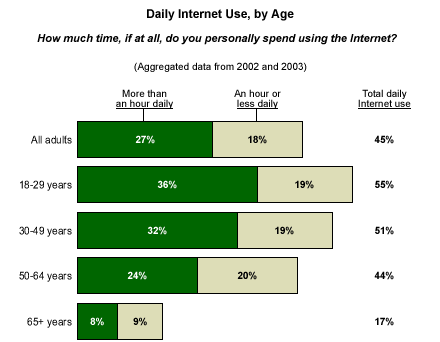
The Internet has become incredibly pervasive in many aspects of Americans' lives over the last decade -- aggregated Gallup data collected in 2002 and 2003* indicate that nearly half of all adults (45%) now use the Internet daily. Nonetheless, younger people still appear to feel more at home in cyberspace than their elders do. Fifty-two percent of Americans between the ages of 18 and 49 say they log on every day, but frequency of daily use begins to significantly decline after age 50, and drops dramatically after age 65 -- just 17% of Americans aged 65 and older use the Internet on a daily basis.
Internet Activities for Every Age
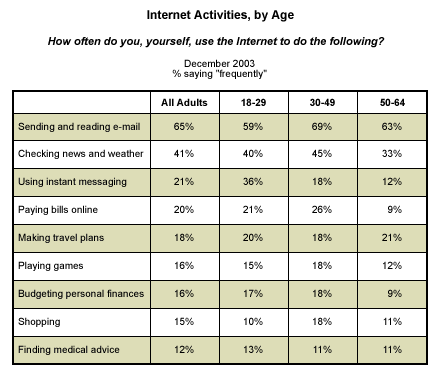
Are those differences reflected in age-based patterns regarding what people actually do in cyberspace? According to the December 2003 survey**, Internet users' most frequent activity, regardless of age, is reading and sending e-mail. Sixty-five percent of adult Internet users check their e-mail frequently. Checking up on the news and weather is the second-most popular Internet activity overall (41% do it frequently).
How frequently one uses the Internet for different activities varies by age. Sending and receiving e-mail, making travel plans, playing games, shopping, and finding medical advice are done frequently by about the same percentage of Internet users in all age groups***. However, Internet users younger than age 50 are more likely than older users to pay bills online, check news and weather, and to budget personal finances. One activity -- instant messaging (or IM) -- stands out as the domain of the youngest Internet users. Thirty-six percent of Internet users between the ages of 18 and 29 say they use instant messaging frequently, compared with 18% of those in the 30- to 49-year-old age group and 12% of those 50 and older.
"Ttyl gtg," wrote Oliver Benton, a 23-year-old graphic artist from Long Island, N.Y., at the end of an "instant message" interview. For the uninitiated, that's IM-speak for "Talk to you later. I have to go now." But before Benton signed off, he wrote this about instant messaging. "I save cell minutes; I don't have to wait for an e-mail response; it's quick and easy," he said of the IM technology, which allows individuals to send text messages back and forth in "real time."
Becky Steele, a 22-year-old administrative assistant from New Jersey, says IM is a "cheap and efficient way to stay in touch, especially with people who are far away and who you wouldn't necessarily keep up with. It also enables you to gather your thoughts before responding, and that's usually a good thing." When asked why they thought the youngest adults use instant messaging more frequently than older people do, both Benton and Steele offered the same explanation: People in their age category often have boring, entry-level jobs. While many can't make phone calls at work, they can chat intermittently -- and silently -- with their friends on the computer throughout the day.
Other Demographics
Although daily Internet use is relatively consistent among age groups, it does vary considerably across two other demographic categories. Men are more likely to use the Internet every day than women are (49% vs. 40%, respectively), and rural dwellers are less likely to go online daily (34% do so) than their suburban (49%) and urban (47%) counterparts are.
In a sign that the "digital divide" between advantaged and disadvantaged Americans is narrowing, aggregated data from 2002 and 2003 indicate that daily Internet use is equally common among whites and nonwhites -- 44% of whites say they use it every day, as do 46% of nonwhites. Public libraries have played a significant role in that change. "Ninety-five percent of public libraries in the United States offer free access to computers and the Internet, often providing the only Internet access for residents of the nation's poorest areas," according to the Bill and Melinda Gates Foundation Web site. The Gates Foundation has been actively addressing the digital divide through financial support of their U.S. Library Program since 1996.
Bottom Line
Regular Internet access has become the norm for an increasingly broad spectrum of people, though older Americans tend to use it less heavily. And the youngest Americans are virtually guaranteed to become familiarized with the Web. According to the National Center for Education Statistics, by the beginning of the school year in 2001, 99% of all U.S. public schools had access to the Internet, up from 35% in 1994.
*Results are based on aggregated data from telephone interviews with 2,012 national adults, aged 18 and older, conducted Dec. 11-14, 2003, and Dec. 5-8, 2002. For results based on the total sample of national adults, one can say with 95% confidence that the margin of sampling error is ±2 percentage points.
**For results based on the sample of 734 Internet users from telephone interviews conducted Dec. 11-14, 2003 -- the maximum margin of sampling error is ±4 percentage points.
***The sample of Internet users includes 125 between the ages of 18 and 29 (margin of error ±10 percentage points), 334 between the ages of 30 and 40 (±6), and 269 50 and older (±7).