Some ideas sound great in the abstract, but lose their luster when couched in terms of specific consequences. That appears to be the case with Americans' views on nuclear energy. According to a Gallup March 2004 Environment poll*, more than half of Americans favor nuclear energy as a way to provide electricity in the United States. However, on the 25th anniversary of the Three Mile Island nuclear power plant disaster, far fewer like the idea of having a nuclear energy plant in their own areas.
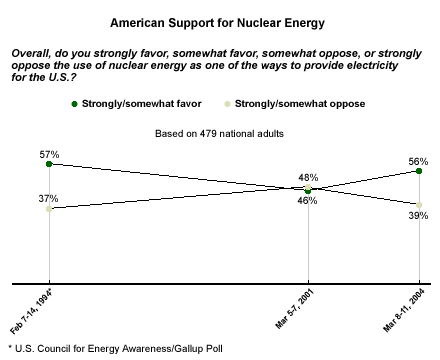
Currently, 56% of Americans favor "the use of nuclear energy as one of the ways to provide electricity for the U.S." -- 19% "strongly favor" the idea, while 37% "somewhat favor" it. About 4 in 10 (39%) say they "strongly oppose" (19%) or "somewhat oppose" (20%) the idea of using nuclear energy for electricity.
The percentage of Americans in favor of nuclear energy as an electricity source has increased 10 percentage points since the question was last asked in 2001. Results now closely resemble those found when Gallup first asked the question 10 years ago.
This Is a No-Fission Area
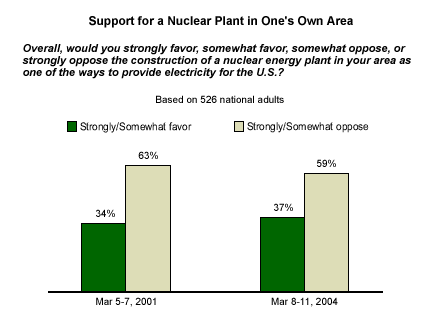
But when Americans are asked how they would feel about a nuclear facility being built in their own areas, their feelings are quite different. Fifty-nine percent of Americans oppose the construction of a nuclear energy plant in their proximity -- 37% strongly oppose the idea, and 22% somewhat oppose it. Slightly more than a third of Americans (37%) would strongly (10%) or somewhat (27%) favor the construction of a nuclear energy plant in their areas.
This "not in my backyard" phenomenon is well documented when it comes to nuclear plants and nuclear waste. In 2001, the U.S. Department of Energy (DOE) proposed building a nuclear waste dump in Yucca Mountain, Nev., and the Bush administration accepted the proposal. But Nevada's citizens and state leadership were quite unenthusiastic about the prospect of nuclear waste being transported to their state from all over the country and buried in the ground. They vehemently opposed the decision, and continue to do so today. Nevada State Attorney General Brian Sandoval recently filed a lawsuit against the DOE over the proposed Yucca Mountain facility.
Bottom Line
The rolling blackouts in California in 2001 and last summer's power outage in the Northeast offer stark examples of the need for reliable, sustainable power sources. Such examples may be contributing to a rise in support for nuclear-powered electricity over the past three years. Still, energy concerns currently seem to be relatively low on most Americans' lists of public priorities (see "Energy Not Fueling Public Concern" in Related Items); and support for nuclear power in particular may still be tempered by fear of the local risks of nuclear plants and waste materials.
*Results are based on telephone interviews with 479 and 526 national adults, aged 18 and older, conducted March 8-11, 2004. For results based on the total sample of national adults, one can say with 95% confidence that the margin of sampling error is ±5 percentage points.
