In March 1977*, Gallup asked American non-Catholics if they favored or opposed having women as pastors, ministers, priests, or rabbis in their own faith or denomination. Less than a majority -- 42% -- favored the idea, while 27% were opposed, and 32% said they had no opinion.
Twenty-three years later, in May 2000**, Gallup re-asked the question. That year, 73% of American non-Catholics favored women in the clergy, 22% were opposed, and 5% didn't answer or didn't know. Even including Catholics' responses in the 2000 results doesn't change the numbers much: 71% in favor, 23% opposed. The idea of women in the clergy seems to have become far more acceptable to Americans, regardless of their religious persuasion.
Data from the U.S. Bureau of Labor Statistics (BLS) show that the actual number of female clergy members has grown along with the public's acceptance of the idea. According to 2002 BLS data, 13% (54,000) of the roughly 406,000 clergy in the United States are women. This denotes a significant upward trend in the last 20 years; in 1983, the number of female clergy was a little over 16,000 (see "Church Reform: Women in the Clergy" in Related Items).
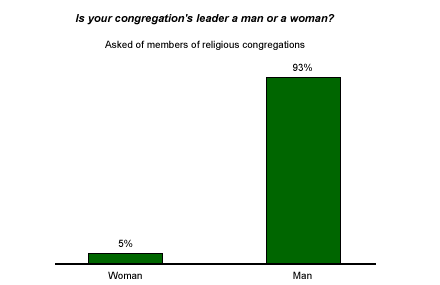
But is the number of women in actual congregation leadership positions keeping pace with the number of women who identify themselves as clergy more generally? Recent Gallup data suggest that there is a substantial gap. As part of its 2003 congregational engagement survey***, Gallup asked members of religious congregations across the country if the leader of their congregation is a man or a woman. More than 9 in 10 respondents (93%) reported that their leader is a man, while only 5% reported their leader is a woman.
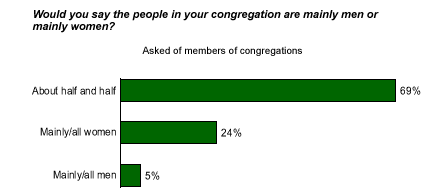
Yet Gallup data have consistently shown that women tend to be more active members in their congregations, attending services more frequently than men do (aggregated 2003 data show that 36% of men said they had attended church or synagogue in the last seven days, compared with 44% of women). Still, when asked if the other members of their congregations were mostly men, mostly women, or about half and half, about 7 in 10 respondents (69%) said half and half (24% said mainly or all women, and 5% said mainly or all men). That perception may be encouraged by the fact that in many congregations, men still take more visible leadership roles.
Bottom Line
Is there a "glass ceiling" within American religious congregations? Gallup data suggest that there may be. Religious leaders at the "executive" or "headquarters" levels of their organizations may want to consider examining whether women are being offered sufficient opportunities to advance into congregation leadership positions.
*Results are based on telephone interviews with 969 national adults, aged 18 and older, conducted March 4-7, 1977. For results based on the total sample of national adults, one can say with 95% confidence that the margin of sampling error is ±3 percentage points.
**Results are based on telephone interviews with 1,032 national adults, aged 18 and older, conducted May 23-24, 2000. For results based on the total sample of national adults, one can say with 95% confidence that the margin of sampling error is ±3 percentage points.
***Results are based on telephone interviews with 1,000 adult members of a church, synagogue, or other religious faith community, aged 18 and older, and 500 nonmembers, conducted in October and November 2003. For results based on this sample, one can say with 95% confidence that the margin of sampling error is ±2.6 percentage points.
