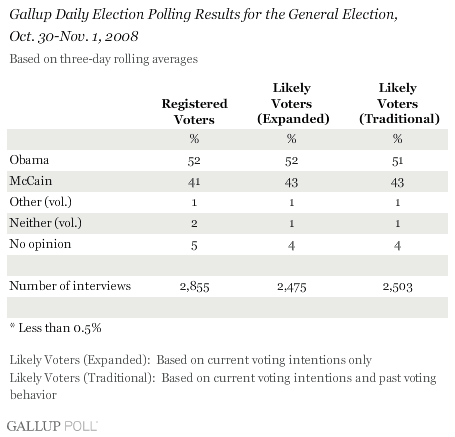
PRINCETON, NJ -- Voters' presidential preferences remain favorable to a Barack Obama win on Tuesday, with 51% of traditional likely voters supporting the Democratic nominee for president, and 43% backing John McCain. An additional 1% say they support some other candidate, leaving 5% undecided.
Today's Gallup Poll Daily tracking results are from interviews conducted nationwide from Thursday through Saturday, Oct. 30-Nov. 1.
The traditional likely voter model producing an eight percentage point lead for Obama takes into account voters' participation in previous presidential elections as well as their interest in and intention to vote in the 2008 election.
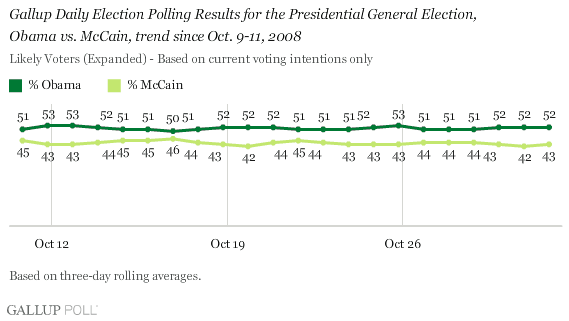
An expanded likely voter model uses only voters' interest and self-professed likelihood to vote in the current election. On this basis, Obama leads by nine points -- 52% to 43% -- also with 1% supporting some other candidate and 5% undecided. The expanded model assumes that voter turnout may follow different patterns this year than historically, such as with greater participation by new or infrequent voters.
The expanded likely voter results are not much different from those based on all registered voters. Among the entire sample of eligible voters, Obama leads by 11 points, 52% to 41%. Another 1% name a different candidate while 7% are undecided.
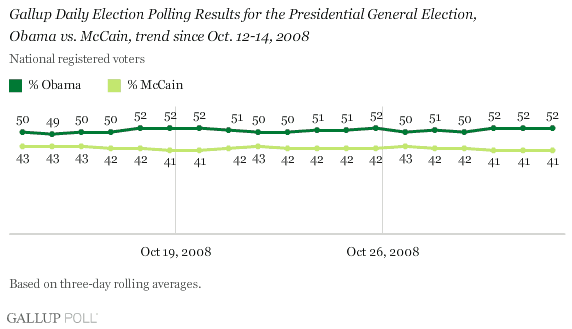
Obama's lead over McCain among all registered voters has been stable, at or above eight points for each of the past five days. Over the same time period, his lead among traditional likely voters has experienced more variation, highlighting the importance of turnout at this stage of the race in determining whether the election ends up being close, or whether Obama could win by a comfortable margin. -- Lydia Saad
Survey Methods
For the Gallup Poll Daily tracking survey, Gallup is interviewing no fewer than 1,000 U.S. adults nationwide each day during 2008.
The general-election results are based on combined data from Oct. 30-Nov. 1, 2008. For results based on this sample of 2,855 registered voters, the maximum margin of sampling error is ±2 percentage points.
Results based on "traditional" likely voters (based on the model taking into account current voting intention and past voting behavior) include interviews with 2,503 voters, and assume a turnout of 64% of national adults. The likely voter sample is weighted to match this turnout assumption, so the weighted sample size is 1,968. The associated maximum margin of sampling error is ±3 percentage points.
For results based on the sample of 2,475 "expanded" likely voters (based on the model taking into account current voting intention only), the maximum margin of sampling error is ±2 percentage points. The expanded likely voter model does not make any assumptions about turnout level.
Interviews are conducted with respondents on land-line telephones (for respondents with a land-line telephone) and cellular phones (for respondents who are cell-phone only).
In addition to sampling error, question wording and practical difficulties in conducting surveys can introduce error or bias into the findings of public opinion polls.
