On March 30, Americans lined up at bookstores across the country, awaiting the release of a long-anticipated novel. No, it wasn't a new installment of the Harry Potter series; rather, it was Glorious Appearing, the latest installment of Tim LaHaye and Jerry Jenkins' 12-volume apocalyptic Left Behind series.
Since the release of the first book, Left Behind, in 1995, the series has sold nearly 60 million copies worldwide. That represents almost a billion dollars in sales of Left Behind books alone, and there are additional revenues from children's and young-adult books, videotapes, computer programs, and even greeting cards based on the series. In a 2001 Barna Research Group survey, 84% of the readers of the Left Behind series identified themselves as born-again Christians -- a demographic group wielding increasing economic and political clout.
Born-Again Christians a Sizable Minority
When Gallup first asked Americans in 1976 whether they considered themselves to be "born again," 35% said that they did. That figure climbed steadily throughout the last quarter of the 20th century, and between 1993 and 2003 held fairly steady in the low- to mid-40% range, according to aggregated survey responses collected throughout each year*. The two exceptions were 36% and 39% readings in 1994 and 1996, respectively. The 2003 measurement is 42%.
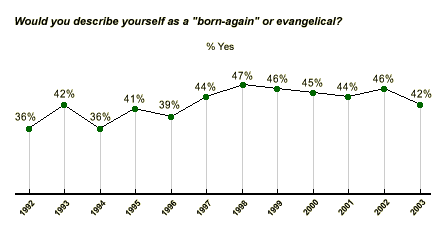
Notwithstanding the possibility that the 42% is probably an overestimate of the percentage of born-again Christians in the United States (because some respondents may not understand the term -- indeed many "born-again" Christians are not Protestants), the fact remains that a substantial proportion of Americans have a strong enough commitment to their Christian faith to identify themselves as born-again. This is a huge group with a common interest -- an opportunity that marketers have learned to tap in recent years. The "born-again market" is a multibillion-dollar industry, offering Christian books, music, movies, video games, artwork, and even vacation cruise packages.
The Political Influence of Born-Again Christians
When Jerry Falwell founded the Moral Majority -- a group made up of politically and socially conservative Christians -- in 1979, he envisioned the group having a major influence on the political direction of the United States. Indeed, in the decade of its existence, the Moral Majority did take high-profile stands on such issues as abortion rights, homosexuality, and teaching creationism in public schools. The Moral Majority was dissolved in 1989, but the influence of born-again Christians on national politics is still evident on these and other issues.
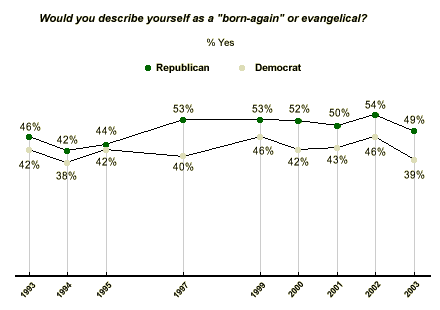
While there are sizable numbers of born-again Christians in both political parties (and also among independents), the gap between the percentages of Republicans and Democrats who identify as born again has widened in the last 10 years. In 1994, 42% of Republicans and 38% of Democrats said they were born again; in 2003, the percentage of born-again Republicans was 49% and the percentage of Democrats was 39%.
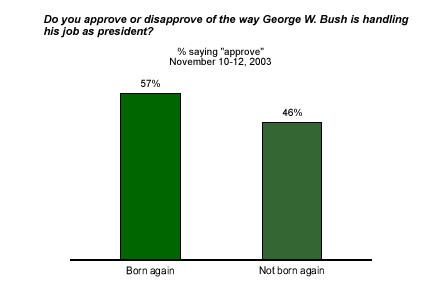
Born-again Christians also tend to give President George W. Bush -- a conservative, born-again Christian -- higher approval ratings than do those who are not born-again Christians. In November 2003 (when Gallup last asked respondents whether they are born again), 57% of born-again Christians said they approved of the job Bush was doing, compared with 46% of those who said they are not born-again. Bush's overall approval rating at the time was 51%.
Born-again Christians are not only a group that affects the nation's economy, but also one with the potential to affect the nation's politics. Currently that influence favors Bush and the Republican Party.
*Results based on approximately 2,000 to 3,000 telephone interviews conducted annually with American adults from 1993 to 2003.
