Issue at Hand: The North American Free Trade Agreement (NAFTA) between Canada, Mexico, and the United States took effect on Jan. 1, 1994, establishing the world's largest free trade zone. At the time, former President Bill Clinton said he hoped the pact would lead the way to a wider worldwide trade agreement that would promote greater economic growth and world peace. Since then, some have questioned whether the economic benefits of NAFTA have outweighed the costs, especially in terms of job losses in certain sectors of the U.S. economy. Nonetheless, President George W. Bush, Mexican President Felipe Calderon, and Canadian Prime Minister Stephen Harper met earlier this year to voice their unanimous support for the agreement.
Obama's Stance: During the presidential campaign, Obama's Web site stated, "NAFTA and its potential were oversold to the American people" and promised to "fix" the agreement so it "works for American workers." Obama claimed he would seek renegotiation of the trade deal to include more rigorous labor and environmental stipulations -- a position that has not received positive responses from the leaders of Canada and Mexico.
American Views on NAFTA: Critics of NAFTA argue that the trade agreement is responsible for devastating job losses in the United States, especially in the manufacturing industry.
- In August, a slim majority of American respondents (53%) told Gallup that the effect of NAFTA on the U.S. economy has been "mainly negative," while 37% said the effect has been "mainly positive."
- Working Americans are slightly more likely than unemployed Americans to say the effect of NAFTA on the U.S. economy has been "mainly negative," 56% to 48%.
Canadian Views on NAFTA: Canada's Harper said it would be a mistake to renegotiate NAFTA, but said he will come to the table if the United States and Mexico insisted.
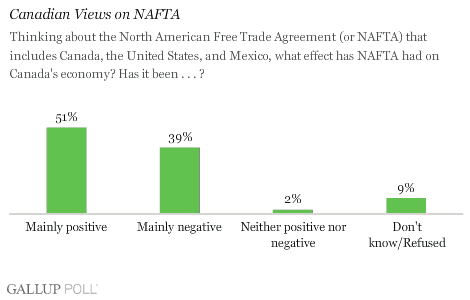
- Canadians are more positive about NAFTA's effect on their country's economy than are respondents from the United States or Mexico. When Gallup polled Canadians in September, a bare majority (51%) said NAFTA has had a "mainly positive" effect on the Canadian economy, while 39% said the agreement has been "mainly negative" for the economy.
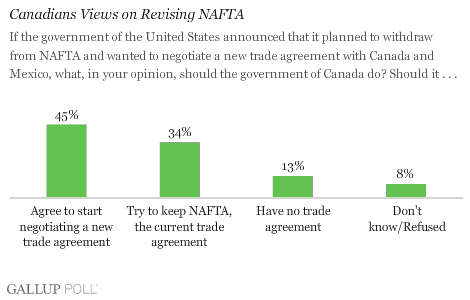
- When asked if they would support revising the agreement if the United States planned to withdraw from NAFTA and wanted to negotiate a new trade deal, 45% of Canadians said their government should agree to start negotiating a new trade agreement, while about a third (34%) said the government should try to keep NAFTA in its current form.
- Canadians who said they have a job were no more likely than those without a job to view NAFTA's effect on their economy as positive.
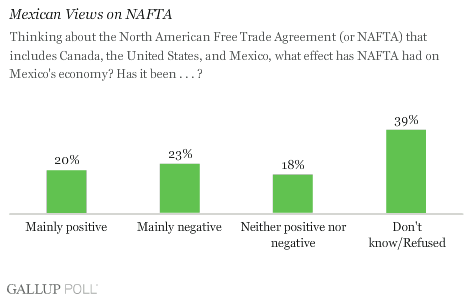
Mexican Views on NAFTA: Mexico's Calderon has argued that renegotiation of NAFTA is unnecessary and would lead to increased illegal immigration in the United States. When Gallup asked Mexicans in August 2008 whether NAFTA has had a "mainly positive" or "mainly negative" effect on the Mexican economy, citizens were divided:
- Twenty percent of Mexicans said the effect of NAFTA on the Mexican economy has been "mainly positive," while 23% said its effect has been "mainly negative."
- Eighteen percent said NAFTA has been neither positive nor negative for the country's economy.
- Roughly 4 in 10 Mexicans (39%) did not have an opinion.
- Mexicans who said they have a job are more likely than those who said they do not work to view NAFTA's effect on their economy as "mainly positive," 25% vs. 18%.
Policy Implications: More than a half million Americans lost their jobs in November alone, a 34-year high, bringing the unemployment rate up to 6.7%. Obama outlined his job creation plan last month that included massive public works programs and promised to create 2.5 million new jobs by 2011.
Obama had repeatedly stated that NAFTA should be renegotiated to include better labor provisions, among other things. Given the current state of the U.S. economy, the Obama administration is likely to face pressure from critics who blame the trade agreement for significant jobs loss in the United States over the past decade.
Survey Methods
Results are based on telephone interviews with approximately 1,000 adults in August 2008, aged 15 and older, in Mexico and the United States and approximately 1,000 adults in September 2008, aged 15 and older, in Canada. For results based on the total sample of national adults, one can say with 95% confidence that the maximum margin of sampling error is ±3 percentage points. In addition to sampling error, question wording and practical difficulties in conducting surveys can introduce error or bias into the findings of public opinion polls.