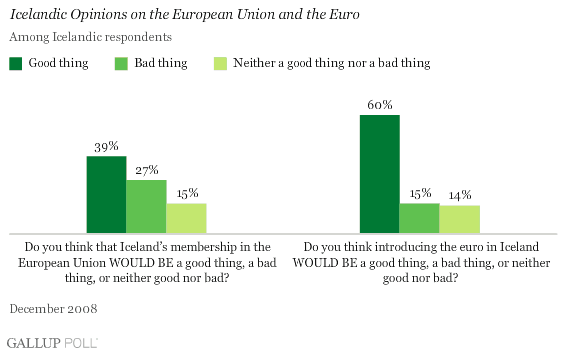
WASHINGTON, D.C. -- Voters in Iceland in April affirmed their inclination toward European Union membership when they elected a pro-EU coalition to the majority in parliament. When Gallup polled Icelanders last December, 39% thought EU membership would be a good thing for their country, and 27% thought it would be a bad thing. A clear majority -- 60% -- thought introducing the euro would be a good thing, while only 15% thought the opposite.
Icelanders' interest in EU membership and the euro may be economically motivated -- 96% of residents at the time of the Gallup Poll said that economic conditions in the country were not good and 83% expected conditions to get worse. Since the collapse of the country's economy last fall, Iceland has sought a solution for its devalued currency, the krona. Some pundits called for immediate adoption of the euro, but the former governing coalition, under the leadership of the center-right Independence Party, was reluctant to pursue such a course.
Icelanders may have political motivations as well. Last December, nearly 8 in 10 residents (79%) told Gallup they did not approve of their country's leadership. The collapse of the government the following month brought Prime Minister Johanna Sigurdardottir into power and last month's parliamentary vote was the first time center-left parties had won a majority of seats since Iceland's independence from Denmark -- a clear rebuke for the Independence Party's economic indecision and perceived mismanagement.
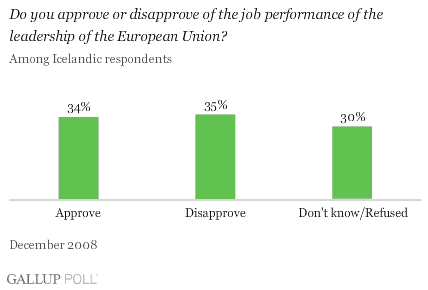
Overall, however, Icelanders are not necessarily as sold on the EU's leadership as they are on its stable currency. When asked if they approved or disapproved of the job performance of the EU's leadership, responses were mixed.
Iceland has long spurned EU membership for fear of how the Union's marine quotas could hamper the Icelandic fishing economy (fish products account for more than 40% of exports). However, just before Iceland's parliamentary elections, the European Commission (the EU's executive arm) pledged to devise a less restrictive fishing quota system, which could ultimately improve Icelandic opinions toward EU leadership.
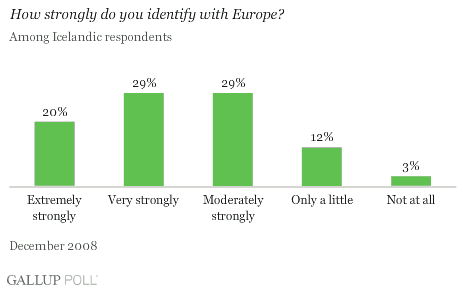
In the end, economic and political interests tell only part of the story. As Turkey's EU membership journey has shown, perceptions about identity can play a role in a country's bid. In the December 2008 Gallup Poll, Gallup asked Icelanders how strongly they identified with Europe. Fifteen percent said they identify with Europe "only a little" (12%) or "not at all" (3%), while 78% said they identified with Europe to at least a moderate extent.
New EU member states no longer have the option to opt out of adopting the euro; all must adopt the currency as soon as they meet the requisite economic conditions. While Icelanders have more affinity toward the euro than EU membership, they cannot enjoy the benefits of one without the other. And joining the European Union could draw Icelanders closer to Europe than they have been since their 1944 independence from Denmark.
Survey Methods
Results are based on telephone interviews with 502 adults, aged 15 and older, conducted in December 2008 in Iceland. For results based on the total sample of national adults, one can say with 95% confidence that the maximum margin of sampling error is ±5.2 percentage points. In addition to sampling error, question wording and practical difficulties in conducting surveys can introduce error or bias into the findings of public opinion polls.
Cynthia English contributed to this report.